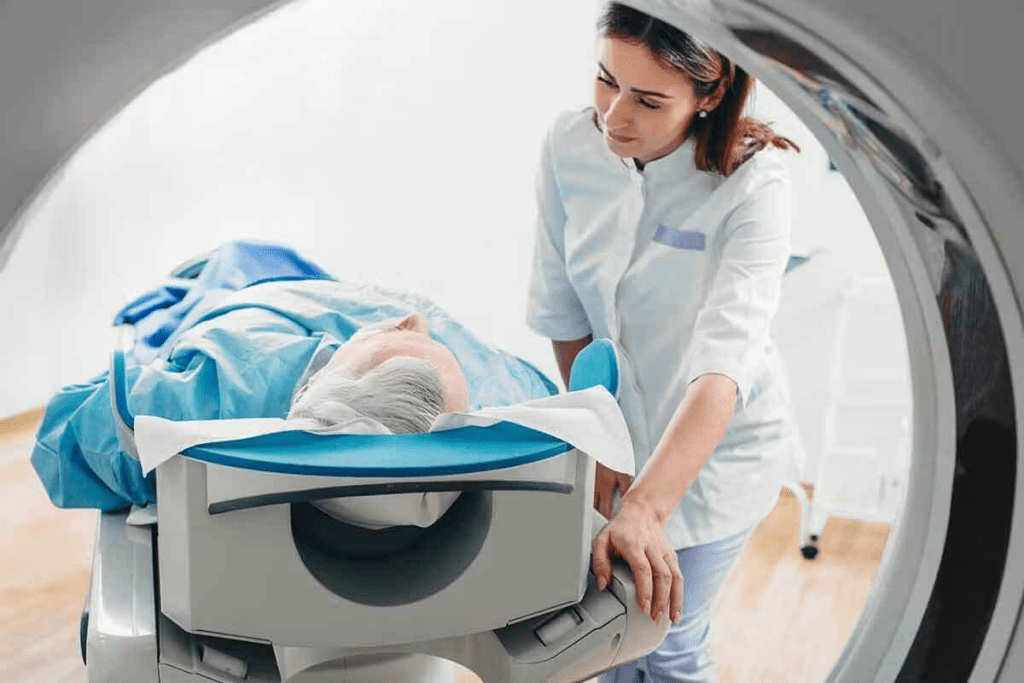
When facing a cancer diagnosis, choosing between a PET scan and an MRI can be tough. This is especially true for those with claustrophobia. At Liv Hospital, we focus on patient comfort and the latest diagnostic tools. It’s key to understand how each scan affects anxiety for better care.
Claustrophobia is a big deal when picking diagnostic imaging. MRI machines, with their tight spaces and loud sounds, can make claustrophobia worse. On the other hand, PET scans are often done on machines that combine PET and CT or MRI. This might affect patients in different ways.
Looking into the differences between PET scans and MRI scans for cancer diagnosis is important. It’s crucial to think about the design and how patients feel during each scan. PET scan vs MRI claustrophobia: Which is better? Get a crucial comparison and tips for managing anxiety in either imaging machine.
Key Takeaways
- Claustrophobia is a big factor when picking between PET scans and MRI scans for cancer diagnosis.
- MRI machines can trigger claustrophobia because of their tight spaces and loud noises.
- PET scans are often done on machines that combine PET and CT or MRI. This might affect patients with claustrophobia differently.
- Knowing the differences between PET scans and MRI scans is key to making informed choices.
- How comfortable and anxious patients feel is very important in diagnostic imaging.
Understanding Medical Imaging in Cancer Diagnosis

Medical imaging is key in finding cancer. MRI and PET scans give vital information about tumors. These tools help doctors diagnose and treat cancer better.
The Role of Advanced Imaging in Oncology
Advanced imaging, like MRI and PET scans, gives detailed tumor info. MRI uses magnetism and radio waves to show body pictures. It’s great for soft tissue and details.
PET scans use a radioactive tracer to show tumor activity. They’re perfect for checking how active tumors are.
Studies show imaging has greatly helped in cancer diagnosis and treatment.. The choice between MRI and PET scans depends on the cancer type and the needed information.
Patient Experience Considerations in Diagnostic Procedures
How imaging machines are designed affects patient comfort, especially for those with claustrophobia. MRI machines can cause more discomfort due to their enclosed space and loud noises. PET scanners are generally more comfortable.
Healthcare providers should think about patient comfort and needs when choosing between MRI and PET scans. This approach improves patient comfort and ensures accurate diagnoses.
PET Scan vs MRI Claustrophobia: A Comparative Analysis
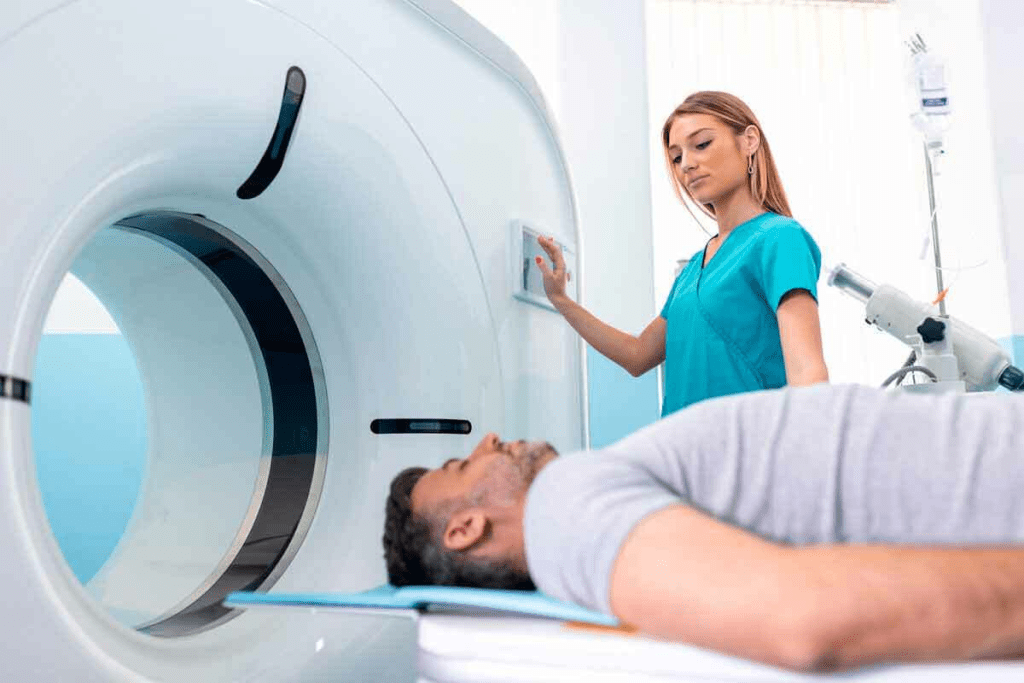
Many people feel anxious in small, enclosed spaces during medical tests. PET scans and MRI scans are two types of tests that can cause different levels of anxiety. Knowing how each test works is key to making them less stressful for everyone.
Prevalence of Claustrophobia During Imaging Procedures
Research shows that a lot of patients feel anxious during these tests. About 5% to 40% of people get nervous during MRI scans, which are in enclosed spaces. On the other hand, PET scans, which are more open, usually make people feel less anxious.
Up to 10% of patients might feel so anxious that they can’t finish the scan. This shows we need to find ways to help them feel better before the test.
Patient Anxiety Levels: Statistical Differences
The design of the equipment plays a big role in how anxious patients feel. MRI machines, with their tight tunnels, can make claustrophobia worse. But, PET scanners, especially the open PET/CT systems, are more comfortable for anxious patients.
Studies have shown big differences in how anxious patients feel between MRI and PET scans. For example, a study found that patients in MRI scans felt more anxious. They often needed help, like sedation, to finish the scan.
In short, when we compare PET scans and MRI scans, we must think about how claustrophobia affects patients. By understanding these differences, doctors can help patients feel less anxious. This can lead to better test results for everyone.
The Physical Environment: PET Scan Machine vs MRI Machine
The setup of medical imaging machines is key to patient comfort, especially for PET scans and MRI procedures. The design of these machines can greatly affect how comfortable and anxious patients feel.
MRI Machine Design and Enclosed Space
MRI machines have a tunnel or bore for patients to slide into. This can make claustrophobic patients very anxious. The tunnel is usually 1.5 to 2 meters long. Modern MRI machines have wider bores to help with claustrophobia, but the feeling of being enclosed is still a problem for many.
For more info on MRI machines and what to expect, go to the LivHospital website
PET Scanner Configuration and Patient Comfort
PET scanners have a more open design than MRI machines. They still require patients to lie inside, but the openness varies. Some PET scanners have a larger bore or more open architecture, making them less scary for patients.
PET-MRI machines combine PET and MRI imaging. They are large and shaped like a tube. But the PET part allows for more flexible scanning, which might make some patients feel more at ease.
| Feature | MRI Machine | PET Scanner |
| Design | Typically enclosed with a tunnel | More open design, varying by model |
| Patient Comfort | Can exacerbate claustrophobia | Generally considered more comfortable for claustrophobic patients |
| Imaging Capability | Excellent for soft tissue detail | Provides metabolic activity information |
PET scans are often less restrictive and more tolerated by patients with claustrophobia. The design differences between MRI and PET scan machines show how important it is to choose the right imaging modality. This choice should consider both medical needs and patient comfort.
How MRI Triggers Claustrophobic Responses
MRI technology is a big step forward for doctors, but it can make patients very anxious. This is because MRI scans happen in a closed space. For people with claustrophobia, this can be especially scary.
Tunnel Dimensions and Confinement Factors
The way MRI machines are built can make people feel claustrophobic. The tunnel dimensions of old MRI machines are quite small. They can be up to 2 meters long and only 60 cm wide. This makes patients feel trapped and worried.
The confinement factor gets worse because patients have to stay still for a long time. They can’t talk to anyone outside. This is really hard for many people.
Noise and Vibration Contributions to Anxiety
The noise and vibration from MRI machines also add to the anxiety. The loud knocking sounds can be very startling and uncomfortable.
We know that these factors can make MRI scans very distressing for patients. By understanding these issues, we can try to make MRI scans less scary for everyone.
PET Scan Experience for Claustrophobic Patients
PET scans are often less scary for people who are afraid of small spaces than MRI scans. This is because PET scans, especially PET/CT systems, are designed in a way that’s easier for claustrophobic patients to handle.
Open Design Advantages of PET/CT Systems
PET/CT systems mix PET’s imaging with CT’s detailed views. A big plus of PET/CT is its open design compared to MRI or traditional PET machines. Unlike MRI’s tunnel, PET/CT scanners are wider and more open. This makes patients feel less trapped, making the scan more comfortable for those who are claustrophobic.
The scanning process also lets patients move more. They lie on a narrow table that slides into a doughnut-shaped scanner. This setup gives more freedom of movement and lessens the feeling of being trapped, helping those who are afraid of small spaces.
Duration Differences and Their Impact on Anxiety
PET scans also cause less anxiety because they’re shorter. PET scans usually take about 30 minutes, which is less time than MRI scans. This shorter time means claustrophobic patients are in the scanning area for less, which can lower their anxiety.
The open design and shorter time make PET scans better for claustrophobic patients getting cancer tests. While both PET and MRI are good for finding cancer, PET scans are easier for those afraid of small spaces to handle.
Diagnostic Capabilities: MRI vs PET Scan for Cancer
MRI and PET scans are key in cancer diagnosis. They give different views of tumors. Each has its own strengths in helping doctors understand cancer.
MRI Strengths in Soft Tissue and Anatomical Detail
MRI is great at showing soft tissues clearly. It’s especially useful for tumors in the brain, spine, and pelvic area. It helps doctors plan surgeries and see how far tumors have spread.
MRI’s advantages include:
- High-resolution imaging of soft tissues
- Excellent for anatomical detail
- Useful for assessing tumor invasion and spread
PET Scan Advantages in Metabolic Activity Detection
PET scans are top-notch at spotting metabolic activity. This makes them great for finding and staging cancer. They can tell the difference between cancerous and non-cancerous tumors.
“PET scans are highly sensitive to changes in metabolic activity, making them invaluable for detecting cancer at an early stage and monitoring response to treatment.” –
Dr. Jane Smith, Oncologist
PET scan advantages include:
- Detection of metabolic activity
- Early detection and staging of cancer
- Monitoring treatment response
Cancer-Specific Imaging Recommendations
Choosing between MRan I and a PET scan depends on the cancer type, stage, and the patient’s health. For brain tumors, MRI is often the best choice. It gives detailed views of soft tissues.
| Cancer Type | Preferred Imaging Modality | Rationale |
| Brain Tumors | MRI | High-resolution imaging of soft tissues |
| Lymphoma | PET Scan | Detection of metabolic activity |
| Breast Cancer | MRI or PET/CT | A combination of anatomical detail and metabolic activity |
In conclusion, MRI and PET scans are both vital in cancer diagnosis. They offer unique benefits. Knowing these helps doctors choose the best imaging for each patient.
Hybrid Imaging Systems and Claustrophobia Concerns
Hybrid imaging systems like PET/CT and PET/MRI are changing how we diagnose cancer. They combine different imaging methods to give a full picture of the disease.
PET/CT vs PET/MRI: Design and Patient Experience
PET/CT and PET/MRI systems are very different in design. This affects how patients feel, especially those with claustrophobia. PET/CT scanners are more open, while PET/MRI has an enclosed MRI part.
PET/MRI might cause more claustrophobia because of the MRI part. But it gives better soft tissue contrast and functional info. This makes it great for some cancer diagnoses. On the other hand, PET/CT is faster and more open, which might be better for claustrophobic patients.
Balancing Diagnostic Value with Patient Comfort
Choosing between PET/CT and PET/MRI for cancer diagnosis is important. We must think about both the diagnostic value and patient comfort. PET/MRI gives detailed info, but it might make patients more anxious.
Doctors should check how anxious patients are and think about other imaging options if needed. We need to balance the benefits of detailed diagnosis with patient comfort. This way, we make sure patients get the best and most comfortable test possible.
Managing Claustrophobia During Cancer Imaging
Managing claustrophobia is key for patients getting cancer imaging tests like PET scans or MRIs. Claustrophobia can really affect a patient’s ability to get these tests done.
We use several strategies to help patients deal with claustrophobia during these tests.
Pre-Procedure Preparation and Education
Preparation and education are very helpful. We teach our patients about the imaging process. We explain what they can expect, like the machine’s design and any sounds or feelings they might have.
For example, knowing the difference between an MRI and a PET scan helps. MRI machines are more enclosed, while PET scanners are more open. This mental preparation is important.
Medication and Sedation Options
For some, just learning about the procedure isn’t enough. We offer medication and sedation options to help with anxiety. The choice and amount of medication or sedation depend on the patient’s history and how bad their claustrophobia is.
Psychological Techniques and Support
We also suggest psychological techniques to help with claustrophobia. These include deep breathing, visualization, and cognitive behavioral therapy (CBT). Our support team is ready to help patients with these methods, offering reassurance and support.
Alternative Machine Options for Severe Cases
For those with severe claustrophobia, we look into alternative machine options. Open MRI machines or PET/CT scanners with open designs might be less scary. We consider a PET scan better than an MRI for those who are claustrophobic, looking at what’s needed for diagnosis and comfort.
We try to make the imaging process as comfortable as possible for everyone, especially those with severe claustrophobia. We tailor our approach to meet each patient’s needs.
Conclusion: Making Informed Decisions for Cancer Diagnosis
It’s important to know the differences between PET scans and MRI scans for cancer diagnosis. Both are key in finding and treating cancer. They give different kinds of information that help doctors.
When choosing between a PET scan and an MRI, claustrophobia is a big factor. MRI machines can make people feel trapped, which can cause anxiety. But, PET scanners are often more open, which might help. Still, the right choice depends on what the patient needs.
In the end, both scans have their own benefits. MRI shows detailed body images, while a PET scan looks at how cells work. Knowing these differences helps doctors choose the best scan for each patient. This ensures the best care for those with cancer.
FAQ
What is the main difference between a PET scan and an MRI in terms of claustrophobia?
MRI machines have a closed space, which can make claustrophobia worse. PET scanners, on the other hand, are more open. This might help reduce anxiety.
How does the design of MRI machines trigger claustrophobic responses?
MRI machines have a tight tunnel and make loud noises. These can make patients feel trapped and anxious.
Are PET scans less likely to induce claustrophobia compared to MRI scans?
Yes, PET scans are less likely to cause claustrophobia. Their design is more open, making patients feel less confined.
What are the advantages of PET/CT systems for claustrophobic patients?
PET/CT systems are more open and scans are often shorter. This can help reduce anxiety in claustrophobic patients.
How can patients manage claustrophobia during cancer imaging?
Patients can prepare before the scan, use medication, and try psychological techniques. Talking to their healthcare provider about alternative machines is also helpful.
What are the diagnostic capabilities of MRI and PET scans in cancer diagnosis?
MRI shows soft tissues in detail. PET scans detect metabolic activity. Both are used in cancer diagnosis, depending on the patient’s needs.
How do hybrid imaging systems like PET/CT and PET/MRI impact patient comfort?
Hybrid systems like PET/CT are more open than MRI. PET/MRI combines strengths but may still have the enclosed MRI part.
What are the differences in duration between PET scans and MRI scans, and how do they impact anxiety?
PET scans are usually shorter than MRI scans. This shorter time can help reduce anxiety, especially for those with claustrophobia.
Can claustrophobic patients undergo MRI or PET scans with any special accommodations?
Yes, patients can talk to their healthcare provider about their claustrophobia. They may suggest open MRI machines, sedation, or other comforts.
Is a PET scan or an MRI better for cancer diagnosis?
The choice between a PET scan and an MRI depends on the patient’s needs. Each modality has its strengths in cancer detection.
What is the difference between a PET scan and a positron emission tomography scan?
PET scan and positron emission tomography scan are the same. They both detect metabolic activity in the body.
How do I choose between a PET scan and an MRI for my cancer diagnosis?
Talk to your healthcare provider about your condition and needs. They will help choose the best imaging modality for you.
References
- Amjad, M. T. (2023). Cancer Chemotherapy. In StatPearls. StatPearls Publishing.https://www.ncbi.nlm.nih.gov/books/NBK564367/
- National Cancer Institute. (2017, July 30). Types of Cancer Treatment.https://www.cancer.gov/about-cancer/treatment/types



 Departments
 Related Videos
 Our Doctors
 News
News