
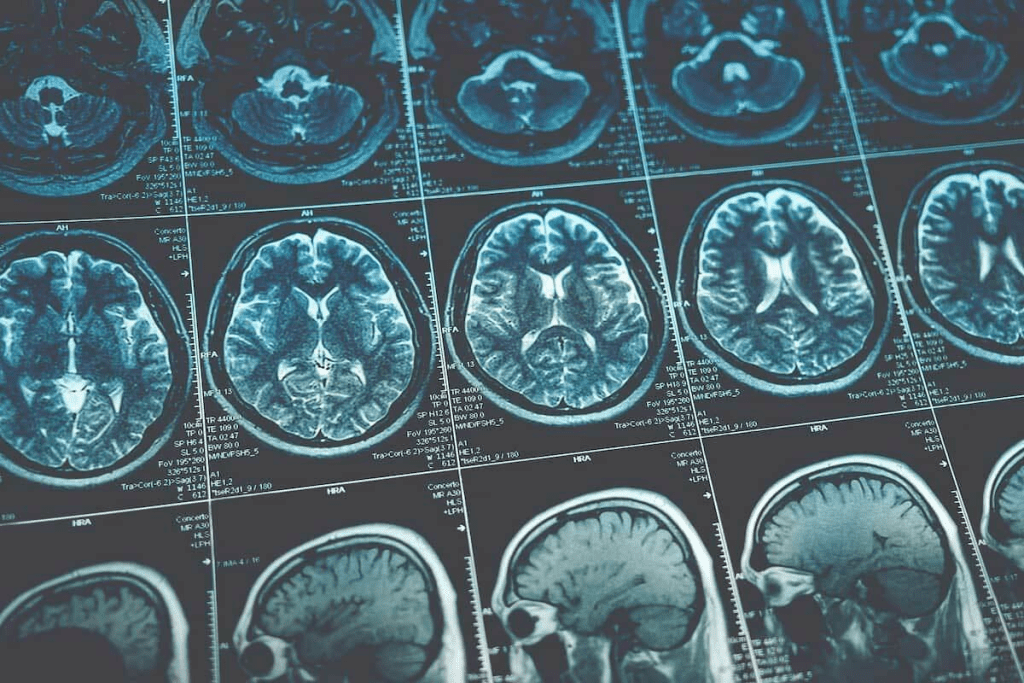
Medical imaging has changed how we find and understand small brain tumors. It helps doctors give the best care. We use MRI images to spot tiny changes in brain tissue. This helps us find both harmless and dangerous growths.
Studies show that deep learning can be very good atclassifying brain tumors with MRI images.
At places like Liv Hospital, we use the latest imaging and AI to look at brain MRI tumor images. This lets us make accurate diagnoses and plan treatments. We mix medical knowledge with new technology to give top-notch care. We also support patients from all over with detailed help and advice.
Key Takeaways
- Advanced imaging and AI techniques improve the detection and classification of small brain tumors.
- MRI images help identify subtle changes in brain tissue, supporting the detection of benign and malignant growths.
- Deep learning techniques achieve high accuracy in brain tumor classification using MRI images.
- Patient-focused centers utilize MRI images to provide precise diagnoses and effective treatment plans.
- Combining medical expertise with cutting-edge technology delivers world-class healthcare delivery.
The Fundamentals of Brain Tumor Detection Through MRI
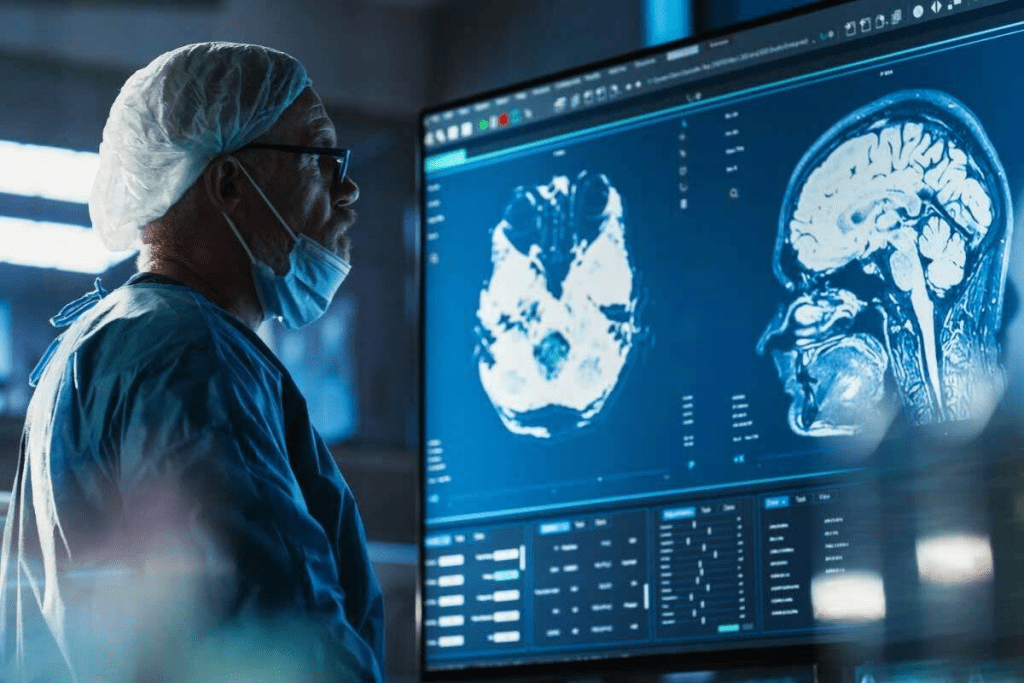
Learning about MRI for brain tumor detection is key to good diagnosis and treatment plans. MRI is the top choice for finding brain tumors. It shows detailed images and looks at tumors from many angles.
How MRI Technology Visualizes Brain Tissue
MRI uses strong magnetic fields and radio waves to see brain tissue. It makes detailed pictures of brain structures. This helps spot even small changes in tissue, which is important for early detection.
We use MRI sequences like T1-weighted and T2-weighted images. T1-weighted images show clear anatomy. T2-weighted images are better at showing tissue changes.
Why Early Detection Matters
Finding brain tumors early is key to better patient outcomes. Early detection means treatment can start sooner. This can lower the risk of problems and improve survival chances.
Early detection also helps plan treatments better. This includes surgery or radiation therapy, tailored to the tumor’s specific needs.
Comparison with Other Imaging Modalities
MRI beats other imaging, like CT scans, for soft tissue contrast. While CT scans are faster and easier to get, MRI gives more detailed tumor information.
| Imaging Modality | Soft Tissue Contrast | Use in Brain Tumor Detection |
| MRI | Excellent | Preferred for detailed tumor assessment |
| CT Scan | Poor | Used in emergency situations or when an MRI is not available |
Key Characteristics of Small Brain Tumor MRI Images
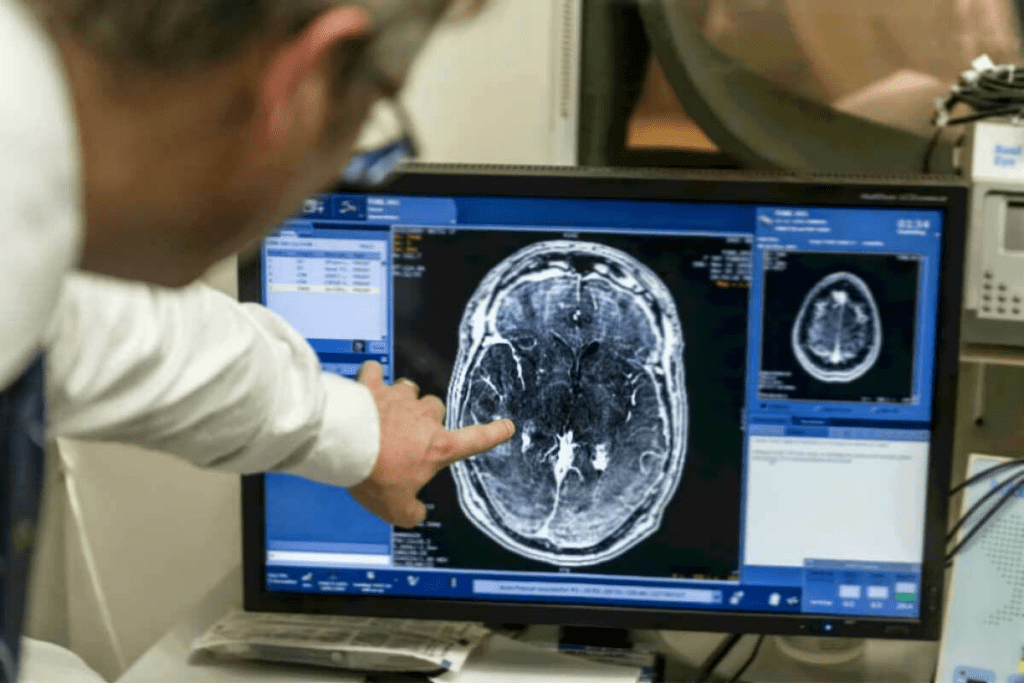
Spotting small brain tumors on MRI images is all about looking for certain signs. Doctors use things like how the tumor looks with contrast, its makeup, and its brightness to tell if it’s a tumor.
Signal Intensity Patterns
Signal intensity patterns on MRI images are key to finding brain tumors. Tumors show up differently on T1 and T2 images. Some look bright on T2 images because they have a lot of water, while others look dark on T1 images.
Contrast Enhancement Features
Contrast enhancement is a big deal for brain tumors. Gadolinium contrast agents make the tumor stand out more. Tumors that really show up with contrast are often more aggressive and might be more serious.
Mass Effect and Surrounding Edema
The mass effect and edema are also important. The mass effect is when the tumor pushes other brain parts out of the way. Edema is swelling from extra fluid. These signs tell us how aggressive the tumor is and how it might affect the brain.
| Characteristic | Description | Clinical Significance |
| Signal Intensity Patterns | Varying signal intensities on T1 and T2-weighted images | Helps in identifying tumor type and composition |
| Contrast Enhancement Features | Use of contrast agents to highlight tumor boundaries and structure | Indicates tumor vascularity and potentially malignancy |
| Mass Effect and Surrounding Edema | Displacement of brain structures and swelling due to tumor presence | Provides insights into tumor aggressiveness and its impact on the surrounding tissue |
By looking at these key traits, doctors can understand more about the tumor. This helps them plan the best treatment. MRI images are a big part of diagnosing and treating brain tumors.
Differentiating Benign vs. Malignant Tumors
Telling benign from malignant brain tumors is key to choosing the right treatment. MRI is a big help, giving clear images that show what the tumor is like.
Visual Indicators of Malignancy
Malignant brain tumors show certain signs on MRI that set them apart from benign ones. These signs include irregular shapes, mixed signals, and strong contrast. “Necrosis in the tumor points to malignancy,” studies say.
These tumors look more aggressive on MRI. They might invade nearby brain tissue and cause a lot of swelling. Invasion into surrounding brain tissue and significant mass effect are signs of malignancy.
Advanced MRI techniques are very important here. They help us understand the tumor’s biology. This helps doctors tell benign from malignant tumors.
Benign Tumor Imaging Characteristics
Benign brain tumors have their own look on MRI. They are well-defined, have the same signal everywhere, and might show even contrast. Benign tumors look different on MRI, with clear edges and little swelling around them.
Meningiomas, usually benign, show a special sign on MRI. They have a “dural tail.” Spotting these signs is key for the right diagnosis and treatment.
Importance of Accurate Classification
Getting the type of brain tumor right is vital for treatment and predicting how well a patient will do. Wrong guesses can lead to bad outcomes. Deep learning models are being used to improve tumor classification with MRI images.
Studies show deep learning models can accurately tell benign from malignant tumors on MRI. Experts say, “AI in radiology is changing neuro-oncology. It’s making diagnoses better and helping doctors make decisions.”
Common Brain Tumor Types and Their MRI Signatures
Knowing the different brain tumors is key for correct diagnosis and treatment. MRI datasets now have thousands of cases to help train algorithms. We use these to spot the unique MRI signs of each tumor type.
Gliomas: Imaging Features and Grades
Gliomas start from glial cells and are common primary brain tumors. Their MRIs vary by grade. High-grade gliomas show mixed enhancement with necrosis areas. Low-grade gliomas might look like non-enhancing or slightly enhanced lesions.
Studies use big MRI datasets to train and test deep learning models for tumor types.
The WHO grading system classifies gliomas based on their appearance under a microscope. MRI helps by showing tumor details like enhancement, necrosis, and edema. A leading researcher says, “MRI features with clinical data are key for accurate grading and planning.”
“Advanced MRI techniques have greatly helped in diagnosing and managing gliomas.”
Meningiomas: Typical Presentation
Meningiomas are usually benign and come from the meninges. On MRI, they look like well-defined, extra-axial masses with strong contrast enhancement. They often have a dural tail sign, a sign of these tumors.
- Meningiomas are usually isointense or slightly hyperintense on T1-weighted images
- They often show intense homogeneous enhancement on post-contrast T1-weighted images
- A dural tail sign is frequently observed, indicating tumor attachment to the dura
Pituitary Tumors: Distinctive Characteristics
Pituitary tumors, or adenomas, are benign and come from the pituitary gland. On MRI, they appear as sellar or suprasellar masses. Microadenomas are under 10 mm, while macroadenomas are over 10 mm. MRI shows tumor size, location, and how it relates to nearby structures, which is vital for surgery.
Using MRI datasets has greatly improved our knowledge of these tumors and their MRI signs. By studying many MRI images, researchers find patterns that help identify tumor types. This improves diagnosis and treatment results.
Advanced MRI Techniques for Enhanced Tumor Visualization
We now have advanced MRI methods that greatly improve brain tumor detection and analysis. These techniques help us see tumors better, giving us key info for diagnosis and treatment planning.
Diffusion-Weighted Imaging
Diffusion-weighted imaging (DWI) measures water molecule movement in tissues. It’s great for spotting acute ischemic strokes and gives insights into tumor cellularity. Tumors with lots of cells show up bright on DWI, helping us tell tumor types apart and check treatment success.
Perfusion MRI
Perfusion MRI looks at blood flow in the brain tissues. It’s key for checking tumor blood supply and growth. With dynamic susceptibility contrast (DSC) MRI, we get detailed blood volume maps, spotting active tumor areas.
Spectroscopy Applications
Magnetic resonance spectroscopy (MRS) gives metabolic insights into brain tissues. It spots changes in metabolites like choline and N-acetylaspartate, common in tumors. MRS helps tell tumor types apart, check tumor grade, and track treatment progress. Combining MRS with other MRI methods gives a full view of tumor biology.
Using diffusion-weighted imaging, perfusion MRI, and spectroscopy applications together has greatly improved our understanding of brain tumors. This approach gives a detailed and accurate tumor picture. It boosts diagnostic confidence and helps tailor treatments.
Some key benefits of these advanced MRI techniques include:
- Improved tumor detection and characterization
- Enhanced assessment of tumor aggressiveness and grade
- Better differentiation between tumor types and non-tumorous lesions
- More accurate monitoring of treatment response
As MRI tech keeps getting better, we’ll see even more advanced methods. These will help us visualize and understand brain tumors even better.
Artificial Intelligence Revolution in Brain Tumor Analysis
AI is changing how we find and understand brain tumors from MRI images. It makes diagnosing more accurate and helps doctors make better choices.
Deep Learning Models for Detection
Deep learning models are great at spotting brain tumors in MRI scans. They learn from big datasets to find things humans might miss.
The benefits of deep learning models are:
- Improved Accuracy: They can spot complex patterns in MRI images, making detection more accurate.
- Enhanced Speed: AI can quickly analyze images, saving time compared to manual checks.
- Consistency: AI gives the same results every time, making diagnoses more reliable.
Classification Accuracy Achievements
Deep learning models can also accurately classify brain tumors like gliomas and meningiomas. They look at MRI image features like signal intensity and contrast.
This accuracy is key for choosing the right treatment. It helps doctors know if a tumor is benign or malignant.
Computer-Aided Diagnosis Systems
Computer-aided diagnosis (CAD) systems use AI to help doctors diagnose. They offer insights that can help spot tumors and understand their type.
CAD systems can:
- Enhance Diagnostic Confidence: They highlight areas of concern, making doctors more confident in their diagnoses.
- Support Clinical Decision-Making: They help create personalized treatment plans by accurately classifying tumors.
In summary, AI is making a big difference in brain tumor analysis. It’s improving detection and classification. As AI gets better, we’ll see even more progress in diagnosing and treating brain tumors.
Comprehensive Brain Tumor MRI Datasets for Algorithm Training
Having detailed brain tumor MRI datasets is key to improving algorithm training for tumor detection. These datasets are vital for teaching and checking automated detection tools. Thanks to large public datasets, researchers can now develop better deep learning models.
Major Public Datasets Available
Several major public datasets have greatly helped brain tumor research. These include:
- The Cancer Genome Atlas (TCGA)
- The Cancer Imaging Archive (TCIA)
- BraTS (Brain Tumor Segmentation) dataset
- OpenNeuro dataset
These datasets offer a wide range of MRI images. They show different tumor types and features. For example, the BraTS dataset is made for brain tumor segmentation and is very popular in research.
Dataset Requirements for Effective Training
A dataset needs to meet certain criteria to train algorithms well:
| Requirement | Description |
| Diversity | Include various tumor types, sizes, and locations |
| Quality | High-resolution images with few artifacts |
| Annotation | Accurate labeling of tumor boundaries and characteristics |
Validation Methodologies
It’s important to check how well algorithms work on these datasets. Common ways to do this include:
- Cross-validation techniques
- Comparison against ground truth annotations
- Use of metrics such as the Dice score and Hausdorff distance
Good validation makes sure algorithms are reliable and work well on new data. By using detailed brain tumor MRI datasets and strict validation methods, we can create more precise and trustworthy diagnostic tools.
Clinical Challenges in Interpreting Small Brain Tumor MRI Images
Reading small brain tumor MRI images is tough. It’s hard to tell if something is a tumor or not. This can lead to wrong diagnoses if not done right.
Differentiating Tumors from Non-Tumorous Lesions
One big challenge is telling tumors apart from other brain issues on MRI images. Signal intensity patterns and contrast enhancement features are key. But, some brain issues can look like tumors, making it hard to tell them apart.
We use advanced MRI methods like diffusion-weighted imaging and perfusion MRI. These help us learn more about the issue. They tell us if it’s a tumor or not.
Radiological Assessment Protocols
Having clear rules for reading MRI images is vital. These rules help us make sure we’re right. They make sure we don’t miss anything important.
We look at the size, location, and morphology of the issue. We also check how it affects the brain around it. This detailed look helps us make a good diagnosis.
Multidisciplinary Approach to Image Interpretation
It’s important to have doctors from different fields work together. Radiologists, neurologists, and neurosurgeons all have their say. This teamwork leads to a better diagnosis and treatment plan.
We make sure to use what we see on the MRI images and what we know about the patient. This team effort helps us give the best care to our patients.
Future Innovations in Brain Tumor Imaging Technology
The field of brain tumor diagnosis is about to see big changes thanks to new imaging tech. We’re exploring new ways to see brain tumors more clearly. This could lead to better treatments and care for patients.
Emerging MRI Techniques
New MRI methods are being created to show brain tumors in more detail. Diffusion-weighted imaging helps us see the tumor’s structure better. Functional MRI is also key for mapping brain functions and finding important areas.
These new methods are making diagnoses more accurate. They also help us understand tumors better. For example, MRI can tell us about the tumor’s type and how serious it is. This info is vital for choosing the right treatment.
Integration of Multimodal Imaging
Using different imaging types together is a big step forward. By mixing MRI with PET and CT, doctors get a full picture of brain tumors. This mix helps with understanding tumor activity, shape, and function.
For example, MRI and PET together show where tumors are most active. This helps doctors decide where to take biopsies and plan treatments.
Personalized Imaging Approaches
Personalized medicine is key in treating brain tumors, and imaging is central to this. Advanced imaging tailored to each patient helps doctors create better treatment plans. Radiomics uses image data to predict patient outcomes and tailor treatments.
Personalized imaging also lets us track how treatments work. We can see if tumors change over time. This means we can adjust treatments as needed, which could lead to better results for patients.
Looking ahead, new brain tumor imaging tech will keep getting better. These advancements will help us diagnose and treat tumors more effectively. By using these new tools, we can improve care and outcomes for brain tumor patients.
Conclusion: Advancing Brain Tumor Detection Through Integrated Approaches
We’ve seen how small brain tumor MRI images are key in finding and classifying tumors. We’ve also looked at how MRI tech and AI are getting better. Studies show that using MRI and AI together can make finding and classifying brain tumors more accurate.
Advanced MRI methods like diffusion-weighted imaging and perfusion MRI help us see tumors better. AI, including deep learning models, is also making diagnoses more accurate. This is a big step forward.
The future of finding brain tumors is bright. It will involve using both human skills and AI. Small brain tumor MRI images will keep being important. They will help us find and classify tumors early, leading to better care for patients.
FAQ
How do MRI images help in detecting small brain tumors?
MRI images spot small brain tumors by showing tiny changes in brain tissue. This helps find both harmless and dangerous growths.
What are the advantages of using MRI for brain tumor detection?
MRI gives detailed views of brain tumors, helping doctors find and classify them accurately. It’s great for seeing soft tissues and tumors in hard-to-reach brain areas.
Can MRI differentiate between benign and malignant brain tumors?
Yes, MRI can tell benign from malignant tumors by looking at signal patterns and how they react to contrast. But, doctors often need to look at other signs and symptoms too.
What are the common brain tumor types and their MRI signatures?
There are many brain tumor types, like gliomas, meningiomas, and pituitary tumors. Each has its own MRI look. Gliomas vary in danger, meningiomas are usually clear, and pituitary tumors have specific signs on MRI.
How is artificial intelligence used in brain tumor analysis?
Artificial intelligence, like deep learning, boosts brain tumor detection and classification. AI looks at MRI images for patterns and features that people might miss.
What is the importance of a large brain tumor MRI dataset?
A big MRI dataset is key for training AI to spot and classify brain tumors right. It has lots of images with different tumor types, helping AI learn and get better.
Can MRI detect brain tumors at an early stage?
Yes, MRI can find brain tumors early, even when they’re tiny. Finding them early is key for better treatment and outcomes.
What are the clinical challenges in interpreting small brain tumor MRI images?
Challenges include telling tumors from other brain changes, understanding tumor traits, and making sense of images with patient history. A team effort is often needed for an accurate diagnosis.
How do emerging MRI techniques improve brain tumor imaging?
New MRI methods, like diffusion-weighted imaging and perfusion MRI, give more info on tumor traits. This helps in more accurate detection and classification.
What is the role of multimodal imaging in brain tumor diagnosis?
Multimodal imaging combines MRI, CT, and PET to give a full view of brain tumors. This combo can make diagnosis more accurate and help plan treatment.
Can brain tumor MRI datasets be used for research purposes?
Yes, MRI datasets are great for research. They help develop and test AI, explore new imaging ways, and deepen our understanding of brain tumors.
How can AI improve brain tumor diagnosis?
AI enhances diagnosis by analyzing lots of MRI data, spotting patterns and features humans might miss. It offers accurate classification and detection.
References
- Carll, J., et al. (2025). Guideline of guidelines: PSMA PET in staging newly diagnosed intermediate-risk prostate cancer. BJU International.https://pubmed.ncbi.nlm.nih.gov/40704877/
- Jochumsen, M. R., et al. (2024). PSMA PET/CT for primary staging of prostate cancer: A systematic review and meta-analysis. European Urology, 85(3), 245“256.https://www.sciencedirect.com/science/article/pii/S0001299823000557
- Islam, R., et al. (2025). The role of PSMA PET imaging in prostate cancer. Current Oncology Reports, 27(6), 45.https://pmc.ncbi.nlm.nih.gov/articles/PMC12126340/