
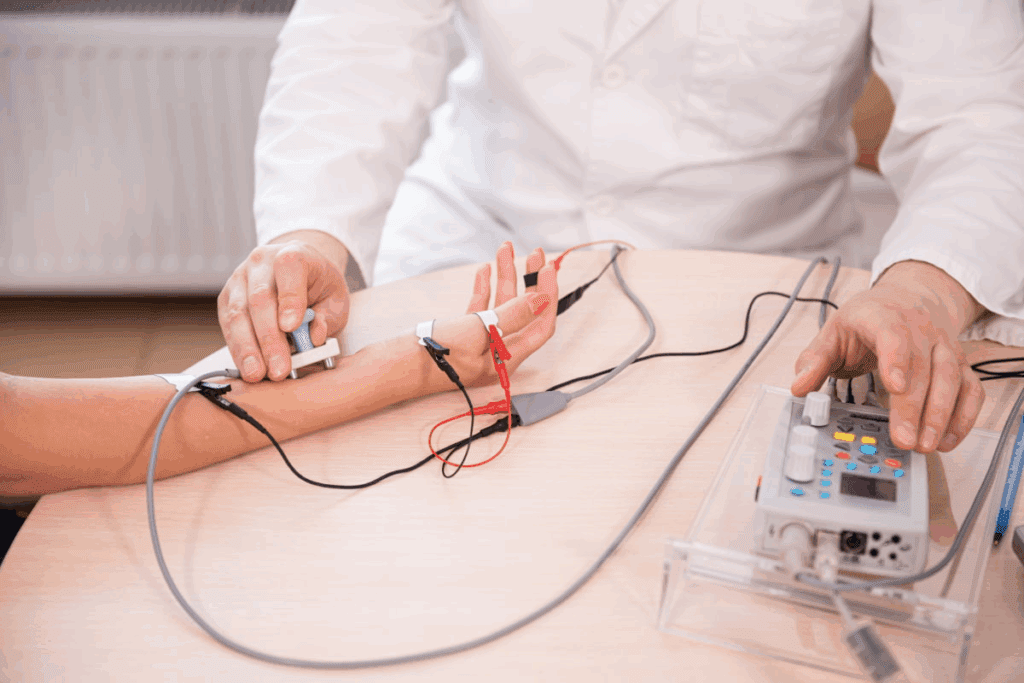
At Liv Hospital, we know how important cranial nerve 11, or the spinal accessory nerve, is. It helps control neck and shoulder movements. This nerve lets us move our heads and shoulders by working with two key muscles. An ultimate guide to spinal accessory nerve function (CN XI). Learn what this critical nerve does and the key muscles it controls.
The spinal accessory nerve is special because it goes into and out of the skull. This makes it unique and at risk during neck surgeries. Knowing how important significance of CN XI is helps us see its role in our movement and what happens if it gets hurt.
Key Takeaways
- Cranial nerve 11 controls neck and shoulder movements.
- The spinal accessory nerve innervates key muscles involved in head rotation and shoulder elevation.
- Damage to CN XI can significantly impact mobility.
- Understanding CN XI is essential for diagnosing and treating related conditions.
- The spinal accessory nerve is vulnerable during neck surgeries.
The Spinal Accessory Nerve: An Overview

Understanding the Spinal Accessory Nerve is key to knowing its role in our bodies. This nerve, also known as Cranial Nerve 11 or CN XI, is special. It has both spinal and cranial parts, making it unique.
Definition and Classification
The Spinal Accessory Nerve is the eleventh cranial nerve. It’s mainly a motor nerve. Its dual origin makes it stand out, unlike other cranial nerves that start from the brainstem.
“The spinal accessory nerve is a complex structure that has been the subject of much anatomical study and debate,” say medical experts. Its classification has changed as we learn more about it.
Unique Characteristics Among Cranial Nerves
The Spinal Accessory Nerve is special because it’s the only cranial nerve that both enters and exits the skull. This is key to its function. Its spinal part comes from the upper cervical spinal cord, and its cranial part from the brainstem.
- The nerve has a unique course through the neck.
- It innervates specific muscles, including the sternocleidomastoid and trapezius.
- Its function is mainly motor, helping control these muscles.
Historical Context and Discovery
Our understanding of the Spinal Accessory Nerve has grown over centuries. Early anatomists first identified and described it. Over time, our knowledge of its function has improved.
As medical science advances, so does our understanding of the Spinal Accessory Nerve. It’s a vital area of study in neurology and anatomy.
Anatomy and Origin of Cranial Nerve XI

Cranial Nerve XI has a unique anatomy. It has both spinal and cranial roots. This makes it special and important in the human body.
Spinal Root Components
The spinal root comes from the upper cervical spinal cord. It usually starts at C1 to C5 or C6. These fibers go through the foramen magnum into the skull.
This root is key for controlling muscles in the neck and shoulder. It helps with head, neck, and shoulder movements.
Cranial Root Components
The cranial root comes from the medulla oblongata’s side. It meets the spinal root in the skull. But, it’s now seen as part of the vagus nerve (Cranial Nerve X).
Its fibers help with swallowing and speaking. This is thanks to its connection with the vagus nerve.
Dual Origin Significance
The spinal accessory nerve’s dual origin is key to its function. It combines spinal and cranial roots. This lets it control different muscles, making it vital for many motor functions.
- The spinal accessory nerve has a unique dual origin.
- The spinal root arises from the cervical spinal cord.
- The cranial root originates from the medulla oblongata.
- The nerve is critical for the sternocleidomastoid and trapezius muscles.
Knowing about the spinal accessory nerve’s anatomy is vital. It shows its role in motor functions and its clinical importance. Its complex structure highlights its significance in the nervous system and its effects on the body.
Pathway and Course of the Spinal Accessory Nerve
The spinal accessory nerve has a special path because it starts from two places. Knowing this path helps us understand its role and any possible problems it might cause.
Intracranial Course
This nerve comes from the spinal cord and goes up into the skull through the foramen magnum. Inside the skull, it meets with another part before leaving.
Passage Through the Jugular Foramen
It leaves the skull through the jugular foramen, with the glossopharyngeal and vagus nerves. This exit is key because it’s where the nerve can get hurt or compressed.
Extracranial Distribution
After leaving the skull, the nerve goes down with the internal carotid artery. It then reaches the sternocleidomastoid and trapezius muscles. These muscles are important for moving the shoulder, like shrugging.
The spinal accessory nerve, or CN XI, controls the sternocleidomastoid and trapezius muscles. Its journey from the spinal cord to these muscles is complex and very important for our health.
Segment | Description |
Intracranial | The nerve ascends through the foramen magnum into the cranial cavity. |
Jugular Foramen | The nerve exits the skull through the jugular foramen with other cranial nerves. |
Extracranial | The nerve descends to innervate the sternocleidomastoid and trapezius muscles. |
Knowing the spinal accessory nerve’s pathway is key for diagnosing and treating nerve problems. This nerve is vital for shoulder movements, like shrugging, which we do every day.
CN XI, or the spinal accessory nerve, is very important for motor functions, mainly in the shoulder and neck. Its unique path shows how complex cranial nerve anatomy is and why precise neurological checks are so important.
Spinal Accessory Nerve Function
It’s important to know how the spinal accessory nerve works. This nerve, or cranial nerve XI, mainly controls muscles in the neck and shoulder. It’s a key part of our body’s movement.
Motor Innervation Properties
The spinal accessory nerve helps the sternocleidomastoid and trapezius muscles work. These muscles are key for moving the head and shoulders. The sternocleidomastoid muscle helps turn the head and bend the neck. The trapezius muscle lifts and rotates the scapula.
This nerve’s role is to control these movements well. It’s vital for everyday tasks and keeping our posture right. Damage to this nerve can cause big problems with these movements.
Comparison with Other Cranial Nerves
The spinal accessory nerve is mostly motor, unlike most cranial nerves. It’s different from nerves like the trigeminal nerve (cranial nerve V). The trigeminal nerve has both sensory and motor functions.
Cranial Nerve | Primary Function | Muscles Innervated |
Spinal Accessory Nerve (XI) | Motor | Sternocleidomastoid, Trapezius |
Trigeminal Nerve (V) | Mixed (Sensory & Motor) | Muscles of Mastication |
Facial Nerve (VII) | Mixed (Sensory & Motor) | Muscles of Facial Expression |
Functional Integration with Other Systems
The spinal accessory nerve works with the musculoskeletal system for movement. It helps the sternocleidomastoid and trapezius muscles for actions like shrugging and head rotation. This is important for keeping good posture.
This teamwork is key for our physical activities and mobility. Knowing how it works helps us see its importance for our health and movement.
Muscles Innervated by Cranial Nerve 11
It’s important to know which muscles Cranial Nerve 11 controls. This nerve, also known as the spinal accessory nerve, helps two main muscles work. These muscles are key for moving the neck and shoulders.
The Sternocleidomastoid Muscle
The sternocleidomastoid muscle is controlled by Cranial Nerve 11. It helps turn the head and bend the neck to the side. This muscle is important for moving the head and neck.
The Trapezius Muscle
The trapezius muscle is also controlled by this nerve. It helps move the shoulders up and back. This muscle is key for shrugging and other shoulder actions.
In short, Cranial Nerve 11 is vital for the muscles in the neck and shoulders. Knowing this helps doctors treat muscle and nerve problems.
Clinical Significance of the Spinal Accessory Nerve
It’s important to know about the spinal accessory nerve’s role in health. This nerve, or cranial nerve XI, helps control muscles in the neck and shoulders. These muscles are key for moving these areas.
Common Injuries and Their Manifestations
Damage to the spinal accessory nerve can cause serious problems. This includes muscle weakness or paralysis. Such damage can happen from trauma, surgery issues, or other reasons.
Signs of nerve injury include:
- Hard time rotating the head or lifting the shoulder
- Weakness in the sternocleidomastoid and trapezius muscles
- Visible muscle wasting over time
- Pain or discomfort in the neck and shoulder
Manifestation | Description |
Difficulty in head rotation | Patients may struggle to turn their head to the opposite side due to sternocleidomastoid weakness |
Shoulder elevation weakness | Weakness in the trapezius muscle makes lifting the arm or shoulder hard |
Muscle atrophy | Visible wasting of the sternocleidomastoid and trapezius muscles can happen over time if the nerve damage is not treated |
Iatrogenic Injuries During Surgery
Surgical procedures in the neck can sometimes harm the spinal accessory nerve. Surgeons need to know where the nerve is to avoid damage.
Diagnostic Approaches
Diagnosing nerve injuries involves clinical checks and tests. Electromyography (EMG) is a key tool for checking muscle function.
Other ways to diagnose include:
- Physical exam to check muscle strength and movement
- Imaging like MRI or CT scans to find structural issues
- Nerve conduction studies to check nerve function
Treatment and Rehabilitation Options
Treatment aims to fix nerve damage and ease symptoms. Physical therapy is key in rehab, helping to strengthen muscles and improve movement.
In some cases, surgery might be needed. This could be to repair the nerve or to do nerve transfer procedures.
Testing Spinal Accessory Nerve Function
Doctors use different methods to check the spinal accessory nerve’s function. This is key for diagnosing and treating related issues. They look at the strength and function of the muscles it controls, like the sternocleidomastoid and trapezius muscles.
Physical Examination Techniques
Physical exams are the first step in checking the spinal accessory nerve. Shoulder shrug and head rotation against resistance are important tests. They help see how strong the trapezius and sternocleidomastoid muscles are.
For example, to test the trapezius, the patient shrugs their shoulders against resistance. If one side is weak, it might mean a nerve problem. Testing the sternocleidomastoid involves rotating the head against resistance.
Electrophysiological Assessment
If physical exams show nerve issues, electrophysiological assessments can offer more details. Electromyography (EMG) is a key tool for checking muscle function. It can tell if the problem is with the nerve or the muscle itself.
Imaging Studies
Sometimes, imaging studies like MRI or CT scans are needed. They help find structural problems like nerve compression or tumors. These studies are important for diagnosing nerve issues.
Disorders and Pathologies Affecting Cranial Nerve 11
It’s important to know about the disorders that affect the spinal accessory nerve. This nerve, or cranial nerve 11, controls neck and shoulder muscles. When it’s affected, it can cause muscle weakness or paralysis, affecting a person’s life.
Accessory Nerve Palsy
Accessory nerve palsy is when the spinal accessory nerve doesn’t work right. This leads to weakness or paralysis of the sternocleidomastoid and trapezius muscles. It can happen due to injuries, surgery problems, or no known reason.
Symptoms include shoulder drooping, trouble rotating the neck, and weak shoulder movements. Doctors use exams and imaging to find out why it happens.
Spinal Accessory Neuropathy
Spinal accessory neuropathy is damage or disease to the spinal accessory nerve. It can come from injuries, infections, or autoimmune diseases. The symptoms depend on how much and where the nerve is damaged.
It can cause long-term pain, muscle wasting, and less mobility. Treatment often includes physical therapy, pain management, and sometimes surgery.
Congenital Abnormalities
Congenital abnormalities of the spinal accessory nerve are rare but serious. They can come from genetics or developmental issues in the womb. Early diagnosis and treatment are key to help manage these conditions.
They may need various therapies and support to improve their situation.
Conclusion
The spinal accessory nerve, also known as cranial nerve 11, is key for neck and shoulder movements. It helps control the sternocleidomastoid and trapezius muscles. These muscles are vital for many motor activities.
We’ve looked at the nerve’s anatomy and where it starts. It’s unique among cranial nerves because of its dual origin and path through the jugular foramen.
The nerve’s role is mainly in motor functions. This sets it apart from other cranial nerves. Knowing how it works is important for diagnosing and treating problems.
In healthcare, understanding cranial nerve 11 is critical. Damage to this nerve can greatly affect a patient’s life. So, knowing about the spinal accessory nerve’s function is essential for doctors and nurses.
FAQ
What is the spinal accessory nerve?
The spinal accessory nerve, also known as CN XI, is the eleventh cranial nerve. It controls the sternocleidomastoid and trapezius muscles. These muscles help move the neck and shoulders.
What does the spinal accessory nerve do?
This nerve is mainly a motor nerve. It helps the sternocleidomastoid and trapezius muscles move. This includes head rotation, lateral flexion, and shoulder elevation.
What is the origin of the spinal accessory nerve?
The spinal accessory nerve comes from both spinal and cranial roots. The spinal root comes from the cervical spinal cord. The cranial root comes from the lateral aspect of the medulla oblongata.
What is the pathway of the spinal accessory nerve?
The nerve exits the skull through the jugular foramen. It then goes down along the internal carotid artery. It innervates the sternocleidomastoid and trapezius muscles.
What are the muscles innervated by the spinal accessory nerve?
The nerve innervates the sternocleidomastoid muscle. This muscle helps in head rotation and lateral flexion. It also innervates the trapezius muscle. This muscle is key for shoulder elevation and scapular retraction.
What are the clinical implications of damage to the spinal accessory nerve?
Damage to this nerve can cause muscle weakness or paralysis. It affects neck and shoulder movements. It can be caused by injury, disease, or surgical complications.
How is spinal accessory nerve function tested?
Testing involves physical examination and electrophysiological assessments. Physical examination checks muscle strength. Electromyography is used for nerve function tests.
What are the treatment options for spinal accessory nerve damage?
Treatment includes physical therapy and nerve transfer surgery. The choice depends on the damage’s extent and cause.
What is accessory nerve palsy?
Accessory nerve palsy is a condition caused by injury or disease. It leads to muscle weakness or paralysis.
Can congenital abnormalities affect the spinal accessory nerve?
Yes, congenital abnormalities can impact its development and function.
References
National Center for Biotechnology Information. Evidence-Based Medical Guidance. Retrieved from https://www.ncbi.nlm.nih.gov/books/NBK537282/