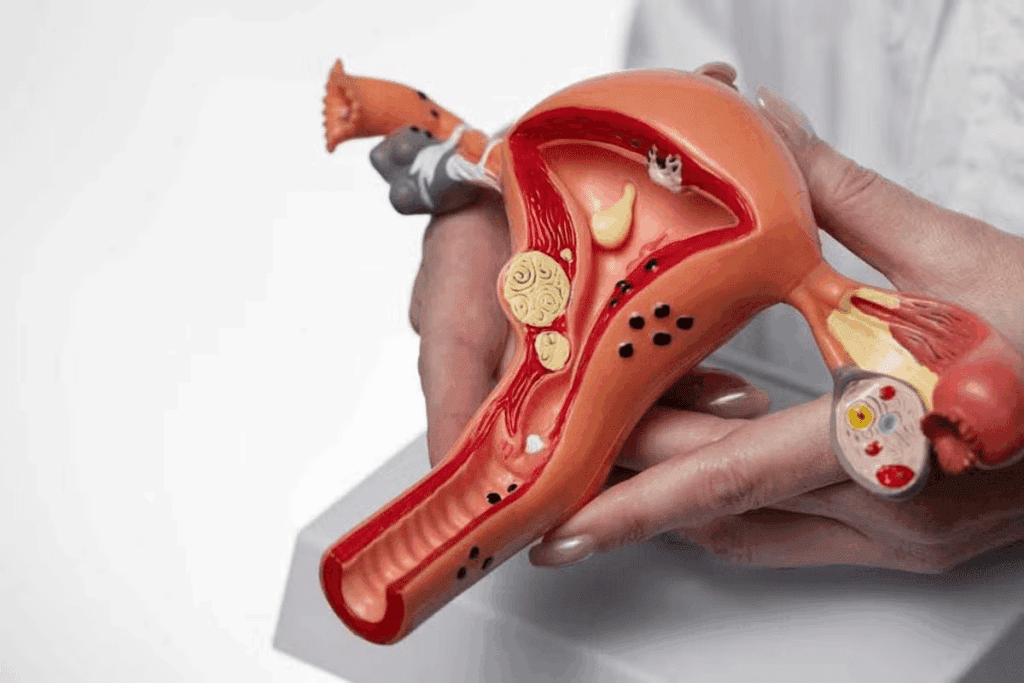
Getting an ultrasound report with a thickened uterine lining can be scary. It makes you wonder about your health. This issue, known as endometrial hyperplasia, means the lining of your uterus is too thick. It’s seen on ultrasound scans.
The lining of your uterus is key to your reproductive health. It gets thicker each month, ready for pregnancy. But if it gets too thick, it could mean a few things. It might be due to hormonal imbalances or other serious health issues.
We at top healthcare centers know how vital it is to check and treat you right. We aim to give you the best care and support. We focus on treating conditions related to a thickened uterine lining with care and science. A thickened uterine lining seen on ultrasound can be alarming. This vital guide explains the critical causes and essential next steps.
Key Takeaways
- Understanding the implications of a thickened uterine lining is key for women’s health.
- This condition can point to many health issues, from mild to serious.
- Getting a detailed check-up is important to find out why.
- Custom treatment plans are vital for good care.
- We offer full support for those dealing with this issue.
Understanding the Uterine Lining

The endometrium, or uterine lining, is key to the female reproductive system. It changes a lot during the menstrual cycle. This layer is thin, soft, and spongy, covering the uterus’s inside.
Normal Endometrial Structure and Function
The endometrium has two layers: the basal layer and the functional layer. The basal layer stays the same throughout the cycle. The functional layer changes with hormone levels.
At first, the endometrium is about 3-4 mm thick. It grows to 8-12 mm near ovulation. This growth helps the uterus get ready for a fertilized egg.
The Menstrual Cycle and Endometrial Changes
The endometrium changes a lot during the menstrual cycle. In the proliferative phase, it gets thicker because of estrogen. Then, in the secretory phase, it gets even thicker and more blood-rich because of progesterone.
If there’s no pregnancy, the endometrium sheds. This leads to menstrual bleeding. This cycle is vital for keeping the reproductive system healthy.
- The endometrium thickens in anticipation of a fertilized egg.
- Hormonal changes drive the thickening and shedding of the endometrium.
- Understanding these changes is key to spotting uterine lining issues.
Knowing how the endometrium works and changes helps us understand a thick uterine lining on ultrasound.
Thickened Uterine Lining Seen on Ultrasound: Definition and Significance

An ultrasound showing a thickened uterine lining might mean there’s a hormonal imbalance. We’ll look into what this condition is and its effects on women’s health.
What is Endometrial Hyperplasia?
Endometrial hyperplasia is when the uterus lining gets too thick. This usually happens because of too much estrogen without enough progesterone. It’s seen as a precancerous condition because it could turn into endometrial cancer if not treated.
Normal vs. Abnormal Endometrial Thickness
The uterus lining’s thickness changes with a woman’s menstrual cycle. In premenopausal women, it’s thinnest during menstruation and gets thicker as the cycle goes on. Abnormal thickening means it’s thicker than expected for a woman’s cycle or age.
For women after menopause, a lining thicker than 5 mm is abnormal and needs checking.
Clinical Significance of Thickened Endometrium
A thickened uterus lining can be serious. It increases the risk of endometrial and uterine cancers, mainly in postmenopausal women. So, finding and treating the causes of thickening is key to avoiding problems.
Knowing the causes, like hormonal imbalances, and fixing them can lower these risks. We’ll talk about common causes and how to diagnose them next.
Ultrasound Evaluation Techniques
Ultrasound is a key tool for checking the uterine lining’s thickness and health. It helps us understand the endometrium’s details. This is vital for diagnosing and treating gynecological issues.
Transvaginal vs. Transabdominal Ultrasound
There are two main ultrasound methods: transvaginal and transabdominal. Transvaginal ultrasound gives a detailed look at the endometrium, showing its thickness accurately. A small, smooth wand is used in the vagina to see inside the uterus. It sends safe sound waves that create detailed pictures.
Transabdominal ultrasound scans the abdomen to see the uterus. It gives a wider view but might not show as much detail as transvaginal ultrasound, like endometrial thickness.
“Transvaginal ultrasound has become an indispensable tool in gynecological imaging, providing high-resolution images that are critical for evaluating endometrial pathology.”
— Expert in Gynecological Imaging
How Endometrial Thickness is Measured
Measuring endometrial thickness is key in ultrasound checks. We measure the thickest part of the endometrium, usually in the sagittal plane. This is important for spotting risks of hyperplasia or cancer, mainly in postmenopausal women.
- The measurement is taken from one basal layer to the other, excluding the hypoechoic inner layer.
- Clear visualization is key, and transvaginal ultrasound is best for this.
Localized vs. Global Thickening Patterns
Endometrial thickening can show up in different ways. Global thickening means the whole endometrium is thicker. Localized thickening points to specific areas, like polyps or lesions.
Knowing the thickening pattern helps figure out the cause and plan treatment. For example, localized thickening might need hysteroscopy or biopsy to check for cancer.
Diagnostic Thresholds for Endometrial Thickness
When checking endometrial thickness, it matters if a woman is premenopausal, postmenopausal, or perimenopausal. Knowing these details helps doctors spot any issues and plan the best care.
Thresholds for Premenopausal Women
In premenopausal women, endometrial thickness changes throughout the cycle. A normal thickness is up to 14-16 mm in the late cycle. But, if it’s over 7 mm early in the cycle, more tests might be needed.
Thresholds for Postmenopausal Women
For women after menopause, a thickness over 5 mm is a red flag. This is because older women are at higher risk for certain health problems.
Special Considerations for Perimenopausal Women
Perimenopausal women are in a phase of big hormonal changes. Their thickness thresholds might be similar to premenopausal women. But, doctors must use their best judgment, considering symptoms and ultrasound results.
Reproductive Status | Normal Endometrial Thickness | Threshold for Further Investigation |
Premenopausal | Up to 14-16 mm (late proliferative phase) | > 7 mm (early proliferative phase) |
Postmenopausal | Typically | > 5 mm |
Perimenopausal | Varies, similar to premenopausal | Clinical judgment required |
Doctors need to understand these thresholds to care for their patients well. They look at endometrial thickness, symptoms, and more to decide on tests and treatments.
Common Causes of Thickened Uterine Lining
Hormonal imbalances, like too much estrogen, often cause the uterine lining to thicken. The thickness of the lining is influenced by hormones and metabolism.
Estrogen Dominance and Hormonal Imbalances
When estrogen levels are too high and progesterone too low, the lining thickens. Estrogen dominance is linked to irregular periods and PCOS.
Medical Expert, a top gynecologist, says, “Hormonal imbalances are key in thickening the lining. It’s important to manage these imbalances to avoid problems.”
“Hormonal imbalances, like too much estrogen, are key in endometrial hyperplasia.”
Polycystic Ovary Syndrome (PCOS)
PCOS is a hormonal disorder in women of childbearing age. It causes irregular periods, cysts on the ovaries, and hormonal imbalances. Women with PCOS are more likely to have a thickened lining due to too much estrogen.
Condition | Effect on Endometrium | Risk Factors |
PCOS | Increased risk of endometrial thickening | Hormonal imbalances, irregular menstrual cycles |
Obesity | Increased estrogen levels, endometrial thickening | Metabolic syndrome, insulin resistance |
Tamoxifen | Endometrial thickening, cysts, and polyps | Breast cancer treatment |
Obesity and Metabolic Factors
Being overweight can also lead to a thickened lining. Fat tissue can turn androgens into estrogens, raising estrogen levels. Metabolic syndrome and insulin resistance increase the risk of endometrial hyperplasia.
Medications (Including Tamoxifen)
Some medicines, like tamoxifen, can cause the lining to thicken. Tamoxifen is used for breast cancer and can change the lining, causing it to thicken. Women on tamoxifen should be closely monitored.
Knowing the causes helps in finding the right treatment. By tackling the root causes, doctors can lower the risk of problems and improve results.
Symptoms Associated with Endometrial Thickening
Women with endometrial thickening may show various symptoms that need medical attention. These symptoms can affect daily life and reproductive health.
Abnormal Uterine Bleeding Patterns
One key symptom is abnormal uterine bleeding. This can be heavy menstrual periods or irregular bleeding between periods. Some women may also have prolonged menstrual bleeding.
These bleeding patterns can be unpredictable. They can cause discomfort and worry. Women with these symptoms should see a healthcare provider for evaluation and diagnosis.
Other Common Symptoms
Women with endometrial thickening may also have other symptoms. These include pelvic pain or discomfort and bloating or changes in abdominal pressure. Some may notice changes in their menstrual cycle, like irregular periods or anovulatory cycles.
When Symptoms May Be Absent
Some women with endometrial thickening may not have symptoms. In these cases, the condition might be found during a routine ultrasound. The lack of symptoms doesn’t mean the condition is less severe. A thorough medical check is needed to find the cause of endometrial thickening.
Knowing the symptoms of endometrial thickening is key for early detection and treatment. If you notice any unusual symptoms or concerns, see a healthcare professional.
Potential Complications and Risks
A thickened uterine lining can lead to serious health issues, including endometrial cancer. This condition, known as endometrial hyperplasia, needs careful management. We will look at the risks and complications it poses.
Risk of Endometrial Cancer
A thickened uterine lining increases the risk of endometrial cancer. Women with this condition are more likely to develop cancer, if they are obese or have a family history of cancer.
Types of Endometrial Hyperplasia and Cancer Risk
There are different types of endometrial hyperplasia, each with its own cancer risk. Simple hyperplasia without atypia has a lower risk than complex hyperplasia with atypia. Knowing the type is key to choosing the right treatment and follow-up.
Type of Hyperplasia | Cancer Risk |
Simple Hyperplasia without Atypia | 1% |
Complex Hyperplasia without Atypia | 3% |
Simple Hyperplasia with Atypia | 8% |
Complex Hyperplasia with Atypia | 29% |
Long-term Health Implications
The long-term effects of a thickened uterine lining can be serious. Untreated, it can cause abnormal bleeding, affecting a woman’s life quality. The risk of cancer also means constant monitoring and management are needed.
Research links thicker uterine linings to higher body mass index (BMI) in postmenopausal women. Studies also show a higher risk of endometrial and uterine cancers with thicker linings.
Follow-up Diagnostic Procedures
When a thickened uterine lining is found on ultrasound, more tests are needed. These tests help find out why the lining is thick. It could be due to hormonal issues, structural problems, or other health concerns.
Endometrial Biopsy Methods
An endometrial biopsy takes a tissue sample from the uterine lining. It’s checked for diseases like endometrial hyperplasia or cancer. There are different ways to do this biopsy, like:
- Pipelle biopsy: A thin, flexible tube is used.
- D&C (Dilation and Curettage): This is more invasive, involving the cervix and uterine lining scraping.
Hysteroscopy
Hysteroscopy lets doctors see inside the uterus with a thin, lighted telescope. It can spot problems like polyps or fibroids that might cause the lining to thicken.
Additional Imaging Studies
More imaging tests might be suggested to look at the uterine lining and nearby areas. These include:
- Saline infusion sonohysterography (SIS): Saline is put into the uterus to improve ultrasound images.
- MRI (Magnetic Resonance Imaging): It gives detailed pictures of the uterus and tissues around it.
Laboratory Tests and Markers
Lab tests might check hormone levels and other markers. These tests help doctors decide on treatment and see how well it’s working.
Conclusion: Treatment Approaches and When to Seek Medical Care
A thickened uterine lining can be a worrying sign on an ultrasound. Many wonder what it signifies. It’s important to know the causes and how to treat them effectively.
Several factors can lead to a thickened uterine lining. These include hormonal imbalances, polycystic ovary syndrome (PCOS), and some medications. Treatment depends on the cause, and hormone therapy is often used to balance hormones.
If you notice a thickening uterus, it’s key to see a doctor. They can find the cause and create a treatment plan. If you’re experiencing unusual bleeding, get medical help right away.
Knowing what a thickened uterus means and the treatment options helps you make informed health choices. This way, you can get the care you need.
FAQ
What does a thickened uterine lining mean on ultrasound?
A thickened uterine lining, or endometrial hyperplasia, means the lining of the uterus is too thick. This can be seen on an ultrasound. It often points to hormonal issues.
What is the normal thickness of the uterine lining?
The uterine lining’s thickness changes throughout the month. For women not in menopause, it’s usually 4-14 mm. For those in menopause, it should be 5 mm or less.
What causes the uterine lining to thicken?
Hormonal imbalances, like too much estrogen, often cause a thickened lining. Other reasons include PCOS, being overweight, and some medicines like tamoxifen.
What are the symptoms of a thickened uterine lining?
Signs can be heavy or irregular bleeding. Some women might feel pelvic pain or discomfort. But, some may not show any symptoms.
Is a thickened uterine lining a sign of cancer?
A thickened lining can raise the risk of endometrial cancer, if there are abnormal cells. But, not all thickened linings are cancerous. More tests are needed to find out why.
How is endometrial thickness measured on ultrasound?
Ultrasound, usually transvaginal, measures the lining’s thickness. It looks at the thickness from one basal layer to the other.
What are the treatment options for a thickened uterine lining?
Treatment varies based on the cause. It might include hormone therapy to balance hormones. Sometimes, surgery is needed. Always talk to a healthcare provider for the best plan.
Can a thickened uterine lining be a sign of an underlying hormonal imbalance?
Yes, it often is. Hormone therapy can help balance hormones and reduce the lining’s thickness.
How is a thickened uterine lining diagnosed?
Ultrasound imaging usually spots it first. Then, tests like endometrial biopsy or hysteroscopy are used to find the cause.
What are the possible complications of a thickened uterine lining?
Complications can include a higher risk of endometrial cancer. Long-term issues like anemia and poor quality of life from abnormal bleeding are also possible.
References
National Health Service (NHS). Thickened Uterine Lining on Ultrasound: Endometrial Hyperplasia. Retrieved from https://www.nhs.uk/conditions/endometrial-hyperplasia/