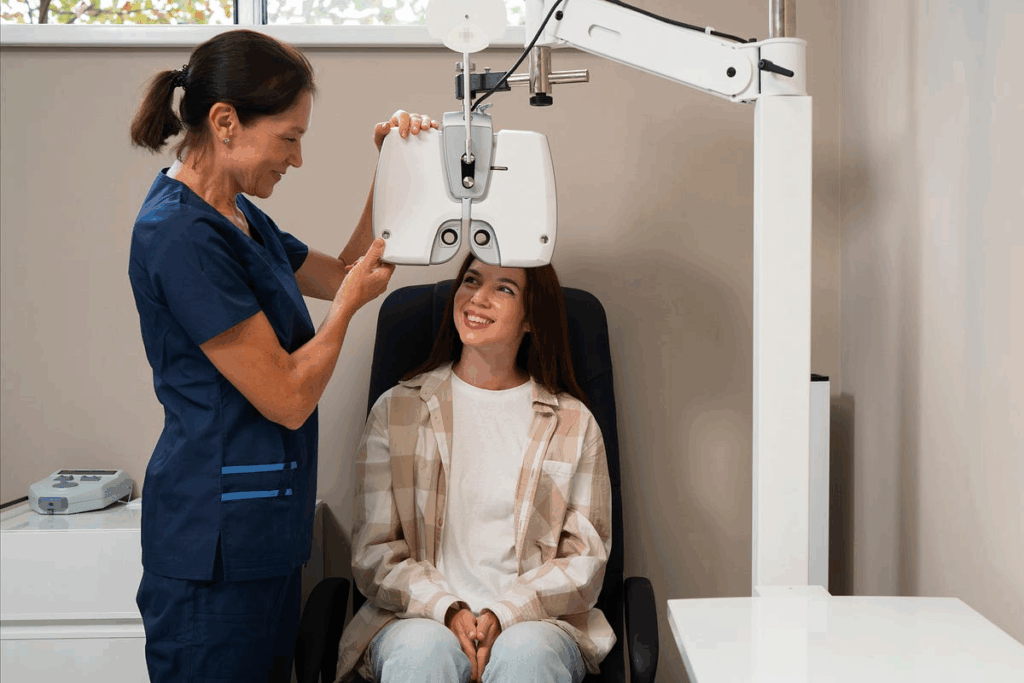
Under eye bags can make you look tired or older. Millions of people want to fix this. Botox, made from a purified neurotoxin, has been used in beauty treatments for years. Detailed comparison of Botox versus blepharoplasty under eye bags for permanent bag removal. Consider blepharoplasty under eye bags.
Many wonder if Botox can get rid of under eye bags. It depends on why you have them. Knowing the difference between Botox, fillers, and surgery is important.
Key Takeaways
- Botox is a safe and effective cosmetic treatment with decades of use.
- The cause of under eye bags determines the most suitable treatment.
- Botox, dermal fillers, and surgery are options for addressing under eye bags.
- Understanding the differences between these options is key to making informed decisions.
- Consulting a professional is essential for determining the best course of treatment.
Understanding Under Eye Bags: Causes and Concerns

Under eye bags can greatly affect how we look and feel. It’s important to know what causes them and why they matter. This includes looking at the physical, environmental, and mental sides of the issue.
Anatomical Factors Behind Under Eye Bags
Under eye bags come from a mix of physical reasons. These include:
- Fat displacement or prolapse in the orbital area
- Volume loss in the tear trough area, leading to a hollow appearance
- Fluid retention, which can cause puffiness
- Skin laxity or looseness due to aging or genetic factors
Knowing these physical factors helps us choose the best treatment. This could be plastic surgery on eye bags or other non-surgical methods.
Aging and Environmental Influences
As we get older, under eye bags become more common. The skin loses elasticity, and fat moves, making the area look puffy. Things like:
- Exposure to UV radiation
- Smoking
- Poor diet and hydration
- Lack of sleep
can make the problem worse. While under eye bags botox can help with some issues, it doesn’t solve the main problems.
Psychological Impact of Under Eye Bags
Under eye bags can really affect our self-esteem and confidence. Many turn to plastic surgery for under eye bags to look younger and more awake. It’s key to understand the emotional side of this issue.
In summary, under eye bags are a complex problem. They are influenced by physical, aging, and environmental factors, with big emotional impacts. Knowing all these aspects is key to finding the right treatment, whether it’s surgery or not.
The Science Behind Botox: Mechanism and Applications

Knowing how Botox works is key to understanding its use in beauty treatments. Botox has botulinum toxin type A, which stops muscles from contracting. This is why it’s good for making faces look younger.
How Botulinum Toxin Works in the Skin
Botulinum toxin relaxes muscles that cause wrinkles, making skin look smoother. When Botox is injected, it stops muscles from moving. This reduces wrinkles and fine lines.
The effects of Botox last a few months. This is because the nerves and muscles start working again. Because it’s temporary, many people choose Botox for a quick fix.
Traditional Uses for Facial Rejuvenation
Botox is used for many beauty treatments, including:
- Treating glabellar lines (frown lines between the eyebrows)
- Reducing crow’s feet (lines around the eyes)
- Softening forehead wrinkles
Its success in these areas has made Botox a favorite in beauty treatments.
FDA-Approved vs. Off-Label Applications
Botox is approved by the FDA for some uses, but it’s also used for others. The FDA says it’s okay for treating frown lines, crow’s feet, and other wrinkles. But it’s also used for things like migraines and too much sweating.
Knowing the difference between approved and off-label uses is important. It shows the balance between safety and new medical practices.
Understanding Botox and its uses helps people make better choices for their beauty treatments.
Can Botox Actually Treat Under Eye Bags?
Botox is known for fighting facial wrinkles, but its role in treating under eye bags is more complex. Under eye bags come from several causes like fat movement, volume loss, fluid buildup, and loose skin.
Understanding the Limitations
Botox relaxes facial muscles, reducing wrinkles caused by muscle movement. But, under eye bags are not just about muscle activity. Medical Expert, a well-known plastic surgeon, says, “Botox can help some under-eye issues, but it’s not a cure-all for under eye bags.” This is key to understanding Botox’s role in this area.
Under eye bags come from many factors, like aging and the environment. So, while Botox can tackle some issues, like crow’s feet, it’s not the best for under eye bags.
Muscle-Related vs. Fat-Related Concerns
It’s important to know the difference between muscle and fat issues under the eyes. Botox works well for muscle-related problems, like fine lines and wrinkles. But, it can’t fix fat-related problems, like fat prolapse or volume loss.
A 2003 clinical study showed Botox can improve wrinkles in the lower eyelids and crow’s feet. But, this doesn’t mean it’s a solution for under eye bags, which need a broader approach.
When looking at treatments for under eye bags, a mix of methods is often needed. This might include Botox along with other treatments to tackle all the causes of under eye bags.
Clinical Evidence: The 2003 Study and Beyond
A 2003 study sparked interest in using Botox for under eye bags. It showed Botox can make the lower eyelid look fuller. This reduces bagginess and fine lines. More studies have looked into how well it works and its uses.
Key Findings from Clinical Research
The 2003 study found Botox injections in the lower eyelids and crow’s feet area improved results. It showed a decrease in under-eye bags and a fresher look around the eyes. Later studies backed these results, seeing Botox as a good non-surgical fix for under eye bags.
Key benefits of Botox for under eye bags include its easy procedure and quick results. Patients see changes in a few days, with effects lasting months.
Combined Treatment Approaches
While Botox is promising, mixing it with other treatments can improve results. Using dermal fillers with Botox tackles both muscle issues and volume loss. This approach tailors treatment to each patient’s needs.
Combination therapy is gaining traction for a more complete facial rejuvenation. By mixing Botox with other cosmetic procedures, patients can look younger and more refreshed.
Limitations of Current Research
Despite encouraging results, current research on Botox for under eye bags has its limits. Many studies have small groups, and more long-term data is needed. Also, results can vary, and not everyone is a good candidate for Botox.
More research is needed to set up standard treatment plans. It should also look into using Botox with other cosmetic treatments. This will help doctors and patients get better results.
Blepharoplasty Under Eye Bags: The Surgical Gold Standard
Blepharoplasty is now the top choice in plastic surgery for under-eye bags. It removes or moves fat under the eyes. This reduces the look of under-eye bags.
Surgical Technique and Procedure
The surgery uses small cuts in the eyelid’s natural folds to hide scars. It can fix the upper, lower, or both eyelids, based on what the patient needs.
The surgeon will take out or move extra fat, muscle, and skin. This makes the eyes look smoother and younger.
Recovery Timeline and Process
Recovering from blepharoplasty takes a few weeks. Expect some bruising and swelling at first.
The recovery includes:
- Resting with the head up to lessen swelling
- Avoiding hard work for a few weeks
- Using cold packs to reduce bruising
- Following the doctor’s medication plan
Long-Term Results and Effectiveness
Blepharoplasty can last a long time for removing under-eye bags. How well it works depends on skin quality, age, and health.
Factors Influencing Results | Description | Impact on Outcome |
Skin Quality | Elasticity and firmness of the skin | Good skin leads to better, lasting results |
Age | Patient’s age at surgery | Younger patients may see results last longer |
Lifestyle Factors | Smoking, sun, and other environmental factors | A healthy lifestyle helps results last longer |
Knowing about the surgery, recovery, and what affects results helps patients decide on blepharoplasty for under-eye bags.
Botox as a Complementary Treatment
We often suggest using Botox as part of a multi-faceted approach to treat under eye concerns. By combining Botox with other treatments, we can tackle multiple facial aging issues at once.
Combining Botox with Other Procedures
Botox works well when paired with other cosmetic procedures for better results. For example, using Botox with dermal fillers can tackle both wrinkles and volume loss. This approach can lead to more satisfying and longer-lasting results.
- Dermal fillers can restore lost volume under the eyes.
- Laser therapy can improve skin texture and reduce pigmentation.
- Chemical peels can enhance skin brightness and reduce fine lines.
The Crow’s Feet Connection
Treating crow’s feet with Botox can also improve under eye bags. The relaxation of the orbicularis oculi muscle can help reduce the appearance of fine lines and wrinkles in the periocular area. By addressing crow’s feet, we can achieve a more harmonious and rejuvenated look around the eyes.
Creating a Comprehensive Treatment Plan
To get the best results, we need a personalized treatment plan. This might include Botox, dermal fillers, laser therapy, or chemical peels. A well-rounded treatment plan can lead to more natural-looking and longer-lasting results.
- Initial consultation to assess individual concerns.
- Customized treatment plan development.
- Combination therapy implementation.
- Follow-up care to ensure optimal results.
Alternative Non-Surgical Treatments for Under Eye Bags
Non-surgical treatments offer many options for those dealing with under-eye bags. These treatments help without surgery. Under-eye bags can affect how we feel about ourselves.
There are many non-surgical choices, each tackling under-eye bags in different ways. We’ll look at these options, their effectiveness, and how they can make you look more refreshed.
Dermal Fillers for Tear Trough Correction
Dermal fillers are a common choice for under-eye bags, focusing on tear trough correction. They add volume under the eyes, reducing dark shadows and improving the look of the area.
Dermal filler technology has improved a lot. There are many products, each with its own benefits. The right filler depends on your needs and the doctor’s skill.
Radiofrequency and Ultrasound Therapies
Radiofrequency and ultrasound therapies are also non-surgical options for under-eye bags. They stimulate collagen and tighten the skin, making bags look less noticeable.
These treatments are less invasive than surgery. They might have fewer risks and less downtime.
Topical Solutions and Their Efficacy
Topical solutions, like creams and serums, are also used for under-eye bags. They contain ingredients like peptides, caffeine, and vitamins. These can help reduce puffiness and discoloration.
Topical solutions might not work as well as other treatments. But they can be a good addition or maintenance therapy. They help keep the results of other treatments going longer.
Exploring these non-surgical options helps people make better choices for their under-eye bag concerns. They can pick the best treatment for their needs and preferences.
The Botox Procedure for Eye Rejuvenation
The Botox procedure for eye rejuvenation has several steps. It starts with a consultation and ends with post-treatment care. Administering Botox correctly is key, even in sensitive areas like under the eyes.
Consultation and Assessment
The first step is a detailed consultation and assessment. We look at the patient’s concerns, medical history, and facial structure. This helps us decide if Botox is right for their under eye bags. It’s important to talk about what you hope to achieve and what Botox can do.
- Evaluation of facial structure and muscle dynamics
- Discussion of medical history and previous treatments
- Assessment of the severity of under eye bags
Injection Technique and Placement
Injecting Botox under the eyes needs precision. Our skilled practitioners use a fine needle to target specific muscles. Getting the placement right is key to natural-looking results.
- Identifying the correct injection sites based on individual facial anatomy
- Using the appropriate dosage to achieve the desired effect without over-treating
- Administering the injections with precision to target the specific muscles causing under eye bags
Post-Treatment Care
Proper care after Botox is essential for the best results. We give detailed instructions on how to care for the treated area. Following these steps helps you get the most from your treatment.
“Post-treatment care is just as important as the procedure itself. By following our guidelines, patients can enjoy the full benefits of their Botox treatment.”
Expert Opinion
Understanding the Botox procedure helps patients make informed choices. Our team is committed to providing full care and support every step of the way.
Potential Risks and Side Effects
It’s important to know about Botox side effects before getting it for under eye bags. Botox is safe when done by a skilled professional. But, there are risks and side effects to be aware of.
Common Temporary Side Effects
After getting Botox, most people notice some temporary side effects. These can include:
- Bruising and swelling at the injection site
- Temporary muscle weakness
- Headaches
- Drooping eyelids
These side effects are usually mild and go away in a few days. But, sometimes they can be more serious or last longer.
Serious Complications to Be Aware Of
Even though rare, serious problems can happen with Botox. These include:
- Spread of the toxin effect (known as “botox spread” or “antitoxin spread”)
- Corneal exposure or ulcers
- Difficulty swallowing or breathing (in rare cases)
It’s important to know about these serious complications. Talk to your healthcare provider about any worries you have.
Minimizing Risks Through Provider Selection
Choosing a skilled provider can greatly reduce the risk of side effects and complications. When picking a provider, look for:
Criteria | What to Look For |
Qualifications | Board certification in dermatology or plastic surgery |
Experience | Significant experience with Botox injections, specially for under eye bags |
Reputation | Positive reviews and recommendations from previous patients |
By choosing the right provider and knowing the risks, you can decide if Botox is right for you.
Cost Considerations and Value Assessment
It’s important to know the costs of treatments for under-eye bags before making a choice. The price of Botox and other treatments changes based on several things. These include where you are, the skill of the provider, and the treatment method.
Average Price Points for Different Treatments
The cost of Botox for under-eye bags varies by location. In Chennai, it can cost between ₹8,000 to ₹20,000 per session. Other treatments like dermal fillers or surgery have different prices.
Treatment | Average Cost | Duration |
Botox for Under Eyes | ₹8,000 – ₹20,000 | Single Session |
Dermal Fillers | ₹30,000 – ₹60,000 | Lasts 6-12 months |
Blepharoplasty | ₹80,000 – ₹150,000 | Permanent |
Insurance Coverage (or Lack Thereof)
Most cosmetic treatments, like Botox for under-eye bags, aren’t covered by insurance. They are seen as elective. But, if your under-eye bags are due to a medical issue, some treatments might be partially covered. Always check with your provider and insurance to see what’s covered.
Long-Term Investment Comparison
When looking at treatment costs, think about the long-term. Botox might need to be done every 3-4 months, which can add up. But, surgery like blepharoplasty might be more expensive at first. Yet, it can last longer, making it a better value over time.
Key Considerations:
- Initial cost vs. long-term cost
- Duration of the treatment effect
- Potential need for follow-up or maintenance treatments
By looking at these points, you can choose the best treatment for your needs and budget.
Conclusion: Making an Informed Decision About Under Eye Bag Treatment
When looking into treatments for under eye bags, it’s key to know your options. Botox can help with wrinkles, but it might not fix the root cause of under-eye bags. Surgery, like blepharoplasty, is often the best choice for more severe cases.
It’s smart to check out all the treatments, including non-surgical ones like fillers and radiofrequency. A good plan might mix Botox with other methods for the best look. Knowing what each treatment does helps you choose wisely.
Choosing the right treatment depends on what you want to fix and your goals. We suggest talking to a healthcare expert to find the best option for you. This way, you can look and feel younger, improving your overall health.
FAQ
Can Botox remove under eye bags?
Botox can help with under eye bags, but it depends on the cause. It works well if the bags are from muscle activity. But, if they’re from fat or skin, other treatments like blepharoplasty or fillers might be better.
What causes under eye bags?
Under eye bags come from many things like aging and genetics. As we get older, fat bulges and muscles weaken. This makes the bags look worse.
Is Botox FDA-approved for under eye bags?
Botox is FDA-approved for some cosmetic uses. But, using it for under eye bags is off-label. This means it’s not fully approved by the FDA for this purpose.
How does Botox work for under eye bags?
Botox relaxes muscles that make under eye bags look worse. It reduces puffiness and bags by calming the muscles.
What are the alternatives to Botox for under eye bags?
Other options include dermal fillers, radiofrequency, and ultrasound. Topical solutions and blepharoplasty are also choices for severe cases.
Can Botox be combined with other treatments for under eye bags?
Yes, Botox can be used with other treatments like fillers or blepharoplasty. A doctor can find the best mix for you.
What are the possible risks and side effects of Botox for under eye bags?
Side effects like bruising and swelling are common. Rarely, serious issues like eyelid drooping can happen. Choosing a skilled doctor can lower these risks.
How much does Botox for under eye bags cost?
Botox costs vary by location, doctor, and units needed. Prices range from a few hundred to over a thousand dollars per session.
Is Botox for under eye bags covered by insurance?
Insurance usually doesn’t cover Botox for looks, including under eye bags. But, some plans might cover it for medical reasons. Always check with your insurance.
How long do the results of Botox for under eye bags last?
Botox results last 3 to 6 months. You’ll need more treatments as the muscles act up again.
Can plastic surgery remove under eye bags?
Yes, blepharoplasty can remove or reduce under eye bags. It removes excess fat, skin, or muscle.
What is the difference between Botox and blepharoplasty for under eye bags?
Botox is a non-surgical, temporary fix that relaxes muscles. Blepharoplasty is surgery that removes or repositions fat, skin, or muscle for lasting results.