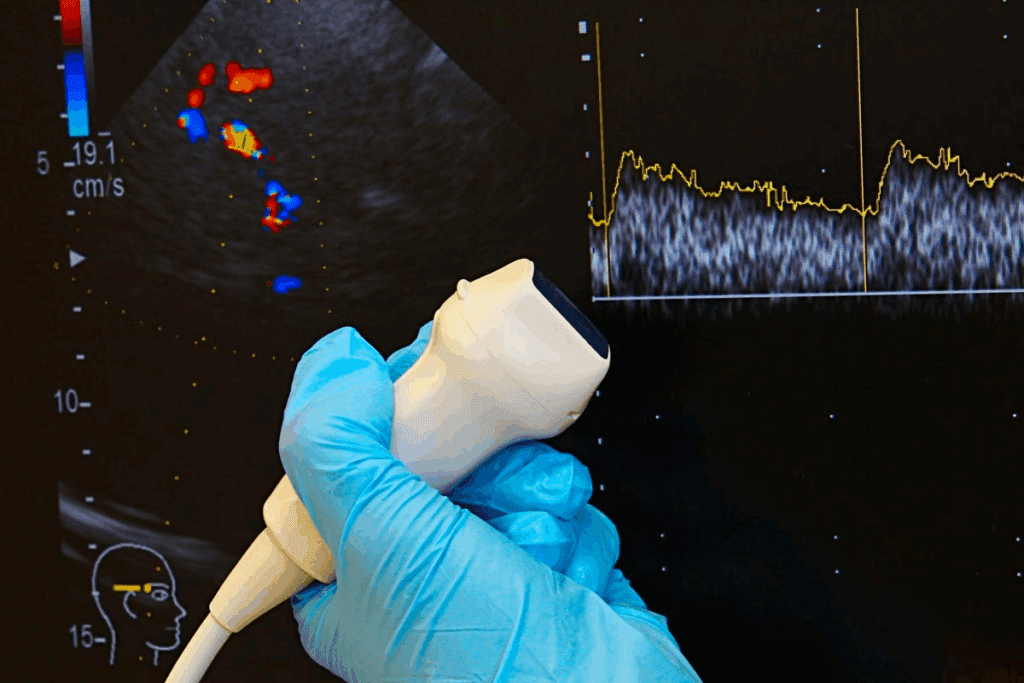
Diagnosing vascular disease needs a good look at Doppler waveforms. At Liv Hospital, we stick to the latest standards. This ensures our patients get top-notch vascular checks vascular doppler.
For over 30 years, vascular Doppler ultrasound has been key for checking blood flow. Knowing the difference between artery and vein waveforms is vital. It helps doctors diagnose and plan treatments accurately.
We make sure to interpret these waveforms correctly. This way, we can give our patients the best care possible.
Key Takeaways
- Understanding Doppler waveforms is critical for vascular disease diagnosis.
- Vascular Doppler ultrasound is a non-invasive assessment tool.
- Accurate interpretation of arterial and venous waveforms is essential.
- Liv Hospital follows internationally recognized protocols for vascular assessment.
- Effective treatment planning relies on precise Doppler waveform interpretation.
The Evolution and Importance of Vascular Doppler Ultrasound
Starting in the 1980s, vascular Doppler ultrasound has grown a lot. It has become a key tool for checking blood vessels without surgery.
Historical Development of Vascular Doppler Ultrasound
From the 1980s, vascular Doppler ultrasound has seen big changes. Improvements in transducer technology and signal processing have made images clearer and diagnoses more accurate. These changes help doctors better handle vascular problems.
The addition of color Doppler and power Doppler has made vascular Doppler ultrasound even better. These features help see blood flow and vessel details more clearly, leading to more accurate diagnoses.
Role in Non-Invasive Vascular Assessment
Vascular Doppler ultrasound is key for checking blood vessels without surgery. Its non-invasive nature means it’s safer than invasive tests.
This technology gives real-time information on blood flow and vessel health. This info is vital for spotting and tracking vascular diseases like peripheral artery disease and deep vein thrombosis.
Fundamentals of Vascular Doppler Waveform Analysis
Vascular Doppler waveform analysis is key in modern vascular diagnostics. It gives insights into blood flow. Knowing the basics of this analysis is vital for understanding vascular conditions.
Basic Principles of Doppler Effect in Vascular Studies
The Doppler effect changes the frequency of a wave when its source moves. In vascular studies, it helps assess blood flow. Ultrasound waves bounce off moving blood cells, changing frequency.
This change lets us calculate blood flow velocity and direction. The Doppler shift shows how fast blood is moving. The faster the blood, the bigger the shift. This info creates waveforms that show blood flow over time.
Standardized Nomenclature by Society for Vascular Medicine
In 2020, the Society for Vascular Medicine set standardized nomenclature for Doppler waveform analysis. This was to clear up long-standing confusion in terms. The goal is to make Doppler assessments more reliable and consistent.
| Term | Description | Clinical Significance |
|---|---|---|
| Triphasic Waveform | A waveform with three distinct phases: forward flow, reverse flow, and a second forward flow component. | Typically seen in normal peripheral arteries. |
| Biphasic Waveform | A waveform with two phases: forward flow and reverse flow. | May indicate some degree of stenosis or vascular disease. |
| Monophasic Waveform | A waveform with a single phase, indicating continuous forward flow. | Often associated with significant stenosis or occlusion downstream. |
Understanding these basics and using standard terms helps doctors better diagnose and manage vascular conditions.
Essential Equipment and Technical Considerations for Vascular Doppler
Vascular Doppler ultrasound is a key tool in healthcare. It needs careful setup for the best results. Knowing the technical details and what equipment is needed is vital.
Probe Selection and Frequency Settings
The right ultrasound probe and frequency settings are key for good vascular Doppler images. Linear array probes work well for looking at superficial structures. The frequency should match the vessel’s depth; higher for shallower, lower for deeper vessels.
| Vessel Depth | Recommended Frequency | Probe Type |
|---|---|---|
| Superficial | 7-12 MHz | Linear Array |
| Deep | 2-5 MHz | Curvilinear or Phased Array |
Angle of Insonation and Its Impact on Waveforms
The angle at which sound hits the vessel is very important. An angle of 60 degrees or less is best for accurate readings. A 90-degree angle can lead to wrong readings.
“The angle of insonation should be kept as low as possible, ideally less than 60 degrees, to ensure accurate velocity measurements.”
Optimizing Display Settings for Accurate Interpretation
Getting the display settings right is key for understanding vascular Doppler waveforms. The sweep speed should be set to show the waveform clearly. The sample volume size should match the vessel’s size. Also, the gain settings must be just right to avoid mistakes.
- Adjust sweep speed for clear waveform display
- Set sample volume size relative to vessel diameter
- Optimize gain settings to avoid artifacts
By focusing on these technical points and equipment needs, doctors can make vascular Doppler ultrasound more accurate and reliable.
Arterial Doppler Waveform Characteristics
Understanding arterial Doppler waveform characteristics is key for accurate vascular assessment. Arterial waveforms have important features like flow direction, phasicity, and resistance patterns.
Flow Direction: Antegrade vs Retrograde
The direction of blood flow is vital in arterial Doppler waveform analysis. Antegrade flow means blood flows away from the heart in arteries. On the other hand, retrograde flow is when blood flows backward, often showing a problem.
In severe stenosis or occlusion, you might see retrograde flow after the blockage. Knowing the flow direction helps spot vascular issues.
Phasicity Patterns: Triphasic, Biphasic, and Monophasic
Arterial Doppler waveforms show different phasicity patterns, each telling us about different vascular conditions. The main patterns are:
- Triphasic: This pattern has three phases – forward flow, a brief reverse flow, and another forward flow. It’s common in healthy, high-resistance arteries.
- Biphasic: It has two phases – forward flow followed by reverse flow. This might suggest some stenosis or vascular disease.
- Monophasic: This pattern has only one phase with continuous forward flow. Monophasic waveforms are seen in low-resistance arteries or significant stenosis.
Spotting these patterns is key for diagnosing and tracking vascular diseases.
Resistance Patterns and Their Significance
Resistance patterns in arterial Doppler waveforms tell us about the vascular bed they supply. High-resistance patterns are common in arteries to muscles at rest. Low-resistance patterns are seen in arteries to organs needing constant blood flow, like the internal carotid artery.
Changes in resistance patterns can signal underlying issues. For example, a drop in resistance in an artery to a muscle group might mean inflammation or vasodilation.
By studying these characteristics, healthcare professionals can understand vascular health better. This helps them make better decisions for patient care.
Normal Arterial Waveform Patterns
Knowing about normal arterial waveform patterns is key for good vascular diagnosis. These patterns tell us a lot about the health and function of the arteries.
Triphasic Arterial Flow Components
A normal arterial waveform usually has a triphasic pattern. This means it has three main parts:
- Rapid antegrade flow during systole: This is the first forward flow in the systolic phase of the heart cycle.
- Transient reversal during early diastole: After systole, there’s a quick flow reversal in early diastole.
- Slow antegrade flow during late diastole: Lastly, there’s a slow forward flow in late diastole.
This triphasic pattern is typical for high-resistance arterial systems, like those in the limbs when at rest.
Regional Variations in Normal Arterial Waveforms
Even though the triphasic pattern is common, there are differences based on the area being studied.
| Region | Typical Waveform Pattern | Characteristics |
|---|---|---|
| Upper Limb Arteries | Triphasic | High resistance, reflective of peripheral resistance |
| Lower Limb Arteries | Triphasic | Similar to upper limb, with high resistance |
| Cerebral Arteries | Low Resistance | Continuous forward flow, indicative of low resistance |
These differences show why it’s important to know the specific area being checked.
Venous Doppler Waveform Characteristics
Understanding venous Doppler waveforms is key in vascular ultrasound exams. These waveforms show unique traits that help us grasp venous circulation.
Spontaneous Flow and Velocity Patterns
Venous Doppler waveforms show spontaneous flow, which means blood flows naturally through veins. The speed of this flow is generally slower than in arteries. Spontaneous flow is a key indicator of venous patency.
Many factors affect venous flow, like breathing and heart activity. The speed of flow changes based on where in the venous system it is.
Respirophasic Nature of Venous Flow
Venous flow changes with breathing. When we inhale, less pressure in the chest increases blood flow. When we exhale, more pressure in the chest reduces blood flow.
Cardiac Influence on Venous Waveforms
The heart’s rhythm also affects venous waveforms. Changes in right atrial pressure during the heart cycle impact venous flow, mainly in veins close to the heart.
To better understand venous Doppler waveforms, let’s look at a table:
| Characteristics | Description | Clinical Significance |
|---|---|---|
| Spontaneous Flow | Natural, unprovoked flow of blood through veins | Indicator of venous patency |
| Respirophasic Variation | Changes in flow velocity with respiratory cycle | Reflects normal physiological response |
| Cardiac Influence | Impact of cardiac cycle on venous flow | More pronounced in central veins |
Knowing these traits is vital for correctly reading venous Doppler waveforms. It helps in making better clinical decisions.
Normal Venous Waveform Patterns
Understanding normal venous waveform patterns is key for accurate vascular diagnosis. Venous waveforms give us important info about the venous system’s health. Knowing how to interpret them is a vital skill in vascular ultrasound.
Direction of Flow Characteristics
Normal venous flow moves towards the heart. This flow is affected by breathing and heart cycles. The direction of flow is very important in analyzing venous waveforms. It helps us spot any venous blockages or blood clots.
Spontaneity Assessment
Venous flow is considered spontaneous if it happens naturally, without needing extra help. Spontaneity shows that the veins are working right. If there’s no spontaneity, it might mean there’s a blockage somewhere.
We check for spontaneity by looking at the waveform. We want to see continuous flow towards the heart.
Regional Variations in Venous Waveforms
Venous waveforms change a lot from one body part to another. For example, waveforms in the legs show more changes with breathing than those in the arms. It’s important to know these regional variations to understand venous Doppler studies well.
These differences come from things like local pressure, muscle activity, and venous valves. We need to think about these when we look at venous waveforms. This helps us avoid making mistakes in diagnosis.
Direct Comparison: Arterial vs Venous Doppler Interpretation
It’s key to tell arterial from venous Doppler waveforms for good care. Knowing the differences in Doppler signals is vital for doctors.
Key Differentiating Features at a Glance
Arterial and venous Doppler signals have clear differences. Here’s a quick look:
| Characteristics | Arterial Doppler | Venous Doppler |
|---|---|---|
| Flow Direction | Primarily antegrade | Direction varies, often towards the heart |
| Phasicity | Triphasic, biphasic, or monophasic | Spontaneous and respirophasic |
| Velocity | Higher velocity | Lower velocity |
| Response to Augmentation | Minimal change with distal compression | Increased flow with distal compression |
Common Misinterpretation Pitfalls
There are traps that can confuse doctors:
- Not knowing how the angle of insonation affects waveforms
- Not thinking about the patient’s history and situation
- Depend too much on automated readings without checking them
- Ignoring how things like probe pressure or patient position affect readings
Clinical Decision-Making Based on Waveform Patterns
Getting Doppler waveforms right is key for making decisions. For example, a triphasic waveform means normal flow. But a monophasic one might show big stenosis.
Knowing the differences and avoiding common mistakes helps doctors. This leads to better care and outcomes for patients.
Conclusion: Mastering Arterial and Venous Doppler Interpretation
Learning to interpret arterial and venous Doppler is key for accurate vascular checks. We’ve looked at how Doppler ultrasound has grown, showing its value in checking blood vessels without surgery. This has been true for over 30 years.
Knowing the basics of Doppler ultrasound is vital. It helps us understand the flow of blood in vessels. By recognizing the patterns in Doppler waveforms, we can see how well blood is flowing.
Understanding the differences in Doppler readings helps doctors make better choices. We stress the need for ongoing practice and learning. This is to improve care and results for patients.
FAQ
What is the significance of Doppler waveform analysis in vascular studies?
Doppler waveform analysis is key in vascular studies. It gives important info on blood flow. This helps in diagnosing and managing diseases of the arteries and veins.
How has vascular Doppler ultrasound evolved over time?
Vascular Doppler ultrasound has seen big changes. It started in the 1980s and now is a detailed, non-invasive tool for checking blood vessels.
What are the basic principles of the Doppler effect in vascular studies?
The Doppler effect is based on sound waves changing frequency when hitting moving objects. This lets us measure blood flow speed.
What is the importance of standardized nomenclature in vascular Doppler ultrasound?
Standardized nomenclature is vital. It ensures accurate and consistent interpretation of Doppler waveforms. This helps doctors communicate better.
How do technical parameters impact the accuracy of vascular Doppler ultrasound?
Technical parameters greatly affect Doppler ultrasound accuracy. Things like probe choice, frequency, angle, and display settings are critical. Getting these right is key for reliable results.
What are the characteristics of normal arterial Doppler waveforms?
Normal arterial Doppler waveforms show triphasic flow patterns. They vary by region. Factors like resistance and cardiac output also play a role.
How do venous Doppler waveforms differ from arterial waveforms?
Venous Doppler waveforms have spontaneous flow and are influenced by breathing and the heart. They are different from arterial waveforms, which are pulsatile and tied to heart output.
What are the common pitfalls in interpreting arterial and venous Doppler waveforms?
Common mistakes include misreading waveforms and ignoring technical limits. Not considering the patient’s situation can also lead to wrong diagnoses.
How do arterial and venous Doppler interpretation inform clinical decision-making?
Correctly reading Doppler waveforms helps doctors make better decisions. It gives insights into vascular disease, guides treatment, and tracks disease changes.
What is the role of vascular Doppler ultrasound in non-invasive vascular assessment?
Vascular Doppler ultrasound is essential for non-invasive checks. It helps doctors diagnose and manage vascular diseases without surgery.
What is the importance of mastering arterial and venous Doppler interpretation?
Understanding Doppler waveforms is critical for doctors. It helps them accurately diagnose and manage vascular diseases. This improves patient care and outcomes.
References
Government Health Resource. Arterial vs. Venous Doppler Waveform Interpretation for Vascular Diagnosis. Retrieved from https://www.portailvasculaire.fr/sites/default/files/docs/interpretation_of_peripheral_arterial_and_venous_doppler_waveforms-_a_consensus_statement_vm2020.pdf



 Departments
 Related Videos
 Our Doctors
 News
News