
The hypoglossal nerve, also known as the 12th cranial nerve or CN XII, is key for tongue movements. It helps us speak, swallow, and form food in our mouths. Discover what cranial nerve innervates the tongue. This guide explains the key motor (CN XII) and sensory nerves for taste and sensation.
This nerve controls almost all tongue muscles. Damage to it can cause the tongue to deviate. This makes checking the nerve very important for doctors.
At Liv Hospital, we focus on accurate checks and diagnoses. We care for each patient with nerve issues deeply.
Key Takeaways
- The hypoglossal nerve (CN XII) controls tongue movements.
- It is responsible for motor innervation of tongue muscles.
- Damage to the hypoglossal nerve can cause tongue deviation.
- Neurological examination is critical for diagnosis.
- Liv Hospital offers patient-centered care for nerve-related disorders.
The Hypoglossal Nerve: An Overview

The hypoglossal nerve is key for tongue movements. It helps with speech and swallowing. Let’s explore what it does and its history.
Definition and Basic Function
The hypoglossal nerve, or CN XII, is a motor nerve. It controls the tongue’s muscles. This lets us move our tongue for speech and eating.
This nerve lets us control our tongue’s movements. It’s vital for talking and swallowing safely.
Historical Context and Naming
The name “hypoglossal” comes from Greek words. “Hypo” means “under” and “glossa” means “tongue.” It shows where the nerve is located.
For centuries, scientists have studied this nerve. It helps us understand how our nervous system works.
Characteristics | Description | Significance |
Nerve Type | Purely somatic motor | Controls tongue movements |
Primary Function | Innervates tongue musculature | Facilitates speech and swallowing |
Nomenclature Origin | Derived from Greek words “hypo” and “glossa” | Reflects anatomical location under the tongue |
Anatomy of the Hypoglossal Nerve
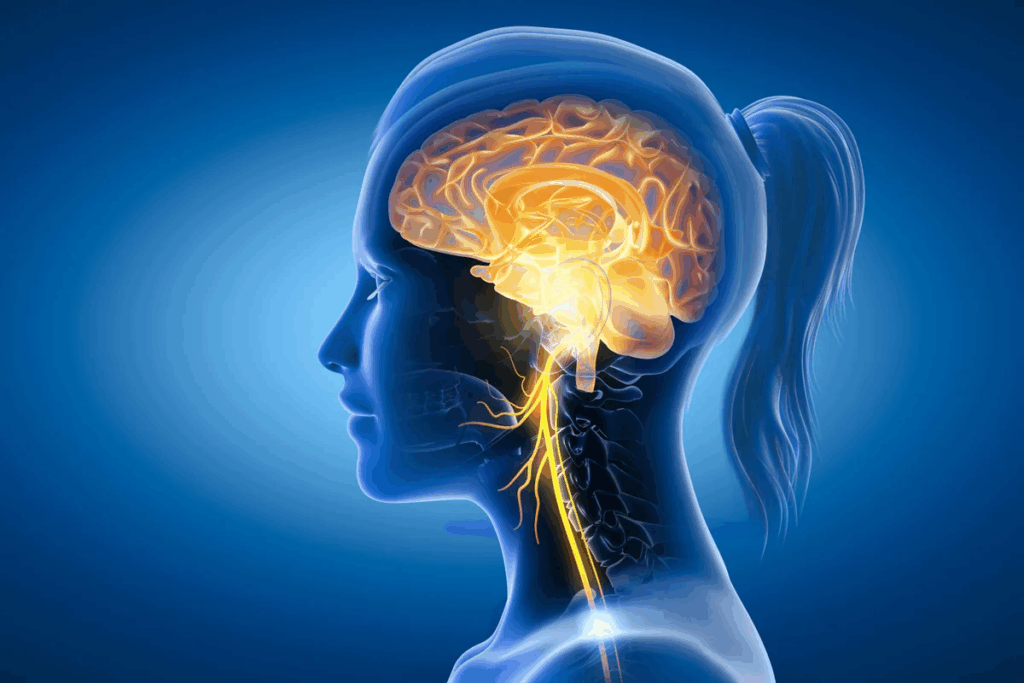
Knowing how the hypoglossal nerve works is key to understanding its role in tongue movements. This nerve, also known as CN XII or the 12th cranial nerve, has a detailed path. It allows the tongue to move in various ways.
Origin in the Hypoglossal Nucleus
The hypoglossal nerve starts in the hypoglossal nucleus. This is in the medulla oblongata, a part of the brainstem. The nucleus is a group of neurons that control the tongue’s motor functions.
Course Through the Hypoglossal Canal
After starting, the nerve fibers go through the hypoglossal canal. This canal is in the occipital bone. It lets the nerve move from the skull to the neck, where it can reach the tongue muscles.
Branching Pattern and Distribution
The hypoglossal nerve splits into smaller nerves that go to different tongue muscles. Its branching is important for controlling tongue movements. This includes sticking the tongue out, pulling it back, and changing its shape.
Branch | Distribution | Function |
Main Trunk | Innervates genioglossus, hyoglossus, and styloglossus muscles | Controls major tongue movements |
Terminal Branches | Distribute to intrinsic tongue muscles | Regulates fine tongue movements and shape changes |
The detailed structure of the hypoglossal nerve shows its vital role in our mouth. It’s key for talking and swallowing. Knowing about this anatomy helps in diagnosing and treating nerve problems.
Neurological Classification of the Hypoglossal Nerve
It’s important to know how the hypoglossal nerve works. This nerve, or CN XII, helps control the tongue’s movements. It’s a key part of our ability to speak and eat.
Pure Motor Nerve Characteristics
The hypoglossal nerve is a pure motor nerve. This means it only carries motor signals. It’s different from other nerves that have both motor and sensory parts. Its job is to control the tongue’s movements, which are vital for speaking and eating.
Neurologists say the hypoglossal nerve is a special nerve. It shows how complex and detailed our nervous system is.
This highlights why knowing about the nerve’s role is so important in medical practice.
General Somatic Efferent Classification
The hypoglossal nerve is also a general somatic efferent (GSE) nerve. This means it sends motor signals to the tongue’s muscles. This classification is key because it shows the nerve’s role in controlling voluntary muscles. These muscles are important for actions like speaking and swallowing.
Absence of Sensory and Autonomic Components
The hypoglossal nerve doesn’t have sensory or autonomic parts. This is different from other nerves that do. It only deals with motor signals. This means it doesn’t send information from the tongue to the brain. It also doesn’t control involuntary actions like some other nerves do.
The hypoglossal nerve is fascinating to study in neurology. By understanding its role, we can learn more about our nervous system. We can see how each nerve has a special job.
What Cranial Nerve Innervates the Tongue: The Role of CN XII
Understanding CN XII’s function is key to knowing how tongue movements are controlled. The hypoglossal nerve, or CN XII, mainly controls the tongue muscles. This lets us make precise movements for speech, swallowing, and other oral tasks.
Complete Motor Innervation Pattern
CN XII gives full motor control to the tongue. It works all intrinsic and most extrinsic tongue muscles. This lets us make a wide range of tongue movements, from small speech changes to big swallowing actions.
The intrinsic muscles of the tongue, like the longitudinal, transverse, and vertical muscles, get their nerve supply from CN XII. These muscles help change the tongue’s shape, which is important for speech.
Distinction from Other Tongue-Related Cranial Nerves
It’s important to know the difference between CN XII and other tongue nerves, like CN IX. CN IX sends sensory info from the tongue, like taste. But CN XII is a motor nerve, focused on tongue movement.
The palatoglossus muscle is a special case. It’s controlled by the vagus nerve (CN X), not CN XII. This shows how different nerves work together to control the tongue’s functions.
Intrinsic and Extrinsic Tongue Muscles
The hypoglossal nerve controls the tongue’s movements. It does this by working with intrinsic and extrinsic tongue muscles. Knowing how these muscles work helps us see the hypoglossal nerve’s role in our mouth and throat.
Intrinsic Muscles and Their Functions
The intrinsic muscles of the tongue are longitudinal, transverse, and vertical. They change the tongue’s shape. The hypoglossal nerve (CN XII) controls these muscles.
These muscles help the tongue move in many ways. They change the tongue’s shape for speaking and eating. They also adjust the tongue’s tension for swallowing.
The intrinsic muscles work with the extrinsic muscles for complex tongue movements. They are key for clear speech and eating food well.
Extrinsic Muscles: Genioglossus, Hyoglossus, and Styloglossus
The extrinsic tongue muscles are the genioglossus, hyoglossus, and styloglossus. They help the tongue move forward, backward, and sideways. The hypoglossal nerve (CN XII) controls them, except for the palatoglossus.
The genioglossus muscle moves the tongue forward. The hyoglossus and styloglossus control backward and sideways movements. Together, they help with speech, swallowing, and eating.
The Exception: Palatoglossus and Vagus Nerve Innervation
The palatoglossus muscle is different. It’s controlled by the vagus nerve (CN X) through the pharyngeal plexus. This muscle helps lift the tongue and form the palatoglossal arch.
The palatoglossus’s unique nerve connection shows its special role. It’s important to know this for a full understanding of tongue anatomy and function.
Embryological Development of the Hypoglossal Nerve
Learning about the hypoglossal nerve’s growth helps us understand its role. This nerve, the 12th cranial nerve, is key for tongue movement.
Origin from Occipital Somites
The hypoglossal nerve starts from the fusion of ventral root fibers of occipital nerves. These nerves come from the occipital somites at the skull’s base. The occipital somites form the tongue’s muscles, and the hypoglossal nerve controls these muscles.
As the embryo grows, the occipital somites move down and merge. This creates the tongue’s muscles. The hypoglossal nerve fibers then connect to these muscles, enabling tongue movement.
Developmental Timeline
The hypoglossal nerve starts forming around the fourth week of gestation. By the sixth week, it begins to control the tongue’s muscles.
The growth of the hypoglossal nerve is tied to the tongue and surrounding areas. Issues during this time can cause birth defects affecting the nerve’s function.
Congenital Abnormalities
Birth defects of the hypoglossal nerve can cause tongue weakness or paralysis. This makes speech and swallowing hard.
Knowing how the hypoglossal nerve develops is key for diagnosing and treating birth defects. This knowledge helps healthcare providers give better care and improve patient outcomes.
Functional Significance of the Hypoglossal Nerve
The hypoglossal nerve plays a key role in tongue movements. It is vital for clear speech and safe swallowing. Its main function is to control the tongue’s actions.
Role in Speech Articulation
The hypoglossal nerve helps the tongue move precisely. This is key for making words and sounds clear. Clear speech is important for communication.
Contribution to Swallowing Mechanics
When we swallow, the hypoglossal nerve helps the tongue move in sync. This ensures food and liquids go down safely. It prevents choking and helps us swallow well.
Importance in Bolus Formation and Manipulation
The nerve helps shape food into a bolus for swallowing. This is important for chewing and swallowing food properly.
Function | Description | Importance |
Speech Articulation | Precise tongue movements for clear speech | Essential for effective communication |
Swallowing Mechanics | Coordinated tongue movement during swallowing | Critical for safe and efficient swallowing |
Bolus Formation | Manipulation of food into a bolus | Vital for effective mastication and swallowing |
The hypoglossal nerve is vital for tongue movement. It’s important for speech, swallowing, and food manipulation. Its role highlights its importance in health and communication.
Clinical Assessment of Hypoglossal Nerve Function
The hypoglossal nerve controls tongue movements, making its check-up key in medical practice. We use several tests to see if this nerve works right.
Tongue Protrusion Test
The tongue protrusion test is a basic way to check the hypoglossal nerve. We ask the patient to stick out their tongue. A healthy tongue sticks out straight. If it goes to one side, it might mean the nerve is damaged.
This test shows if the nerve works well. A tongue that goes off to the side could mean a stroke or nerve damage.
Assessment of Tongue Strength and Mobility
We also check how strong and flexible the tongue is. We see how well the patient can move their tongue and how strong it is when pushed. If the tongue is weak or stiff, it could mean nerve problems.
To measure tongue strength, we use a special device. It shows how hard the tongue presses against the roof of the mouth. This gives us a clear picture of tongue strength.
Interpretation of Clinical Findings
Understanding these tests takes knowing a lot about the hypoglossal nerve. A detailed check can spot small issues that are hard to see at first.
Clinical Finding | Possible Interpretation |
Tongue deviation upon protrusion | Unilateral hypoglossal nerve lesion or palsy |
Reduced tongue strength | Bilateral hypoglossal nerve dysfunction or muscle disease |
Limited tongue mobility | Hypoglossal nerve dysfunction or mechanical restriction |
Knowing what these findings mean is key to diagnosing and treating hypoglossal nerve issues. By looking at the tongue protrusion test, tongue strength, and other tests, we get a full picture of the nerve’s health. This helps us find the best way to help.
Hypoglossal Nerve Disorders and Damage
It’s important to know what causes hypoglossal nerve damage. This nerve controls tongue movements. Damage can really change someone’s life.
Causes of Hypoglossal Nerve Injury
Many things can hurt the hypoglossal nerve. Head or neck injuries can damage it directly. Infections like meningitis or Lyme disease can also harm it.
Stroke, multiple sclerosis, and ALS can damage the nerve too. These conditions can weaken or paralyze the tongue.
Cause | Description | Potential Outcome |
Trauma | Head or neck injury | Tongue weakness or paralysis |
Infection | Meningitis, Lyme disease | Nerve inflammation, damage |
Neurological Disorders | Stroke, multiple sclerosis, ALS | Progressive nerve damage |
Tongue Deviation: Mechanism and Clinical Significance
Tongue deviation means the tongue goes to one side when sticking out. This shows the nerve is damaged. The tongue moves because of weak muscles on one side.
Impact on Speech, Swallowing, and Quality of Life
Hypoglossal nerve damage can mess up speech and swallowing. It can make eating and talking hard. This can also make it hard to join in social activities.
Healthcare workers need to know about these nerve problems. We can help people by understanding and treating these issues. This way, we can improve their lives.
Diagnostic Approaches for Hypoglossal Nerve Pathologies
Diagnosing hypoglossal nerve pathologies needs a detailed approach. This includes different diagnostic methods. The hypoglossal nerve, being a pure motor nerve, makes diagnosis tricky. Knowing the available diagnostic methods is key to correctly identifying and treating hypoglossal nerve disorders.
Advanced Imaging Techniques
Advanced imaging is key in diagnosing hypoglossal nerve issues. Magnetic Resonance Imaging (MRI) is great for seeing the nerve and nearby areas. MRI can spot masses or tumors that might harm the nerve. It also shows signs of nerve damage or fatty changes.
Electromyography and Nerve Conduction Studies
Electromyography (EMG) and nerve conduction studies (NCS) are vital for checking the hypoglossal nerve’s function. EMG looks at the tongue muscles’ electrical activity. NCS checks how well the nerve conducts signals. These tests help find nerve damage and figure out the cause of tongue weakness.
Differential Diagnosis of Tongue Weakness
Tongue weakness can come from many sources, making it important to find the right cause. Doctors must look at many conditions, like hypoglossal nerve palsy and neuromuscular disorders. A detailed check-up, along with imaging and tests, helps find the exact cause. Knowing the signs of hypoglossal nerve problems is essential for a correct diagnosis.
Treatment and Management of Hypoglossal Nerve Disorders
Managing hypoglossal nerve disorders needs a detailed plan. This plan includes different treatments. The right treatment depends on the cause, how bad it is, and how long it lasts.
Conservative Management Approaches
First, doctors often try conservative management. This might include:
- Watching to see if it gets better on its own
- Speech therapy to help with speaking
- Swallowing therapy to avoid choking
- Physical therapy to keep the tongue moving well
A top neurologist says, “Starting with conservative management early can really help patients with hypoglossal nerve injuries.”
“The key to successful management lies in a multidisciplinary approach, combining the expertise of neurologists, speech therapists, and rehabilitation specialists.”
– Medical Expert, Neurologist
Surgical Interventions and Nerve Repair
If conservative methods don’t work, surgery might be needed. This could include:
- Nerve repair or grafting to fix the nerve
- Decompression surgery to take pressure off the nerve
- Tongue suspension or other surgeries to help tongue movement
Surgical Procedure | Indications | Potential Outcomes |
Nerve Repair/Grafting | Severe nerve damage or transection | Restoration of nerve function, improved tongue mobility |
Decompression Surgery | Nerve compression due to tumors, cysts, or other masses | Relief of pressure, possible nerve function recovery |
Speech and Swallowing Rehabilitation
Rehabilitation is key in managing hypoglossal nerve disorders. Speech-language pathologists help patients by:
- Improving speech clarity
- Making swallowing safer and more efficient
- Teaching ways to communicate and eat better
Emerging Therapies and Hypoglossal Nerve Stimulation
New research on therapies like hypoglossal nerve stimulation is exciting. These new methods aim to:
- Help nerves heal and recover
- Improve tongue function and movement
- Lessen symptoms and enhance life quality
As research grows, we’ll see better treatments for hypoglossal nerve disorders. This brings hope to those affected.
Conclusion
The hypoglossal nerve, also known as CN XII or the 12th cranial nerve, is key for tongue movements. It helps with speech, swallowing, and moving food in the mouth. This is because it controls the tongue muscles.
Knowing about the hypoglossal nerve is important for diagnosing and treating nerve disorders. Its role affects our oral health and overall well-being.
In short, the hypoglossal nerve is vital for our nervous system. Its problems can cause big issues. Healthcare workers can better help patients by understanding CN XII’s role.
FAQ
What is the hypoglossal nerve responsible for?
The hypoglossal nerve, or CN XII, controls most of the tongue muscles. It helps with speech, swallowing, and forming food boluses.
What is the origin of the name “hypoglossal nerve”?
The name “hypoglossal nerve” comes from its location. “Hypo” means “under” and “glossal” means “of the tongue”.
Is the hypoglossal nerve sensory or motor?
The hypoglossal nerve is a pure motor nerve. It has no sensory parts and controls tongue muscle movements.
What is the role of CN XII in controlling tongue movements?
CN XII fully innervates the tongue muscles. This allows for precise tongue movements needed for speech, swallowing, and forming food boluses.
What is the difference between the hypoglossal nerve and the glossopharyngeal nerve?
The hypoglossal nerve controls tongue movements. The glossopharyngeal nerve has sensory and motor functions. It innervates the tongue and pharynx and the stylopharyngeus muscle.
What are the muscles innervated by the hypoglossal nerve?
The hypoglossal nerve controls the intrinsic and extrinsic tongue muscles. This includes the genioglossus, hyoglossus, and styloglossus. But not the palatoglossus, which is controlled by the vagus nerve.
What is tongue deviation, and how is it related to the hypoglossal nerve?
Tongue deviation means the tongue goes to one side when pushed out. This shows damage to the hypoglossal nerve on that side.
How is hypoglossal nerve function assessed clinically?
Clinicians use the tongue protrusion test to check the hypoglossal nerve. They also look at tongue strength and mobility.
What are the causes of hypoglossal nerve damage?
Damage to the hypoglossal nerve can come from trauma, tumors, or neurological disorders.
What are the treatment options for hypoglossal nerve disorders?
Treatments include conservative management, surgery, and rehabilitation. New therapies like hypoglossal nerve stimulation are also being explored.
What is hypoglossal nerve stimulation?
Hypoglossal nerve stimulation is a new therapy. It uses electrical stimulation to move the tongue. This helps with obstructive sleep apnea by keeping the airway open.
References
National Center for Biotechnology Information. Evidence-Based Medical Guidance. Retrieved from https://www.ncbi.nlm.nih.gov/books/NBK388/