The facial nerve, or the seventh cranial nerve (CN VII), is key for facial expressions, taste, and parasympathetic functions. Knowing the exit point of the facial nerve is vital in head and neck anatomy.where does the facial nerve exit the skullHow Does a Bone Graft Work and What Does Cadaver Bone Mean?
The facial nerve leaves the skull through the stylomastoid foramen. This spot is between the styloid and mastoid processes of the temporal bone. It’s a big change from being inside the skull to being outside on the face.
Knowing where the facial nerve exits is important for diagnosing and treating nerve disorders. We’ll look into the facial nerve’s path and its importance in medicine.
Key Takeaways
- The facial nerve exits the skull through the stylomastoid foramen.
- This anatomical landmark is located between the styloid and mastoid processes.
- Understanding the facial nerve’s exit is vital for clinical diagnosis and treatment.
- The facial nerve controls facial expressions, taste, and parasympathetic functions.
- Knowledge of the facial nerve’s path is essential for managing related disorders.
Anatomy of the Facial Nerve

Knowing the facial nerve’s anatomy is key for diagnosing and treating disorders. The facial nerve, or cranial nerve VII, controls facial expressions and more. It’s a complex structure.
Origin and Nuclei
The facial nerve starts in the pons, a brainstem part. It has motor and sensory parts. The motor nucleus in the pons controls facial muscles. The sensory part handles taste from the tongue’s front two-thirds.
The nerve has several nuclei. These include the motor nucleus, sensory nucleus, and parasympathetic nuclei. These are vital for its functions.
Functional Components
The facial nerve has motor, sensory, and parasympathetic parts. Its motor functions include controlling facial muscles and the stapedius muscle in the ear. The sensory part sends taste info from the tongue’s front.
The parasympathetic fibers help with tear and saliva production. They supply the lacrimal gland and salivary glands.
Functional Component | Description | Target |
Motor | Innervates muscles of facial expression and stapedius muscle | Muscles of facial expression, stapedius muscle |
Sensory | Transmits taste information | Anterior two-thirds of the tongue |
Parasympathetic | Supplies glands for tear production and salivation | Lacrimal gland, submandibular and sublingual salivary glands |
Embryological Development of the Facial Nerve
The facial nerve’s growth is closely tied to the development of the second branchial arch. This is key to grasping the nerve’s complex structure and possible birth defects.
Formation During Fetal Development
The second branchial arch, or hyoid arch, is where the facial nerve’s journey starts. It’s around the fourth week of pregnancy. The process unfolds over the following weeks.
The facial nerve forms from cells called neural crest cells. These cells move to the second branchial arch. There, they grow into the nerve’s motor and sensory parts.
Developmental Milestones
There are important steps in the facial nerve’s growth:
- The facial nerve starts to form around the fourth week of pregnancy.
- By the sixth week, it begins its path through the temporal bone.
- By the 12th week, it has its main branches.
Common Congenital Anomalies
Birth defects of the facial nerve can happen if development is disrupted. Some common issues include:
Anomaly | Description |
Facial nerve agenesis | A rare condition where the facial nerve is missing or very underdeveloped. |
Abnormal branching patterns | The facial nerve’s branches can vary, which might affect its function. |
Knowing about these developmental stages is vital for diagnosing and treating facial nerve issues. The facial nerve’s complex development highlights the need for detailed anatomical knowledge in medical practice.
Intracranial Course of the Facial Nerve
The facial nerve’s journey starts in the brainstem, between the pons and medulla. This marks the beginning of its complex path.
Brainstem to Internal Acoustic Meatus
The facial nerve moves from the brainstem to the cerebellopontine angle. This area is key for many brain functions. It then goes into the internal acoustic meatus, a canal in the temporal bone, with the vestibulocochlear nerve.
Relationship with Vestibulocochlear Nerve
In the internal acoustic meatus, the facial nerve is close to the vestibulocochlear nerve. This closeness is important because problems in this area can affect both nerves.
The vestibulocochlear nerve handles hearing and balance. The facial nerve controls facial expressions and more. They must navigate this tight space together, showing the complexity of cranial nerve anatomy.
Cerebellopontine Angle Anatomy
The cerebellopontine angle is where the facial and vestibulocochlear nerves are found. It’s surrounded by the cerebellum, pons, and petrous temporal bone. Tumors or lesions here can harm the facial nerve, causing symptoms.
Knowing the cerebellopontine angle’s anatomy is key for diagnosing and treating facial nerve issues and nearby problems.
The Facial Canal: A Protective Pathway
The facial canal is a key part of the temporal bone. It protects the facial nerve as it moves through the bone. This path keeps the nerve safe in a complex area.
Anatomy of the Facial Canal
The facial canal has three main parts: the labyrinthine, tympanic, and mastoid segments. Each part has special features that help us understand the nerve’s journey.
Labyrinthine Segment
The labyrinthine segment is the narrowest part of the facial canal. It’s near the geniculate ganglion. Because of its small size, it’s easily compressed.
Key Features of the Labyrinthine Segment:
- Narrowest part of the facial canal
- Located near the geniculate ganglion
- Susceptible to compression
Tympanic Segment
The tympanic segment is between the geniculate ganglion and the pyramidal eminence. It’s close to the middle ear.
The tympanic segment is close to the middle ear. This makes it more likely to be affected by ear problems.
Mastoid Segment
The mastoid segment is the longest part of the facial canal. It goes from the pyramidal eminence to the stylomastoid foramen. This segment is less likely to be compressed than the labyrinthine segment.
Characteristics of the Mastoid Segment:
- Longest segment of the facial canal
- Extends to the stylomastoid foramen
- Less susceptible to compression
Understanding the facial canal’s anatomy is key for diagnosing and treating facial nerve issues.
Where Does the Facial Nerve Exit the Skull?
Knowing where the facial nerve exits the skull is key for surgeries and tests. This exit is a major landmark in medicine. It affects how doctors and surgeons work.
The Stylomastoid Foramen
The facial nerve leaves the skull at the stylomastoid foramen. This small opening is between the styloid and mastoid parts of the temporal bone. It’s a vital spot for the nerve to move from inside to outside the skull.
Surrounding Bony Landmarks
The stylomastoid foramen is near important bones. The styloid process is thin, and the mastoid process is big. These bones help find the foramen’s location.
Surgical and Clinical Significance
The facial nerve’s exit is very important for surgeries and tests. Knowing this area well is essential for facial nerve surgeries. It also helps in diagnosing nerve problems.
Anatomical Structure | Clinical Significance |
Stylomastoid Foramen | Exit point of the facial nerve from the skull |
Styloid Process | Landmark for identifying the stylomastoid foramen |
Mastoid Process | Major landmark for surgical procedures in the region |
Knowing the facial nerve’s exit and the surrounding bones is critical. It’s essential for good medical care and surgery.
Branches of the Facial Nerve Inside the Temporal Bone
The facial nerve goes through the temporal bone and splits into important branches. Inside the facial canal, it has three main branches. These are the greater petrosal nerve, the nerve to stapedius, and the chorda tympani.
Greater Petrosal Nerve
The greater petrosal nerve is the first branch in the temporal bone. It comes from the geniculate ganglion. It carries parasympathetic fibers for the lacrimal gland and mucous membranes in the nose and mouth.
This nerve is key for tear production and nasal secretion. Damage can cause less tear production and other problems.
Nerve to Stapedius
The nerve to stapedius is another branch in the temporal bone. It controls the stapedius muscle in the middle ear.
This muscle helps protect the ear from loud sounds. If the nerve is damaged, it can cause a condition where sounds are too loud.
Chorda Tympani
The chorda tympani carries taste fibers from the tongue’s front parts. It also has parasympathetic fibers for the submandibular and sublingual glands.
This nerve is important for taste and saliva control. Damage can lead to bad taste and less saliva.
Branch | Function | Clinical Significance |
Greater Petrosal Nerve | Parasympathetic innervation of lacrimal gland and mucous membranes | Decreased tear production, autonomic dysfunction |
Nerve to Stapedius | Innervation of stapedius muscle for sound regulation | Hyperacusis, increased sensitivity to sound |
Chorda Tympani | Taste sensation from anterior two-thirds of tongue, parasympathetic innervation of salivary glands | Impaired taste, decreased salivation |
In conclusion, the facial nerve’s branches in the temporal bone are vital. They help with autonomic functions, sound control, and taste. Knowing about these branches is key for diagnosing and treating facial nerve problems.
Immediate Extracranial Branches
When the facial nerve leaves the skull, it quickly splits into several branches. These branches are key for making facial expressions and controlling functions. They help control muscles in the face and neck.
Posterior Auricular Branch
The posterior auricular branch is one of the first to split off from the facial nerve. It controls the posterior auricular muscle and the occipital belly of the occipitofrontalis muscle. This branch helps move the ear and scalp.
Digastric Branch
The digastric branch goes to the posterior belly of the digastric muscle. This muscle helps lift the hyoid bone and is important for swallowing. It splits off soon after the facial nerve leaves the skull.
Stylohyoid Branch
The stylohyoid branch supplies the stylohyoid muscle. This muscle helps pull and lift the hyoid bone during swallowing. It comes off close to the stylomastoid foramen and is key for swallowing movements.
Relationship to the Parotid Gland
After these branches, the facial nerve goes into the parotid gland. Inside the gland, it divides into its final branches. The parotid gland is a key spot for the facial nerve, as it splits further to reach facial muscles.
Branch | Function | Muscle Innervated |
Posterior Auricular | Controls ear and scalp movement | Posterior auricular muscle, Occipital belly of occipitofrontalis |
Digastric | Elevates hyoid bone during swallowing | Posterior belly of digastric muscle |
Stylohyoid | Retracts and elevates hyoid bone | Stylohyoid muscle |
Knowing about the facial nerve’s extracranial branches is vital for diagnosing and treating facial issues. The facial nerve’s complex anatomy shows how detailed facial expressions are controlled.
“The facial nerve is a complex structure with multiple functions, including controlling facial expressions, transmitting taste sensations, and providing motor control to certain muscles. Its extracranial branches are vital for the innervation of facial muscles.”
— Facial Nerve Anatomy and Clinical Significance
Terminal Branches of the Facial Nerve
The facial nerve splits into five main branches inside the parotid gland. These branches are key for controlling facial muscles. This lets us make many different facial expressions.
Temporal Branch
The temporal branch is one of the facial nerve’s main branches. It helps the muscles in the forehead and temple area. The frontalis muscle, for example, lifts our eyebrows.
Zygomatic Branch
The zygomatic branch controls the orbicularis oculi muscle around the eye. This muscle is vital for closing our eyelids and showing emotions around the eyes.
Buccal Branch
The buccal branch supplies the cheek muscles, like the buccinator and orbicularis oris. These muscles help us smile and pucker our lips.
Marginal Mandibular Branch
The marginal mandibular branch works the muscles of the lower lip and chin. It controls the depressor anguli oris and depressor labii inferioris. These muscles help lower the lower lip and mouth corner.
The facial nerve’s branches work together to create a wide range of facial expressions. From small movements to big gestures, they are essential. Knowing how these branches work is key for diagnosing and treating facial nerve issues.
Key Points:
- The facial nerve divides into five terminal branches within the parotid gland.
- These branches innervate the muscles of facial expression.
- Each branch has a specific function and area of innervation.
Functional Significance and Innervation Patterns
The facial nerve is key for facial expressions, taste, and gland regulation. Its complex innervation shows its role in facial movements, taste, and gland secretions.
Motor Functions and Facial Expression
The facial nerve controls facial expressions, vital for communication. It works the muscles of the face, like around the eyes and mouth. This lets us show emotions through our face.
Different parts of the facial nerve can be affected by diseases. Knowing this helps doctors diagnose and treat nerve problems.
Sensory Functions
The facial nerve also transmits taste from the tongue’s front parts. The chorda tympani branch is key for this. It helps us taste food.
- Taste sensation from the anterior two-thirds of the tongue
- Sensory fibers that contribute to the perception of taste
Autonomic Functions
The facial nerve also controls glands. It helps the salivary and tear glands work right. This is important for our saliva and tears.
Clinical Correlations
Knowing the facial nerve’s role is key for doctors. Problems with the nerve can cause facial weakness or taste issues. Doctors need to understand the nerve’s functions to treat these problems well.
Comparative Anatomy of the Facial Nerve Exit
The facial nerve’s exit varies among species, showing unique adaptations. This nerve controls facial expressions, taste, and some muscle movements. Its exit from the skull changes due to evolution and environment.
Variations Across Species
The facial nerve’s exit is not the same in all animals. In humans and some mammals, it goes through the stylomastoid foramen. But, other species have different exits because of their skull shapes and evolutionary changes.
Species | Facial Nerve Exit | Anatomical Adaptation |
Humans | Stylomastoid foramen | Complex facial expressions |
Rodents | Modified stylomastoid foramen | Enhanced vibrissal control |
Primates | Stylomastoid foramen | Advanced facial musculature |
Evolutionary Significance
The facial nerve exit changes across species have big evolutionary meanings. These changes help different species adapt to their environments and needs. It shows how species have evolved to fit their ecological niches.
Anatomical Adaptations
Species have unique anatomical features related to their facial nerve exits. These are influenced by their diets, environments, and predators. For instance, some may have stronger facial muscles, needing a different nerve exit for better control.
Studying these adaptations helps us understand the evolutionary history and abilities of various species. It shows how anatomy, environment, and behavior are connected.
Clinical Assessment and Diagnostic Approaches
Diagnosing the facial nerve involves many steps. We use different methods to check its function and find any problems.
Physical Examination Techniques
First, we do a physical check. We look at how well the face moves and if it’s balanced. We also see if the patient can smile, frown, and shut their eyes tightly.
House-Brackmann and Other Grading Systems
Grading systems, like the House-Brackmann scale, measure nerve damage. They look at how well the face moves and if it’s even. Other systems might be used too, based on the case.
Electrophysiological Testing
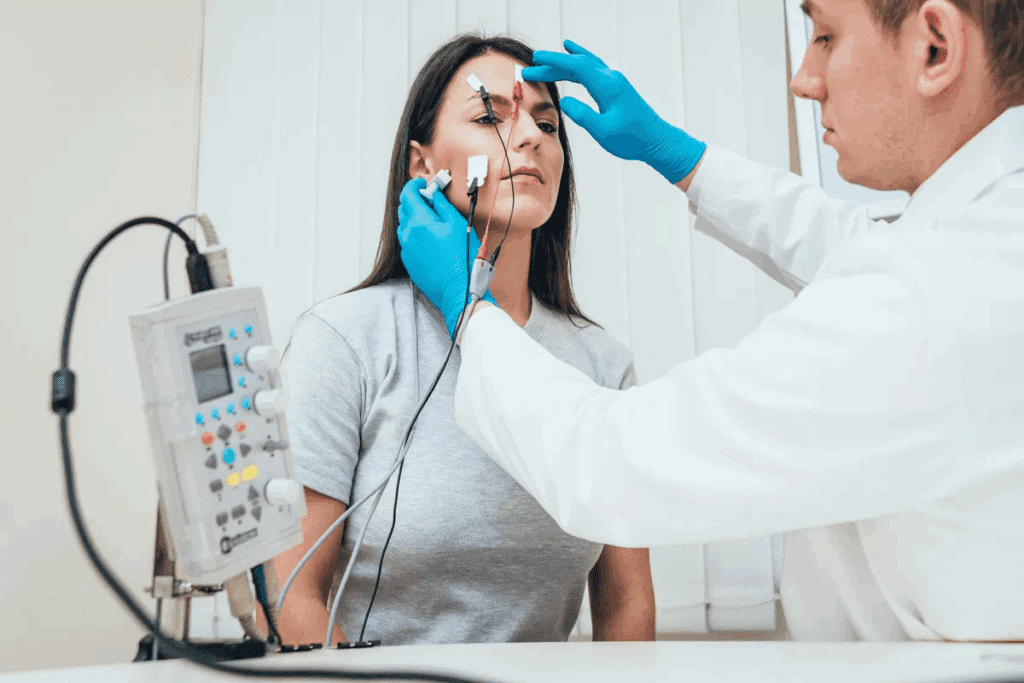
Tests like electromyography (EMG) and electroneuronography (ENoG) check the nerve’s health. They show how much damage there is and help decide treatment.
Imaging Modalities
Imaging like MRI and CT scans show the nerve and nearby areas. They help find any issues that might be causing problems.
By using all these methods, we can fully check the facial nerve. Then, we can make good plans to help patients with nerve issues.
Conclusion
Knowing how the facial nerve leaves the skull is key for doctors and surgeons. It goes out through the stylomastoid foramen, a major landmark.
We’ve looked at the nerve’s complex path, its branches, and what it does. It helps us smile and frown. It also helps with taste and controlling glands.
A detailed look at the facial nerve shows its big role in medicine. Knowing its anatomy and functions is essential for treating nerve problems.
In short, understanding the facial nerve’s anatomy is critical. This knowledge helps doctors and surgeons treat nerve issues better. It ensures patients get the best care possible.
FAQ
Where does the facial nerve exit the skull?
The facial nerve leaves the skull through the stylomastoid foramen. This is a key spot between the styloid and mastoid processes of the temporal bone.
What are the main functions of the facial nerve?
The facial nerve controls facial muscles, handles taste, and manages gland functions. It’s very important for our face and body.
What is the course of the facial nerve within the temporal bone?
Inside the temporal bone, the facial nerve goes through the internal acoustic meatus. It’s near the vestibulocochlear nerve. Then, it passes through the cerebellopontine angle and the facial canal. The facial canal has three parts: labyrinthine, tympanic, and mastoid.
What are the branches of the facial nerve inside the temporal bone?
Inside the temporal bone, the facial nerve has key branches. These include the greater petrosal nerve, the nerve to stapedius, and the chorda tympani.
How does the facial nerve terminate?
The facial nerve splits into five branches in the parotid gland. These branches control the muscles of facial expression.
What is the significance of the stylomastoid foramen in clinical practice?
Knowing the stylomastoid foramen is vital for diagnosing and treating facial nerve issues. It’s also important for surgeries in this area.
How is facial nerve function assessed clinically?
To diagnose facial nerve problems, doctors use physical exams, grading systems, and tests like EMG. They also use imaging to check the nerve.
What are the five terminal branches of the facial nerve?
The facial nerve ends in five branches: temporal, zygomatic, buccal, marginal mandibular, and cervical. These branches are in the parotid gland.
What is the embryological origin of the facial nerve?
The facial nerve comes from the second branchial arch during development. This is why it’s important for understanding its anatomy and possible birth defects.
How do the branches of the facial nerve innervate the face?
After leaving the skull, the facial nerve branches out to control different muscles. Then, it goes into the parotid gland. There, it divides further to control facial muscles.
References
National Center for Biotechnology Information. Evidence-Based Medical Guidance. Retrieved from https://www.ncbi.nlm.nih.gov/books/NBK554569/.