The trigeminal nerve, also known as CN V, is the largest of the 12 cranial nerves. It is vital for both sensory and motor functions. It comes from the 1st pharyngeal arch and has a complex structure. This structure lets it connect with the skin, mucous membranes, and sinuses of the face.which cranial nerve is a sensory nerveWhat Is Arnold-Chiari Disease? Types, Symptoms, and How Common Is Chiari Malformation?
The trigeminal nerve is key in controlling facial sensations and actions. It’s most important in chewing food. Its mixed nerve type lets it control the muscles needed for chewing. This is important for our daily lives.
Knowing about the trigeminal nerve is important for doctors and patients. It helps in diagnosing and treating nerve problems.
Key Takeaways
- The trigeminal nerve is the largest cranial nerve with both sensory and motor components.
- It plays a vital role in facial sensation and motor control, mainly in chewing.
- The nerve is linked to the 1st pharyngeal arch.
- It connects with the skin, mucous membranes, and sinuses of the face.
- Understanding its anatomy and functions is key for diagnosing and treating nerve disorders.
The Trigeminal Nerve: An Overview

We will explore the trigeminal nerve’s definition and classification. This will shed light on its importance in the cranial nerve family. The trigeminal nerve is complex, with both sensory and motor components. It is vital for various bodily functions.
The trigeminal nerve comes from three sensory nuclei and one motor nucleus. It stretches from the midbrain to the medulla. This shows its complexity and the wide range of functions it performs.
Definition and Classification
The trigeminal nerve, also known as the fifth cranial nerve (CN V), is key for facial sensation and motor functions. It is classified as a mixed cranial nerve. This is because it has both sensory and motor functions.
- Sensory functions include sending sensory information from the face to the brain.
- Motor functions involve controlling the muscles of mastication.
Position Among the 12 Cranial Nerves
The trigeminal nerve is the largest of the 12 cranial nerves. It is both physically large and covers a wide area. It is vital for facial sensation and motor control.
Among the 12 cranial nerves, the trigeminal nerve stands out. It is known for its:
- Large size and extensive branching.
- Complex functions, including both sensory and motor roles.
- Wide distribution across the face and head.
Understanding the trigeminal nerve’s classification and position is key. It helps us appreciate its role in human anatomy and its clinical significance.
Anatomy of the Trigeminal Nerve
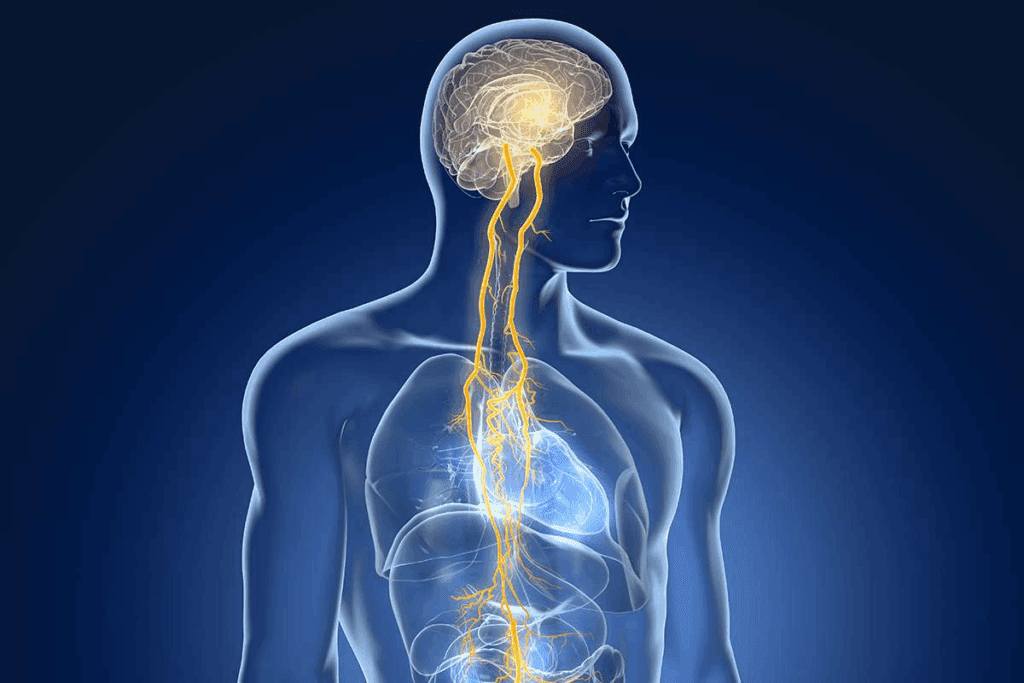
The trigeminal nerve is key to our nervous system. It has many functions and is complex. Knowing its anatomy helps us see its importance.
Origin in the Pons Region
The trigeminal nerve starts in the pons region of the brainstem. This spot is important because it’s where the nerve’s journey begins.
The Trigeminal Ganglion in Meckel’s Cave
The trigeminal ganglion is in Meckel’s cave. It’s a major part of the nerve. It splits into three main parts: V1, V2, and V3. These parts handle different sensory and motor tasks.
Nuclei and Central Connections
The trigeminal nerve has several nuclei and connections. These include the trigeminal sensory nuclei and motor nuclei. They help with sensing and moving.
The nerve’s connections are complex. They involve many brainstem nuclei and higher centers. Knowing these connections helps us understand how the nerve works with others.
The Three Major Branches of the Trigeminal Nerve
The trigeminal nerve has three main branches. Each branch has its own role in the face. They work together to cover the entire face.
Ophthalmic Nerve (V1): Structure and Distribution
The ophthalmic nerve, or V1, is the first branch. It’s a sensory nerve for the upper face. This includes the eye and nearby areas.
Sensory Distribution: It covers the forehead, upper eyelid, and the cornea. It also feels sensations in the nasal cavity.
Maxillary Nerve (V2): Path and Innervation Areas
The maxillary nerve, or V2, is the second branch. It’s also a sensory nerve. It covers the middle third of the face.
Innervation Areas: It feels sensations in the lower eyelid, the side of the nose, the upper lip, and the palate. It also feels sensations in the maxillary sinus.
Mandibular Nerve (V3): The Largest Branch
The mandibular nerve, or V3, is the largest branch. It has both sensory and motor fibers. It handles sensations in the lower face and controls chewing muscles.
Sensory and Motor Functions: It feels sensations in the lower lip, the tongue’s front part, and the mandible’s skin. It also controls the muscles for chewing.
Branch | Sensory or Motor | Area of Innervation |
Ophthalmic Nerve (V1) | Sensory | Upper face, eye, and nasal cavity |
Maxillary Nerve (V2) | Sensory | Middle face, lower eyelid, and palate |
Mandibular Nerve (V3) | Both Sensory and Motor | Lower face, anterior two-thirds of the tongue, and muscles of mastication |
In summary, the trigeminal nerve’s three branches cover the face. They provide both sensory and motor functions. Knowing about these branches helps in diagnosing and treating nerve disorders.
Sensory Functions of the Trigeminal Nerve
The trigeminal nerve helps us feel touch, pain, and temperature on our face. It covers the face, giving us important info about our surroundings.
Facial Sensation Distribution
The trigeminal nerve spreads over the front two-thirds of the face. It splits into three main parts: the ophthalmic, maxillary, and mandibular nerves. Each part covers a different area of the face.
Ophthalmic Nerve (V1): This nerve feels sensations on the upper face, like the forehead, eye, and nose.
Maxillary Nerve (V2): It covers the middle face, including the cheek, upper lip, and nasal area.
Mandibular Nerve (V3): This nerve is for the lower face, like the lower lip, jaw, and ear parts.
Types of Sensory Information Transmitted
The trigeminal nerve sends different kinds of sensory info, such as:
- Touch: We feel tactile sensations on our face.
- Pain: It warns us of harm or injury.
- Temperature: We sense hot and cold.
- Proprioception: It tells us about facial structure position and movement.
The Trigeminal Sensory Nuclei
The trigeminal sensory nuclei are nerve cells in the brainstem. They process info from the trigeminal nerve. There are three main nuclei:
Nucleus | Function |
Mesencephalic Nucleus | Processes proprioceptive information |
Principal Sensory Nucleus | Handles touch and pressure sensations |
Spinal Trigeminal Nucleus | Receives pain and temperature information |
Knowing how the trigeminal nerve and its nuclei work is key for diagnosing and treating facial sensation issues.
Motor Functions of the Trigeminal Nerve
The trigeminal nerve’s motor part is key for chewing. It controls important muscles. This is vital for us to chew and bite every day.
Muscles of Mastication
The trigeminal nerve controls the muscles of mastication. These include the masseter, temporalis, and medial and lateral pterygoids. They work together for chewing movements.
- Masseter: This muscle closes the jaw by elevating the mandible.
- Temporalis: It elevates and retracts the mandible.
- Medial Pterygoid: Helps elevate and rotate the mandible during jaw closure.
- Lateral Pterygoid: Important for depressing the mandible and protruding the jaw.
Tensor Tympani and Tensor Veli Palatini
The trigeminal nerve also innervates the tensor tympani and tensor veli palatini muscles. The tensor tympani regulates sound in the ear. The tensor veli palatini helps tense the soft palate during swallowing.
Functional Importance in Chewing and Biting
The motor functions of the trigeminal nerve are vital for chewing and biting. The muscles it innervates work together for precise chewing. This ensures food is broken down before swallowing.
The role of the trigeminal nerve’s motor functions is huge. Damage to this nerve can cause chewing and biting problems. This shows how important it is for our oral functions.
Which Cranial Nerve Is a Sensory Nerve and Controls Vision? Clarifying Common Misconceptions
The trigeminal nerve and the optic nerve are two different cranial nerves. The trigeminal nerve deals with facial sensation. The optic nerve is key for our vision.
The Trigeminal Nerve’s Sensory Role vs. The Optic Nerve’s Visual Function
The trigeminal nerve is the largest cranial nerve. It’s vital for facial sensation. It has three main branches: ophthalmic, maxillary, and mandibular nerves. These branches help us feel the face.
The optic nerve, on the other hand, is a special nerve for vision. It sends visual information from the retina to the brain. This lets us see and understand what we see.
It’s important to know the difference between these nerves. The trigeminal nerve deals with touch, pain, and temperature. The optic nerve is all about vision.
Cranial Nerve | Primary Function | Sensory Responsibility |
Trigeminal Nerve (V) | Sensory and Motor | Facial sensation (touch, pain, temperature) |
Optic Nerve (II) | Special Sensory | Vision |
How Cranial Nerves Work Together for Facial Sensation and Special Senses
Cranial nerves work together for our sensory experiences. The trigeminal nerve helps us feel the face. The optic nerve lets us see.
Knowing how these nerves work is key for diagnosing and treating sensory issues. Damage to the trigeminal nerve can cause numbness or pain. Damage to the optic nerve can cause vision problems or blindness.
Why the Trigeminal Nerve Is the Largest Cranial Nerve
The trigeminal nerve stands out as the largest among the 12 cranial nerves. It’s not just big; it’s also key to how we feel and move. This nerve plays a big role in our senses and in controlling our muscles.
Physical Size and Fiber Count
The trigeminal nerve is big because it has a lot of fibers. It has many sensory and motor fibers. This makes it very complex and important for the face.
The trigeminal nerve’s large fiber count makes it the largest cranial nerve. It lets the nerve do many things, like help us chew and feel sensations from our face.
Extensive Territorial Coverage
The trigeminal nerve covers a lot of the face. It has three main branches: the ophthalmic, maxillary, and mandibular nerves. Each branch covers different parts of the face.
Branch | Areas Innervated | Functions |
Ophthalmic Nerve (V1) | Eye, forehead, and part of the nose | Sensory |
Maxillary Nerve (V2) | Lower eyelid, nasal cavity, and upper lip | Sensory |
Mandibular Nerve (V3) | Lower lip, lower face, and muscles of mastication | Sensory and Motor |
Complexity of Functions and Connections
The trigeminal nerve is very complex. It has many connections in the brainstem. It helps with reflexes and works with other nerves for things like chewing.
“The trigeminal nerve is a complex structure with both sensory and motor functions, making it indispensable for facial sensation and the control of muscles involved in mastication.” –
A clinical perspective on the trigeminal nerve
The trigeminal nerve is the largest cranial nerve for good reasons. It does many important things for us. Its role in our senses and muscles makes it very important.
Embryological Development of the Trigeminal Nerve
Studies on embryos show that the trigeminal nerve comes from the neural crest. This group of cells is key for the peripheral nervous system. They move to different spots in the embryo, turning into neurons and glial cells that make up the trigeminal nerve.
Neural Crest Origins
The neural crest is where the trigeminal nerve starts. It’s a group of cells in the early embryo. These cells go to the head and neck area, helping form the trigeminal nerve.
The neural crest is important because it leads to many cell types. This includes cells for the peripheral nervous system.
The trigeminal nerve’s growth from the neural crest is complex. It involves cell growth, movement, and change. These steps are controlled by genes and the environment.
Development of the Three Divisions
The trigeminal nerve splits into three parts: the ophthalmic, maxillary, and mandibular nerves. Each part has its own job and covers different face areas.
- The ophthalmic division (V1) handles sensation around the eye.
- The maxillary division (V2) covers the mid-face, like the maxillary sinus and upper teeth.
- The mandibular division (V3) deals with both feeling and movement. It covers the lower face, including lower teeth, and controls chewing muscles.
Evolutionary Significance
The trigeminal nerve’s growth is tied to its role in evolution. Being the biggest cranial nerve, it’s key for facial feeling and movement. These are vital for survival and interacting with the world.
The nerve’s size and complexity show its importance in human evolution. It helped in developing facial features and processing face sensations.
Clinical Significance of the Trigeminal Nerve
The trigeminal nerve plays a big role in our body. It’s important in clinical neurology. Many conditions can affect it, causing a lot of pain and discomfort.
Trigeminal Neuralgia: The “Suicide Disease”
Trigeminal neuralgia is a serious condition. It causes severe pain on one side of the face. This pain is so bad, it’s called the “suicide disease” because it can make people feel like they want to give up.
We figure out if someone has trigeminal neuralgia by how they act. The pain starts with just a touch. It comes and goes, and sometimes, people have spasms in their face.
Key Features of Trigeminal Neuralgia:
- Severe, unilateral facial pain
- Pain triggered by light touch or other stimuli
- Paroxysmal pain episodes
- Potential for significant impact on quality of life
Trigeminal Neuropathy and Sensory Loss
Trigeminal neuropathy happens when the trigeminal nerve gets damaged. This can make the face feel numb or different. It can come from injuries, infections, or medical procedures gone wrong.
To check for trigeminal neuropathy, we do a physical exam. Sometimes, we need tests like MRI or special nerve tests.
Cause | Presentation | Diagnostic Approach |
Trauma | Sensory loss or altered sensation | Clinical examination, MRI |
Infection | Pain, sensory disturbance | Clinical examination, laboratory tests |
Post-procedural complication | Numbness, pain | History, clinical examination |
Examination Techniques for Trigeminal Function
Checking how well the trigeminal nerve works is key. We test it in different ways. We check for touch, pain, and temperature sensitivity. We also look at how well the face muscles work.
We might use special tests like trigeminal evoked potentials. These tests give us more detailed info about the nerve’s function.
Advanced Imaging and Diagnostic Techniques
We now have advanced tools for visualizing and assessing the trigeminal nerve. This has greatly improved our ability to diagnose and manage related disorders.
Advanced imaging techniques like MRI are key in diagnosing trigeminal nerve conditions. These technologies let us see the nerve’s structure and its surroundings in detail.
MRI Visualization of the Trigeminal Nerve
MRI is very useful for finding secondary causes of trigeminal neuralgia, like tumors or multiple sclerosis. It shows the nerve’s anatomy and any possible problems.
The use of MRI in diagnosing trigeminal nerve disorders has changed the field. It helps healthcare providers create specific treatment plans.
Electrophysiological Testing
Electrophysiological testing, including trigeminal evoked potentials, adds another layer to assessing the trigeminal nerve. These tests measure the nerve’s sensory and motor functions.
By combining imaging and electrophysiological data, doctors get a full picture of the trigeminal nerve’s health. This helps in both diagnosing and planning treatments.
Modern Approaches to Trigeminal Assessment
Modern diagnostic methods also include advanced software for analyzing imaging data. This allows for more accurate measurements of nerve dimensions and the detection of small abnormalities.
These cutting-edge techniques are improving our ability to diagnose and manage trigeminal nerve disorders. They offer new hope for patients with these complex conditions.
Treatment Approaches for Trigeminal Nerve Disorders
Treating trigeminal nerve disorders requires different methods. These include medicines and surgery. Knowing these options is key for good care.
Pharmacological Management
Medicine is often the first step in treating trigeminal nerve disorders. Carbamazepine is usually the first choice because it works well to reduce pain. Other drugs like gabapentin and pregabalin are used too, for those who can’t take carbamazepine or have specific pain types.
Choosing the right medicine and how much to take depends on the patient. It’s based on their condition, health history, and how they react to treatment. It’s important to keep an eye on how they’re doing and adjust the treatment as needed.
Surgical Interventions
For those who don’t get better with medicine or have bad side effects, surgery might be an option. Microvascular decompression is a surgery that helps by taking pressure off the nerve. This is often because a blood vessel is pressing on it.
Other surgeries include stereotactic radiosurgery (Gamma Knife surgery). It uses high-dose radiation to target the nerve root and lessen pain. The right surgery depends on the patient’s health, their condition, and what they prefer.
Emerging Therapies and Research Directions
New treatments for trigeminal nerve disorders are being researched. These include new medicines, advanced surgeries, and other treatments like percutaneous balloon compression and stereotactic radiosurgery with better imaging.
Studies on neuromodulation techniques, like nerve stimulation, are also promising. As we learn more about the trigeminal nerve, more treatment options will become available. This brings hope for better lives for those affected.
Conclusion
We’ve looked into the trigeminal nerve, the biggest cranial nerve. It plays a big role in how we feel and move. Its wide reach and detailed connections show how key it is for our face’s sensation and movement.
Knowing the trigeminal nerve’s structure is key. It starts in the pons and has three main branches. Its job in sensing our face is essential for our feelings.
The trigeminal nerve’s role in health is huge. Problems like trigeminal neuralgia and neuropathy really affect people’s lives. By learning more about it, we can improve care and results for patients.
FAQ
What is the trigeminal nerve?
The trigeminal nerve, also known as CN V, is the largest cranial nerve. It’s key for sensing and moving, mainly in chewing.
What are the three major branches of the trigeminal nerve?
The trigeminal nerve has three main parts: the ophthalmic nerve (V1), maxillary nerve (V2), and mandibular nerve (V3). Each part handles different facial feelings and movements.
What is the function of the trigeminal nerve in facial sensation?
The trigeminal nerve sends facial feelings to the brain. It helps us feel sensations from our face.
Which muscles are innervated by the motor component of the trigeminal nerve?
The motor part of the trigeminal nerve controls chewing muscles. It also helps with other face movements.
Why is the trigeminal nerve considered the largest cranial nerve?
It’s the biggest cranial nerve because of its size and many fibers. It covers a lot of area and has complex functions.
What is trigeminal neuralgia?
Trigeminal neuralgia is a severe face pain. It’s one of the most painful conditions and is linked to the trigeminal nerve.
How is trigeminal nerve function assessed?
Doctors check the trigeminal nerve with tests and scans. They use sensory tests and MRI to see how it works.
What are the treatment options for trigeminal nerve disorders?
Treatments include medicines, surgery, and new therapies. The choice depends on the problem and how bad it is.
What is the role of the trigeminal nerve in mastication?
The trigeminal nerve controls chewing muscles. It helps us chew and bite.
How does the trigeminal nerve develop embryologically?
The trigeminal nerve comes from the neural crest. Its parts form early in development. This shows its importance and how it evolved.
References
Government Health Resource. Evidence-Based Medical Guidance. Retrieved from https://www.kenhub.com/en/library/anatomy/the-trigeminal-nerve