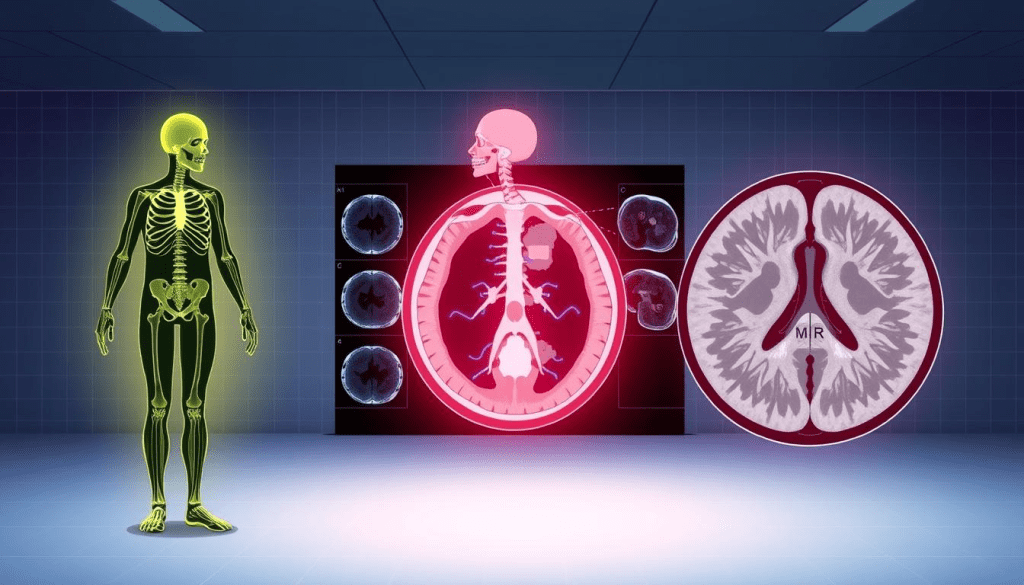
Choosing the right imaging technique is key to accurate injury diagnosis. At Liv Hospital, we are committed to providing the safest and most accurate scans for our patients’ needs. Diagnostic imaging techniques like X-ray, CT, and MRI are essential in medical diagnosis. Understanding the differences between these methods ” x ray vs ct vs mri ” helps patients and doctors choose the best option for each condition.
It’s important to know the differences between these technologies for patients to make informed decisions. For example, X-rays are great for finding bone fractures. On the other hand, MRIs are better for soft tissue injuries.
Key Takeaways
- X-rays are ideal for diagnosing bone fractures.
- MRIs are superior for soft tissue injuries.
- CT scans are useful for diagnosing internal organ injuries.
- The choice of imaging technique depends on the type and severity of the injury.
- Understanding the differences between X-ray, CT, and MRI is key to accurate diagnosis.
The Fundamentals of Medical Imaging
A large and detailed medical imaging laboratory, with various diagnostic equipment arranged in a visually appealing and informative layout. In the foreground, a modern, sleek X-Ray machine and a high-resolution CT scanner stand prominently, their angular forms and metallic finishes catching the soft, directional lighting from above. In the middle ground, a high-field MRI system occupies the central focus, its cylindrical shape and intricate inner workings visible through a cutaway view. The background features additional medical imaging devices such as ultrasound machines and PET scanners, all bathed in a clinical, yet welcoming ambiance. The overall scene conveys the sophisticated and advanced nature of modern medical imaging technologies.
Medical imaging has changed a lot in modern medicine. It helps doctors make more accurate diagnoses and treatments. Knowing the basics of medical imaging is key. It helps us understand why different methods are used.
The Evolution of Diagnostic Technology
Diagnostic technology has changed a lot. Wilhelm Conrad Röntgen discovered X-rays in 1895. This was a big start for medical imaging, letting doctors see inside the body.
Later, we got CT scans and an MRI. Each has its own strengths for different needs.
Why Different Imaging Methods Exist
No single tech can cover all medical needs. The right choice depends on the condition, patient history, and needed information.
X-rays are good for bones and foreign objects. But MRI is better for soft tissues. CT scans are great for organs and complex fractures.
Knowing each tech’s strengths helps choose the right one. This improves diagnosis and care.
X-Ray Imaging Explained
Detailed x-ray machine with a sleek, modern design, placed in a clinical setting with a clean, sterile atmosphere. The machine’s metallic body is illuminated by soft, directional lighting, casting dramatic shadows and highlights that accentuate its intricate components. In the foreground, a human silhouette stands patiently, their body outlined by the machine’s diagnostic beams, conveying the diagnostic process. The background features minimalist medical equipment and a neutral color palette, emphasizing the focus on the x-ray technology itself. The scene captures the precision and sophistication of x-ray imaging, suitable for illustrating its key role in injury diagnosis.
Understanding X-ray imaging is key to knowing how doctors diagnose and treat injuries and conditions. X-ray technology has been a mainstay in medical diagnostics for over a century.
How X-Ray Technology Works
X-ray technology uses X-ray beams to show the inside of the body. When an X-ray beam hits a body part, different tissues absorb it in different ways. For example, bone absorbs more X-rays than soft tissues, making bones stand out in images.
What X-Rays Can and Cannot Show
X-rays are great for finding bone fractures and other bone issues. But they can’t show soft tissue injuries like tendon or ligament damage. This is because soft tissues don’t absorb X-rays much differently from the surrounding tissues.
For instance, “Can X-ray see a tendon tear?” The answer is usually no. Tendon tears are soft tissue injuries, and X-rays can’t show them well. To see tendon or ligament damage, doctors often use an MRI or an ultrasound.
| Condition | X-Ray Visibility |
| Bone Fractures | High |
| Soft Tissue Injuries (Tendon/Ligament Damage) | Low |
In summary, X-ray imaging is very useful for bone issues but has its limits, mainly for soft tissue injuries. Knowing these limits is important for both doctors and patients to choose the right diagnostic tests.
“The choice of imaging modality depends on the clinical question being asked. For bone fractures, X-rays are often sufficient, but for soft tissue injuries, other modalities like MRI are more appropriate.” – Says a Orthopedic Specialist
CT Scan Technology and Applications
CT scans are a big step forward in medical imaging. They give a detailed look inside the body. This is different from X-rays, which only show a two-dimensional view.
From X-Ray to 3D: How CT Scans Work
CT scans are a big leap from X-rays. While X-rays show a flat image, CT scans make a 3D picture. This is done by taking many X-ray images from different angles.
Then, a computer puts these images together to create a detailed 3D image. This helps doctors see injuries and conditions more clearly. For example, CT scans can show the full extent of a complex fracture or internal injury.
“CT scans have become an indispensable tool in emergency medicine, providing quick and accurate diagnoses that are vital in emergency situations.”
When Doctors Order CT Scans
Doctors often choose CT scans when they need more information than an X-ray can give. They use them to check for internal injuries, complex fractures, and conditions like tumors or vascular diseases.
CT scans are very useful in emergencies because they are fast and accurate. They help doctors make quick decisions about treatment, which can save lives.
- Diagnosing internal injuries and bleeding
- Detecting complex fractures and bone disorders
- Guiding certain medical procedures
In summary, CT scan technology has changed medical imaging a lot. It offers detailed diagnostic tools. By understanding how CT scans work and when they are used, patients can see their value.
MRI Technology: The Soft Tissue Specialist
MRI is key in finding soft tissue injuries. It shows details that other methods can’t. This makes MRI a vital tool for doctors.
The Science Behind Magnetic Resonance Imaging
MRI uses nuclear magnetic resonance to create images. It uses a strong magnetic field and radio waves. This method is safer than X-rays or CT scans because it doesn’t use harmful radiation.
It works by aligning hydrogen nuclei with a magnetic field and then using radio waves to disturb them. When they return to their original state, they send signals. These signals help create detailed images of soft tissues like tendons, ligaments, and muscles.
MRI’s Superior Soft Tissue Visualization
MRI is great for finding soft tissue injuries. It can see tendon and ligament tears, muscle strains, and other damage. This is because MRI can tell soft tissues apart based on their magnetic properties.
For example, an MRI can show how bad a tendon injury is. This helps doctors decide the best treatment.
“MRI has become an essential diagnostic tool in orthopedics, providing unparalleled detail of soft tissue injuries.” –
Orthopedic Specialist
While MRI is top for soft tissue images, ultrasound is an option. But MRI’s detailed views and lack of need for an operator make it the first choice for many doctors.
| Imaging Modality | Soft Tissue Visualization | Radiation Exposure |
| MRI | Excellent | No |
| CT Scan | Good | Yes |
| X-Ray | Poor | Yes |
| Ultrasound | Good | No |
In summary, MRI is unmatched for seeing soft tissues. It’s essential for diagnosing injuries like tendon and ligament tears. While ultrasound is an option, MRI’s detailed images make it the top choice for many doctors.
X-Ray vs CT vs MRI: 7 Key Differences
X-ray, CT, and MRI are three different medical imaging tools. They help doctors diagnose injuries in different ways. Knowing their differences helps choose the right tool for each case.
Difference #1: Imaging Technology and Physics
X-rays, CT scans, and MRI work in different ways. X-rays use radiation to show bone images. CT scans use more radiation to create detailed body images.
MRI, on the other hand, uses a strong magnetic field and radio waves. It shows soft tissue images without radiation.
Difference #2: Radiation Exposure
Radiation exposure is a big difference. X-rays and CT scans use ionizing radiation. CT scans use more radiation than X-rays.
MRI doesn’t use ionizing radiation. This makes it safer for pregnant women and others.
Difference #3: Image Detail and Resolution
The detail and resolution of images differ. X-rays mainly show bone images. CT scans provide detailed cross-sections.
MRI gives the highest detail for soft tissues. It’s best for diagnosing muscle, tendon, and ligament issues.
Difference #4: Time Required for Imaging
The time needed for each scan varies. X-rays are quick, taking just a few minutes. CT scans are also fast, usually done in minutes.
MRI scans take longer, from 15 to 90 minutes. This depends on the scan’s complexity.
Understanding these differences helps doctors choose the right imaging tool for each patient.
Can X-Rays Show Tendon or Ligament Damage?
X-rays are a key tool in medical imaging. But, they can’t show soft tissue injuries like tendon or ligament damage well. They’re great for bones, but not for soft tissues.
Why Tendons Don’t Appear on X-Rays
Tendons and ligaments are soft and don’t show up on X-rays like bones do. This is because they don’t absorb X-rays in the same way. Also, healthy tendons and ligaments don’t have calcium, which makes bones visible.
But sometimes X-rays can hint at tendon or ligament problems. For example, if there’s a big injury, bone fragments or calcifications in soft tissues might show up.
Indirect Signs of Soft Tissue Injury
X-rays can’t directly show tendon tears or ligament sprains. But they can hint at soft tissue damage. These hints include:
- Swelling or effusion in the joint can be inferred from changes in the soft tissue shadows around the joint.
- Avulsion fractures, where a tendon or ligament pulls off a piece of bone.
- Joint space narrowing or widening can indicate ligamentous instability.
| Indirect Sign | Description | Possible Implication |
| Soft tissue swelling | Visible as increased soft tissue density around a joint | Possible ligament sprain or tendon strain |
| Avulsion fracture | A fragment of bone is pulled away by a tendon or ligament | Significant tendon or ligament injury |
| Joint space alteration | Narrowing or widening of the joint space | Ligamentous instability or severe sprain |
When Additional Imaging Is Necessary
If a doctor thinks there’s a big tendon or ligament injury, they might order more tests. MRI is often used because it shows soft tissues clearly. This helps doctors check tendons and ligaments directly.
In short, X-rays have their limits when it comes to soft tissue injuries. But they can give clues. For a clear diagnosis, an MRI is usually needed.
Bone Injury Diagnosis: Which Scan to Choose
Choosing the right imaging technique for bone injuries is key. X-rays, CT scans, and MRIs each have their own strengths. The right choice depends on the injury’s type and complexity.
Simple Fractures: The Role of X-Rays
X-rays are often the first choice for simple fractures. They are fast, easy to find, and show bone details well. X-rays work best for fractures in limbs and areas where bone alignment matters.
Key benefits of X-rays for simple fractures include:
- Rapid imaging process
- Low radiation exposure compared to CT scans
- Wide availability in emergency settings
Complex Fractures: When CT Scans Are Needed
For complex fractures with many bone pieces or tricky patterns, CT scans are best. CT scans give a detailed look at bone structure. This helps doctors understand the fracture better.
CT scans are advantageous for complex fractures because they:
- Provide detailed 3D images of the fracture
- Help in planning surgical interventions
- Offer better visualization of bone fragments and their displacement
Bone Bruises and Stress Fractures: MRI’s Advantage
Bone bruises and stress fractures are best seen with an MRI. MRI can see soft tissues and bone marrow. This makes it great for finding these injuries.
MRI is useful for:
- Detecting bone bruises and edema
- Diagnosing stress fractures not visible on other imaging
- Assessing associated soft tissue injuries
Soft Tissue Injury Assessment
Choosing the right imaging modality is key to treating soft tissue injuries. These injuries, like muscle tears and ligament sprains, need a precise diagnosis. This helps doctors make the right treatment plans.
Muscle Tears and Strains
Muscle tears and strains can really hurt your mobility and quality of life. MRI is great for spotting these injuries because it shows soft tissue details well.
Using MRI, we can see how much muscle damage there is. This is important for figuring out the best treatment. The severity of muscle tears can vary, and an MRI helps us know how bad they are. This guides our treatment choices.
Ligament Injuries and Sprains
Ligament injuries and sprains also benefit from advanced imaging. X-rays can show bone alignment and fractures, but they can’t see ligament damage.
MRI is better for showing ligaments, tendons, and soft tissues. This is key for spotting ligament sprains and tears, common in sports injuries.
Tendon Ruptures and Tears
Tendon ruptures and tears are serious and need a quick, accurate diagnosis. MRI is the top choice for checking tendon health because it’s very sensitive and specific.
We use MRI to see how much tendon damage there is. This is critical for planning treatment, whether it’s surgery or other methods. MRI’s detailed images help us spot partial or complete tendon tears.
| Injury Type | Best Imaging Modality | Key Diagnostic Features |
| Muscle Tears | MRI | Visualization of muscle damage, edema, and tear extent |
| Ligament Sprains/Tears | MRI | Detailed imaging of ligament integrity, sprain severity |
| Tendon Ruptures/Tears | MRI | Assessment of tendon damage, partial or complete tears |
Alternatives to MRI for Soft Tissue Imaging
For those who can’t have an MRI, ultrasound, and contrast-enhanced CT scans are good options. These methods can give important information for diagnosis. They work well when an MRI isn’t possible or needed.
Ultrasound for Tendon and Ligament Evaluation
Ultrasound is great for checking tendons and ligaments. It’s cheap, lets you see things in real-time, and can guide treatments. It’s best for looking at things close to the surface.
Ultrasound is special because it shows how things move. This helps find injuries that only show up when moving. It’s very useful for diagnosing certain types of injuries.
Contrast-Enhanced CT Techniques
Contrast-enhanced CT scans use a special dye to make certain areas stand out. This helps spot problems like inflammation or tumors. Even though they use radiation, the dye adds important details.
Choosing between ultrasound and CT scans depends on the injury’s location and the patient’s health. CT scans are better for deeper injuries, while an ultrasound is good for surface issues.
When to Consider Alternative Imaging
Choosing an alternative to MRI depends on several things. These include the patient’s health, any MRI contraindications, and what imaging options are available. Cost, comfort, and the need for dynamic images also play a role.
Here’s a quick guide to help pick the right imaging for soft tissue:
| Imaging Modality | Soft Tissue Detail | Radiation Exposure | Dynamic Imaging Capability |
| Ultrasound | Good for superficial structures | No | Yes |
| Contrast-Enhanced CT | Good, with contrast | Yes | No |
| MRI | Excellent | No | Limited |
Knowing what each imaging method can do helps doctors choose the best one for soft tissue injuries. This ensures patients get the right care.
Clinical Decision Making: Selecting the Right Imaging Test
Choosing the right imaging test is key in medical imaging. Healthcare providers must weigh many factors to pick the best test for each patient. This ensures patients get the right imaging for their health issue.
Emergency vs. Non-Emergency Situations
In emergency situations, we need fast and accurate diagnoses. We often use X-rays or CT scans for this. For example, in a stroke or severe trauma, these tests are vital.
For non-emergency situations, we have more options. We look at the patient’s history, the condition, and if detailed soft tissue imaging is needed. This might mean using an MRI.
Cost-Effectiveness Considerations
Cost-effectiveness is important too. We balance the need for accurate diagnosis with the cost of tests. For example, MRI gives detailed images but costs more than X-rays. So, we often start with cheaper options like X-rays.
But, if a detailed assessment is needed, the cost of MRI or CT scans might be worth it. They can lead to more accurate diagnoses and better care for patients.
Patient-Specific Factors
Patient-specific factors are also key. We consider the patient’s age, medical history, and any issues with certain tests. For example, some patients with metal implants can’t have an MRI.
We also think about patient preferences and anxiety. Some might feel claustrophobic in MRI machines. This could mean using open MRI machines or other options.
Conclusion: Making Informed Decisions About Medical Imaging
It’s important to know the differences between X-ray, CT, and MRI. We’ve looked at what each technology does, how it’s used, and what makes it unique.
Choosing the right imaging tool is key to accurate diagnosis and treatment. We should think about radiation, image quality, and the type of injury or condition. This helps us pick the best imaging method.
X-ray, CT, and MRI each have their own strengths and weaknesses. X-rays work well for simple fractures. CT scans are better for complex ones because they show more detail. MRI is great for seeing soft tissues.
So, the right imaging choice depends on the patient’s needs. We must consider the situation, the condition’s severity, and the benefits and risks of each option. This way, patients get the best care possible.
FAQ
Can X-rays show tendon or ligament damage?
X-rays can’t directly show tendon or ligament damage. They’re better for bone issues. But, they might show signs like joint space widening or bone fragments that suggest soft tissue injury.
What’s the difference between X-ray, CT scan, and MRI?
X-rays use radiation to show bones and dense tissues. CT scans give detailed cross-sections with X-rays. MRI shows soft tissues like tendons, ligaments, and muscles with magnetic fields and radio waves.
Can an X-ray show a torn ligament?
X-rays usually can’t show torn ligaments directly. They might show signs of injury like joint instability or bone avulsion. But MRI is better for diagnosing ligament tears.
Are there alternatives to MRI for soft tissue imaging?
Yes, ultrasound and contrast-enhanced CT are alternatives. Ultrasound is great for tendons and ligaments. Contrast-enhanced CT can also show some soft tissue injuries.
How do I know which imaging test is right for me?
Your healthcare provider will decide based on your injury and medical history. They’ll consider the urgency, cost, and need for detailed soft tissue images.
Can X-rays detect tendon tears?
X-rays can’t directly show tendon tears. They might show signs like tendon calcification or bone spurs. But MRI or ultrasound is more accurate for tendon tears.
What’s the advantage of MRI over CT scans for soft tissue injuries?
MRI shows soft tissues like tendons, ligaments, and muscles better without radiation. It’s the best for soft tissue damage.
Can CT scans show ligament damage?
CT scans can show some soft tissues, but aren’t best for ligament damage. MRI is the top choice for ligament injuries.
Is there a difference between a CT scan and an X-ray?
Yes, CT scans give detailed cross-sections and more info than X-rays. They use X-rays from many angles for a better view.
When is a CT scan preferred over an X-ray?
CT scans are better for detailed images, like complex fractures or internal injuries. They’re needed for a precise bone and soft tissue assessment.
References
- Xiong, C. (2021). An analysis of clinical values of MRI, CT, and X-ray in the differential diagnosis of benign and malignant bone metastases. Journal of Bone Oncology, 26, 100341. https://www.ncbi.nlm.nih.gov/pmc/articles/PMC8290716/
- Kim, T., Lee, S. H., & Park, J. (2022). Comparison of X-ray computed tomography and magnetic resonance imaging to identify pest infestation in plants: A pilot study. Computers and Electronics in Agriculture, 197, 106909. https://www.sciencedirect.com/science/article/pii/S1631073321004186