

Diagnosing hernias accurately is key for good treatment. We use advanced tests like CT scans and MRI to see clearly when physical checks aren’t enough.
Advanced imaging tests have changed how we find hernias. They are very good at spotting them. CT scans, for example, can find complex or hidden hernias with up to 94 percent sensitivity and 96 percent specificity.
At Liv Hospital, we use the newest diagnostic tools to ensure accurate results. Many patients ask, can a CT scan detect a hernia? Yes — advanced CT imaging helps our doctors identify hernias precisely, ensuring patients receive the best care following global healthcare standards.
Key Takeaways
- CT scans and MRI are key for finding hernias right.
- These tests are very good at spotting hernias.
- Liv Hospital focuses on patient safety and global healthcare standards.
- Advanced imaging finds complex or hidden hernias.
- Right diagnosis means better and more personal treatment plans.
Understanding Hernias: Types and Symptoms
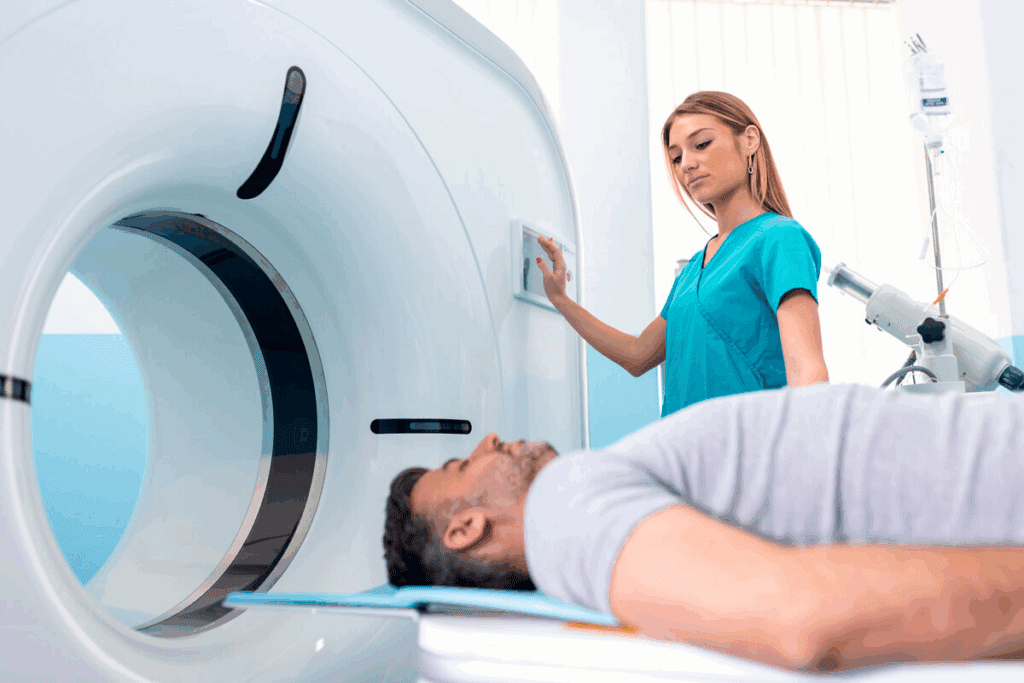
Hernias are different types, each with its own symptoms and effects. A hernia happens when an organ or tissue pushes through a weak spot in the muscle or tissue that usually keeps it in place.
Common Types of Hernias
There are many types of hernias, each with its own traits. The most common ones are:
- Inguinal hernias, which occur in the groin area
- Umbilical hernias, which occur around the belly button
- Incisional hernias, which occur through a scar or incision in the abdominal wall
- Hiatal hernias, which occur when the stomach bulges up into the chest through an opening in the diaphragm
| Type of Hernia | Common Symptoms | Typical Location |
| Inguinal Hernia | Bulge in the groin, discomfort during coughing or lifting | Groin area |
| Umbilical Hernia | Bulge around the belly button, abdominal pain | Around the navel |
| Incisional Hernia | Bulge or protrusion near a surgical scar, discomfort | Near surgical scars |
| Hiatal Hernia | Heartburn, chest pain, difficulty swallowing | Upper stomach into the chest |
Recognizing Hernia Symptoms
Symptoms of hernias vary by type and location. Common signs include a visible bulge, pain, and discomfort, often when coughing, lifting, or bending. Some hernias may not show symptoms until they become serious, which is a medical emergency.
When to Seek Medical Attention
Seek medical help if you have severe pain, vomiting, or if the hernia looks tender, red, or discolored. These could mean a serious hernia that needs immediate care. Early treatment can greatly improve outcomes for hernia patients.
Tests like a test for hernia can find out if you have one and what type. Imaging tests, like hernia MRI or CT scans, are used to confirm the diagnosis. For example, a CT scan can show a hernia, helping doctors plan the best treatment.
The Importance of Accurate Hernia Diagnosis
Getting a hernia diagnosis right is very important. It helps doctors plan the best treatment. We use advanced imaging to see the details of hernias.
Challenges in Clinical Diagnosis
Finding hernias can be hard because they show up in many ways. Symptoms can be similar to other health issues. This makes it tough to diagnose just by feeling the body.
Ventral hernias are extra tricky to find, mainly in heavy people or those who’ve had surgery before.
Why Imaging Tests Matter
Tests like CT scans and MRI are key in finding hernias. They give clear pictures of the hernia and how it affects nearby tissues.
Getting the images right is vital for checking how well the mesh is placed and spotting any problems, like in cases of hernias coming back.
Impact on Treatment Planning
What imaging tests show affects how doctors plan treatment. They use these images to decide if they should do surgery the old way or use a laparoscope.
A CT scan can show what kind of hernia it is, how big it is, and if there are any complications. This helps the surgeon know the best way to fix it.
| Diagnostic Modality | Sensitivity | Specificity |
| CT Scan | Up to 94% | Up to 96% |
| MRI | Up to 91% | Up to 92% |
“Imaging plays a critical role in the diagnosis and management of hernias, providing essential information for treatment planning.”
A renowned surgeon
Basic Principles of Medical Imaging for Hernias
Understanding medical imaging is key for diagnosing and treating hernias. It’s a vital tool that offers many ways to see inside the body. This helps doctors plan the best treatment.
Evolution of Diagnostic Techniques
Medical imaging for hernias has come a long way. At first, doctors used simple X-rays and physical exams. Now, we have ultrasound, CT scans, and MRI.
These new tools help us find and understand hernias better. For example, CT scans are very accurate at spotting hernias. MRI is great for seeing soft tissues, which is helpful for tricky cases.
Comparing Available Imaging Options
Each imaging method has its own strengths and weaknesses. Ultrasound is easy on the wallet and doesn’t hurt, but it depends on the person doing it. CT scans give clear pictures and are good in emergencies. MRI shows soft tissues well without using X-rays.
We pick the right imaging based on the hernia type and the patient’s health. For example, CT scans are fast and good for urgent cases. MRI is best for complex or recurring hernias because it shows soft tissues well.
Hernia Diagnostic Imaging Protocols
Having set imaging plans is important for accurate diagnosis. These plans change based on the imaging method and hernia type. For CT scans, thin slices and 3D views help see the hernia and nearby areas well.
MRI for hernias might use different types of images to check anatomy and soft tissues. By sticking to these plans, we make sure our images help doctors make the right treatment plans.
How CT Scan Technology Works
Understanding CT scan technology is key to seeing its role in finding hernias. CT scans use X-rays and computers to make detailed images of the body. These images help spot hernias and check other areas too.
The Science Behind CT Imaging
CT imaging works by using X-rays differently on different tissues. An X-ray machine sends beams through the body from many angles. Detectors then catch how much X-ray each tissue absorbs.
This info is processed by computers to make detailed images. These images show different tissues clearly. This is important for finding hernias and seeing if there are any problems nearby.
Key aspects of CT imaging technology include:
- Advanced X-ray detection systems
- Sophisticated computer algorithms for image reconstruction
- Ability to differentiate between various tissue types
CT Scan Procedure for Hernia Detection
For hernia detection, the CT scan process starts with getting ready. Then, the patient lies on the CT table and the scan begins. The whole scan takes just a few minutes.
Contrast material might be used to make the scan better. This can go through the mouth, veins, or rectum, depending on the hernia and the question being asked.
The images show the hernia’s size, where it is, and any issues. This info helps doctors plan the best treatment.
The benefits of using CT scans for hernia detection include:
- High accuracy in detecting hernias
- Ability to assess surrounding structures and any complications
- Quick and non-invasive procedure
Can a CT Scan Detect a Hernia? Accuracy and Effectiveness
CT scans are key in finding hernias. They are very accurate and effective. We’ll look at why CT scans are good for finding hernias and their limits.
CT Scan Sensitivity Rates of Up to 94%
Research shows CT scans can spot hernias with up to 94% accuracy. This means they correctly find 94 out of 100 hernias. This high accuracy makes CT scans reliable for diagnosing hernias. Being able to find hernias quickly is important for treatment and avoiding problems.
Specificity Measurements Reaching 96%
CT scans are also very specific in finding hernias, with up to 96% accuracy. This means they correctly say 96 out of 100 people without hernias don’t have one. This high specificity helps avoid unnecessary surgeries. It helps doctors focus on treating those who really need it.
Types of Hernias Best Visualized by CT
CT scans work best for certain hernias, like:
- Incisional hernias
- Ventral hernias
- Complex hernias
These hernias are hard to spot just by feeling. CT scans give detailed pictures. This helps doctors plan the best treatment.
Limitations of CT Scanning for Hernias
Even though CT scans are great for finding hernias, they have some downsides. Small hernias or those in hard-to-reach spots might not show up. Also, CT scans use radiation, which is a concern, mainly for younger people or those needing many scans. We need to think about these downsides when choosing a diagnostic method.
MRI Technology: Fundamentals and Process
MRI, or Magnetic Resonance Imaging, is a top-notch tool for diagnosing hernias. It gives us clear pictures of what’s inside the body. This helps us spot hernias more accurately.
MRI works by using strong magnetic fields and radio waves. It lets us see inside the body without surgery. This makes it a safe and effective way to check on our health.
How MRI Creates Detailed Images
Making MRI images involves a few steps. First, a strong magnetic field lines up the body’s hydrogen atoms. Then, radio waves disturb these atoms, causing them to send out signals.
These signals are caught by the MRI machine. It then turns them into detailed pictures of what’s inside us.
Several things help MRI make such clear images:
- The strength of the magnetic field
- The frequency of the radio waves
- The type of coils used to detect signals
MRI Procedure for Hernia Evaluation
For hernia checks, we use a special MRI protocol. The patient lies on a table that slides into the MRI machine. The machine then takes pictures of the hernia and the area around it.
The MRI procedure for hernia evaluation has many benefits:
- It gives us clear images of soft tissues
- It can spot hernias that other tests miss
- It’s non-invasive, which means it’s safer
Understanding MRI technology helps us see its importance in diagnosing hernias. MRI’s ability to show detailed images of soft tissues is key. It helps us diagnose and plan treatment for hernias more accurately.
Will an MRI Show a Hernia? Diagnostic Capabilities
MRI is very good at finding hernias. It has high sensitivity and specificity. This makes MRI a key tool for diagnosing hernias, even in tough cases.
MRI Sensitivity of 91% for Occult Hernias
Studies show MRI can spot occult hernias with 91% accuracy. Occult hernias are hard to find by just looking. MRI’s high sensitivity means patients get the right diagnosis and treatment.
Specificity Rates Reaching 92%
MRI is also very specific in finding hernias, with a rate of up to 92%. This means MRI can tell when a hernia is there and when it’s not. This helps avoid unnecessary surgeries.
Advantages of MRI for Complex Hernia Cases
MRI is great for complex hernia cases because it shows soft tissue details well. It can pinpoint where and how big a hernia is. This is key for planning surgery. The main benefits of MRI for complex cases are:
- Detailed view of hernia anatomy
- Accurate size and complication assessment
- Finding other injuries or conditions
Limitations of MRI in Hernia Detection
Even though MRI is great for finding hernias, it has some downsides. It might not be as easy to get as CT scans, and it costs more. Some people might feel claustrophobic or have metal implants that block MRI. But for many, MRI’s benefits in diagnosing hernias are worth it.
Comparing CT Scans and MRIs for Hernia Diagnosis
CT scans and MRI are key tools for finding hernias. They offer different benefits like accuracy and comfort. The right choice depends on the hernia type, patient health, and imaging needs.
Diagnostic Accuracy Comparison
Both CT scans and MRI are very good at finding hernias. Studies show CT scans can spot hernias up to 94% of the time. MRI can find them up to 91% of the time, even when they’re hard to see.
The choice between them depends on the hernia and the patient’s health.
| Imaging Modality | Sensitivity Rate | Specificity Rate |
| CT Scan | Up to 94% | Up to 96% |
| MRI | Up to 91% | Up to 92% |
Radiation Exposure Considerations
CT scans expose patients to radiation, which is a big concern. This is more of an issue for young patients or those needing many scans. MRI, on the other hand, is safer because it doesn’t use radiation.
Radiation Exposure: CT scans use X-rays, which means radiation. MRI uses a magnetic field and radio waves, avoiding radiation.
Patient Comfort and Experience
Choosing between CT scans and MRI also depends on comfort. CT scans are fast, lasting just a few minutes. This is good for patients who can’t stay in one place or are scared of tight spaces. MRI, though longer and possibly more uncomfortable, doesn’t use radiation.
Patient comfort considerations: CT scans are quick but use radiation. MRI is safer and more detailed but might be uncomfortable due to its enclosed space and longer time.
When Doctors Choose CT Scans for Hernia Evaluation
CT scans are key for diagnosing hernias, mainly in urgent cases. They help us quickly spot hernias, even when symptoms are severe.
Emergency and Acute Situations
In emergencies, like severe pain or suspected hernia, CT scans are top choice. They give us fast, detailed images. This helps us see if there are serious issues like bowel blockage or strangulation.
A study in the Journal of Radiology shows CT scans are very good at spotting sudden abdominal problems, including hernias. This makes them essential in emergency rooms.
Specific Hernia Types Best Seen on CT
Some hernias are clearer on CT scans. These include:
- Incisional hernias
- Spigelian hernias
- Internal hernias
CT scans give us sharp images of these hernias. We can see their size, where they are, and any complications.
Patient Factors Influencing CT Selection
We think about several things when choosing a CT scan for hernia checks. These include:
| Patient Factor | Influence on CT Selection |
| Obesity | CT scans are often preferred for obese patients due to their ability to penetrate deeper tissue. |
| Previous surgical history | CT scans help identify any complications from past surgeries. |
| Acute symptoms | CT scans are used to quickly diagnose hernias in patients presenting with acute symptoms. |
Evaluating Hernia Size and Complications
CT scans let us accurately measure hernia size and spot complications. This info is key for choosing the right treatment.
By choosing the right time for CT scans, we can give accurate diagnoses. This helps us create effective treatment plans for hernia patients.
When MRI is the Preferred Choice for Hernia Imaging
For certain hernia types, MRI offers unparalleled diagnostic clarity. We will explore the scenarios in which MRI is preferred over other imaging modalities.
Complex and Recurrent Hernias
Complex hernias, which involve multiple defects or are located in challenging anatomical areas, require precise imaging for accurate diagnosis and treatment planning. MRI excels in these situations due to its ability to provide high-resolution images of soft tissues.
Key benefits of MRI for complex hernias include:
- Detailed visualization of hernia anatomy
- Ability to detect multiple defects
- Clear delineation of surrounding tissues
Occult Hernia Detection
Occult hernias, which are not easily detectable through physical examination or other imaging methods, can be identified using MRI. Its high sensitivity makes it an ideal choice for patients with persistent symptoms but negative findings on other tests.
“MRI is a top choice for diagnosing occult hernias. It offers a clear diagnosis for patients who might face unnecessary surgery or prolonged diagnostic uncertainty.”
Expert Opinion
Patient Populations Benefiting from MRI
Certain patient populations benefit significantly from MRI for hernia diagnosis. These include:
| Patient Group | Benefit of MRI |
| Young patients | No radiation exposure |
| Patients with recurrent hernias | Detailed assessment of previous repair sites |
| Patients with complex anatomy | Clear visualization of hernia and surrounding structures |
Surgical Planning Applications
MRI plays a key role in surgical planning for hernia repair. It provides detailed images of the hernia and surrounding anatomy. This helps surgeons plan their approach better, potentially reducing complications and improving outcomes.
We use MRI to better understand each patient’s unique anatomy. This allows for more precise and effective surgical interventions.
Other Diagnostic Tests for Hernia
CT scans and MRIs are important, but other tests help find hernias too. We use many methods to make sure we diagnose and treat right.
Ultrasound Imaging
Ultrasound is often the first test because it’s safe and shows things in real time. It’s great for finding hernias in the groin and spotting problems like incarceration or strangulation.
Advantages of Ultrasound:
- No radiation exposure
- Real-time imaging
- Cost-effective
- Widely available
Herniography
Herniography is a test that uses contrast to see hernias. It’s not the first choice, but it helps when other tests don’t work.
Physical Examination Techniques
A good physical exam is key to finding hernias. Doctors use touch and cough tests to check for hernias and how bad they are.
Key aspects of physical examination:
- Visual inspection
- Palpation
- Cough impulse testing
Emerging Diagnostic Methods
New tests are being developed to find and understand hernias better. These might be more accurate and help you heal faster.
| Diagnostic Test | Sensitivity | Specificity | Advantages |
| Ultrasound | High | High | No radiation, real-time imaging |
| Herniography | Moderate | High | Useful for occult hernias |
| Physical Examination | Variable | High | Non-invasive, cost-effective |
Conclusion: The Future of Hernia Imaging
The field of hernia imaging is always changing. New research and technologies are making it better. Both CT scans and MRIs are key in finding hernias, each with its own benefits and drawbacks.
Looking to the future, hernia imaging will get even better. We’ll see clearer images, less radiation, and more comfort for patients. This is thanks to new ways of diagnosing and imaging hernias.
It’s important for doctors to keep up with these new imaging methods. This will help us give our patients the best care. The ongoing improvement in hernia imaging will make diagnosing and treating hernias more accurate and effective.
By using these new advancements, we can make hernia diagnosis and treatment better. Patients will get the top-notch care they deserve. We’re excited for this future in hernia imaging.
FAQ
Does a CT scan show a hernia?
Yes, a CT scan can spot a hernia. It’s great for emergencies and some types of hernias, with a success rate of up to 94%.
Can an MRI detect a hernia?
Yes, MRI can find hernias, even the tricky ones, with a success rate of 91%. It’s good for planning surgery and checking on hernias that come back.
What is the best imaging test for diagnosing a hernia?
It depends on the situation. CT scans are often used in emergencies. MRI is better for complex or recurring hernias.
How does a CT scan work for hernia detection?
CT scans use X-rays to make detailed pictures of the body. This helps see hernias and the tissues around them.
What are the advantages of MRI for hernia imaging?
MRI gives detailed pictures without using radiation. It’s perfect for tricky cases, recurring hernias, and some patients.
Are there alternative diagnostic tests for hernias?
Yes, there are. Ultrasound, herniography, and physical exams are options. New methods are also being explored.
Can a hernia be detected by a CT scan?
Yes, CT scans can find hernias, even big or complicated ones. They’re very accurate, with a success rate of 96%.
Will an MRI show a hernia?
Yes, MRI can spot hernias, even the hard-to-find ones. It’s very good at this, making it a key tool for doctors.
What are the limitations of CT scans and MRI in hernia detection?
CT scans might miss small or tricky hernias. MRI isn’t good for people with metal implants or who get anxious in tight spaces.
How do doctors choose between CT scans and MRI for hernia diagnosis?
Doctors look at the type of hernia, the patient’s health, and how detailed the image needs to be. They weigh accuracy, radiation, and comfort when deciding.
Can ultrasound diagnose a hernia?
Yes, ultrasound is great for finding hernias, like those in the groin or belly. It’s safe and doesn’t use radiation.
What is herniography?
Herniography is a test where contrast is injected into the belly to see hernias. It’s not used as much now because of other imaging options.