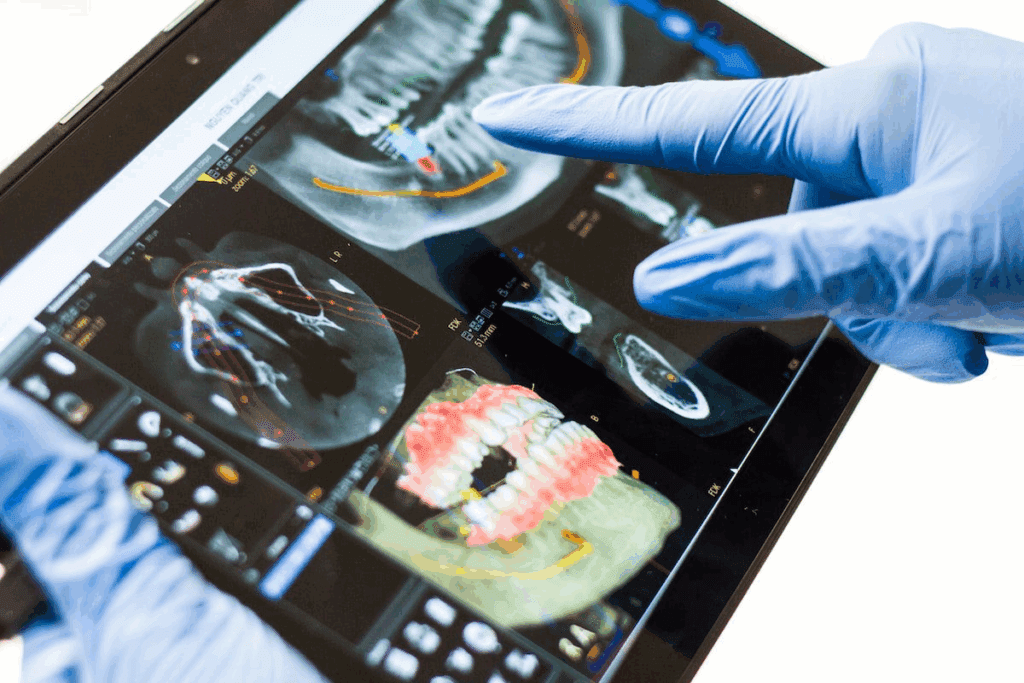
Cone Beam Computed Tomography (CBCT) is a special X-ray that shows teeth, jaw, and facial structures in 3D. We use it to get detailed diagnoses and plan treatments well.
CBCT scans are different from regular X-rays. They give a full view of the body while using less radiation. This helps dentists make better diagnoses and improve patient care.
CBCT scans show a clear picture of teeth, bones, and facial structures. This has changed how we diagnose and plan dental treatments.
Key Takeaways
- CBCT scans provide 3D views of teeth, jaw, and facial structures.
- Lower radiation exposure compared to traditional X-rays.
- Enables accurate diagnoses and better patient outcomes.
- Revolutionizes dental diagnostics and treatment planning.
- Offers detailed anatomical insights for dental professionals.
Understanding CBCT Technology in Dentistry
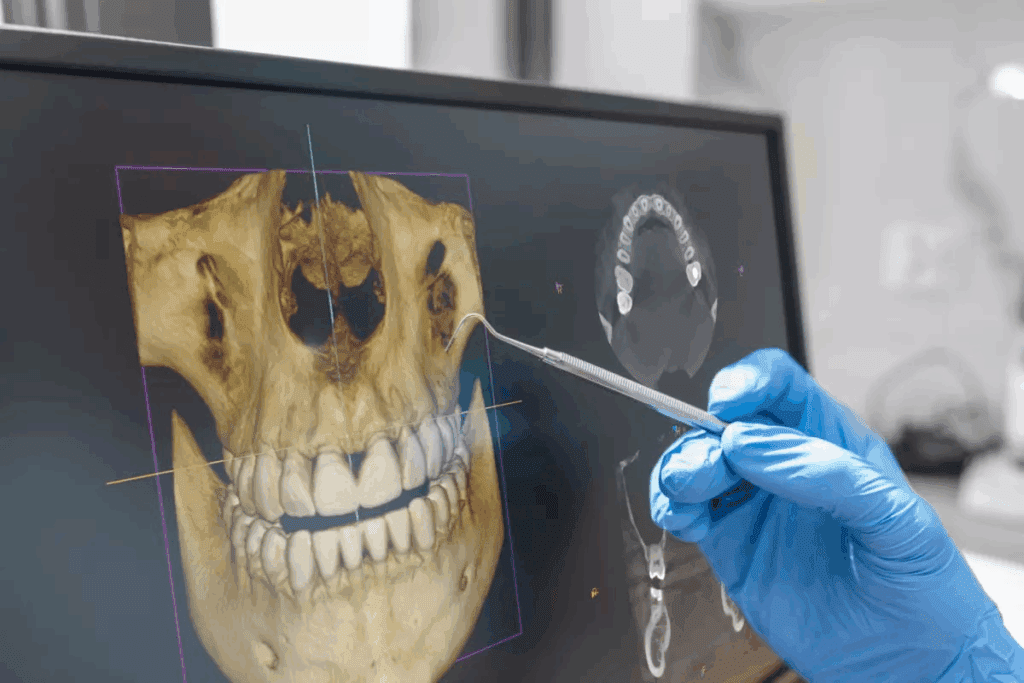
Cone Beam Computed Tomography (CBCT) is a big step up in dental imaging. It’s a technology that has changed how dentists diagnose and plan treatments.
We’ll look at what CBCT is and how it works. We’ll also see how it has changed dentistry from old dental X-rays.
Definition and Basic Principles
CBCT uses a cone-shaped X-ray beam to capture images. It takes a lot of data in one go, showing dental structures in 3D.
It works by taking many images from different angles. Then, it makes a 3D picture. This 3D view helps dentists make accurate diagnoses and plans.
Evolution from Traditional Dental X-rays
Old dental X-rays are 2D, which can limit diagnosis. CBCT scans, on the other hand, are 3D. This makes them much better for finding problems.
CBCT came from a need for better images. It lets dentists see complex structures and problems more clearly.
| Feature | Traditional X-rays | CBCT Scans |
|---|---|---|
| Dimensionality | 2D | 3D |
| Diagnostic Accuracy | Limited by 2D representation | Enhanced with 3D visualization |
| Radiation Exposure | Variable, often higher | Generally lower, compared to medical CT |
Understanding CBCT shows its importance in dentistry today. The CBT scan is key for dentists. It gives them better diagnostic tools and improved patient care.
What Does CBCT Stand For in Dental Imaging
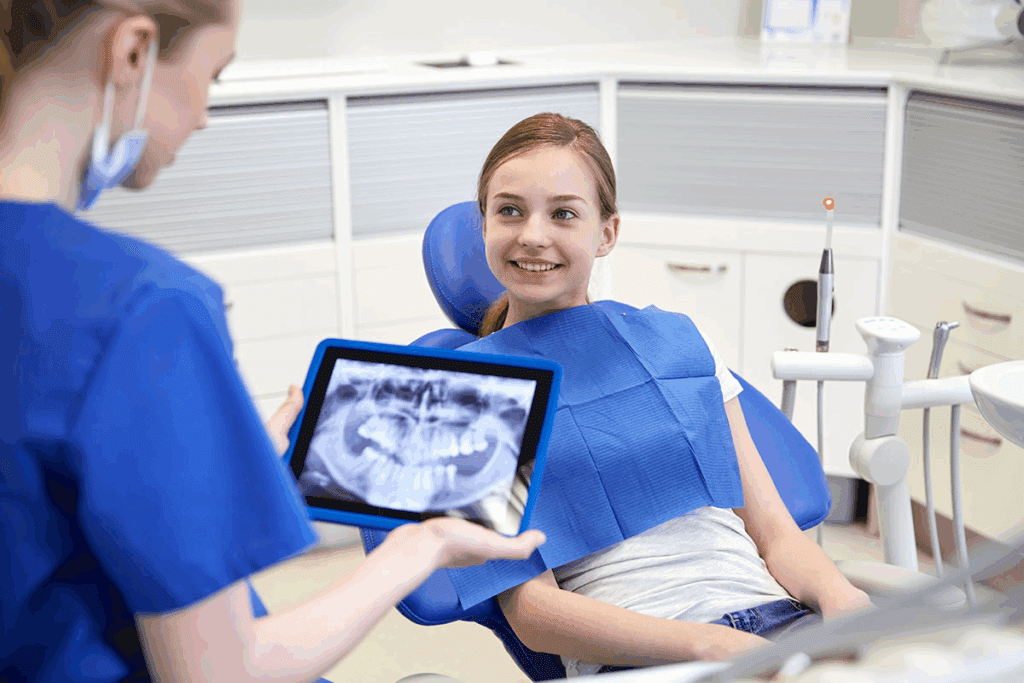
CBCT is a term you might see in dentistry, but what does it mean? Simply put, CBCT stands for Cone Beam Computed Tomography. It’s a technology that has greatly improved dental imaging.
Breaking Down the Acronym
Cone Beam Computed Tomography uses a cone-shaped X-ray beam to take detailed images of teeth and gums. The “Cone Beam” part describes the X-ray beam’s shape. It moves around the patient’s head to take 150 to 200 high-quality images.
These images are then turned into a 3D model. This model gives a full view of the dental structure.
At Mercer Island Dental, led by Medical Expert, we use CBCT scans. They help us give our patients accurate diagnoses and effective treatment plans.
Historical Development of the Technology
The creation of CBCT technology is a big step forward in dental imaging. Old dental X-rays only showed a two-dimensional view. But CBCT scans offer a three-dimensional view, helping us better diagnose and treat dental problems.
The development of CBCT is linked to computer and image processing advancements. Early CT scans were big and expensive, mainly used in hospitals. But as technology improved, CBCT machines became smaller and more affordable for dental offices.
CBCT technology has many benefits:
- It makes diagnoses more accurate
- It helps us see complex anatomy better
- It uses less radiation than traditional CT scans
- It lets us plan complex treatments more precisely
As dentistry keeps getting better, technologies like CBCT are key to better patient care. For example, CBCT scans are often used for dental implants. They help us assess the area before surgery.
How CBCT Scan Dental Imaging Works
CBCT scan dental imaging is key in modern dentistry. It gives us precise info, helping us care for patients better.
The Cone Beam Technology Explained
Cone Beam Computed Tomography (CBCT) uses a cone-shaped X-ray beam. It captures dental structure images, unlike two-dimensional X-rays.
The technology rotates around the patient’s head. It takes data from many angles. This makes detailed, three-dimensional images possible.
Image Acquisition Process
The machine rotates around the patient’s head during a CBCT scan. It takes images from different angles in a few seconds to a minute.
These images are then used to create a 3D model of the dental structure.
3D Reconstruction Techniques
Advanced software compiles the images into a 3D model. This model can be viewed from any angle, giving us valuable insights.
The 3D images show dental anatomy more accurately. This helps in better diagnosis and treatment planning.
| Feature | CBCT Scan | Traditional X-rays |
|---|---|---|
| Dimensionality | 3D Imaging | 2D Imaging |
| Detail Level | Highly Detailed | Limited Detail |
| Diagnostic Capability | Comprehensive Diagnosis | Limited Diagnostic Scope |
CBCT scan dental imaging is a big step forward in dentistry. It helps us diagnose better and improve patient care.
Key Components of a CBCT Scanning System
A CBCT scanning system has key parts that work together to make high-quality images. Knowing these parts helps us see how CBCT scan dental tech works.
Hardware Elements
The hardware of a CBCT system is key for getting the data needed for images. It includes:
- The X-ray source, which sends out a cone-shaped beam of X-rays.
- A detector that catches the X-rays after they go through the patient’s head.
- A rotating gantry that moves the X-ray source and detector around the patient’s head.
During the scan, the patient sits or stands with their head steady. This is important for clear images.
Software and Image Processing
After capturing the data, special software makes the images. This software is a big part of the scan cbct system. It turns raw data into detailed 3D images.
The software rebuilds the data into a detailed 3D image. This lets us see complex structures clearly. It’s very useful for teeth ct scan needs, where detailed images are key for diagnosis and planning.
| Component | Function |
|---|---|
| X-ray Source | Emits a cone-shaped beam of X-rays |
| Detector | Captures X-rays after passing through the patient’s head |
| Rotating Gantry | Moves the X-ray source and detector around the patient’s head |
| Software | Reconstructs 3D images from captured data |
By using advanced hardware and smart software, CBCT systems give us top-notch images. These images are vital for today’s dental care.
The CBCT Scan Procedure: Patient Experience
Getting a CBCT scan for dental health is easy and gives us important insights. We know you might feel a bit nervous, so we’re here to help you know what to expect.
Before the Scan: Preparation
We ask you to take off any metal items before starting. This includes jewelry, glasses, and dental appliances. You’ll be placed in a way that lets us get the images we need. We’ll also give you a lead apron to protect you from too much radiation.
Wear comfy clothes and leave your valuables at home. Our team will explain everything and answer your questions. We want you to feel at ease and informed.
During the Scan: What to Expect
You’ll be asked to stand or sit in a certain way, depending on the scanner. The scanner will move around your head, taking pictures from different angles. This usually takes less than a minute, and you’ll need to stay very quiet and steady.
The scanner is designed to be quiet and comfy. You can breathe and swallow as you need, but we’ll ask you to hold your position during the scan.
After the Scan: Results and Analysis
After the images are taken, our team will look at them closely. This helps us find problems like impacted teeth or jaw issues. We’ll use this info to plan your treatment.
The 3D images from the scan show us your bone structure and nerves. We’ll talk to you about what we found and suggest the best treatment. This way, we can make sure you get the care you need.
CBCT scans have many benefits:
- They help us find and fix complex dental problems.
- They give us detailed 3D images for planning your treatment.
- They use low radiation and are minimally invasive.
- They’re quick and give us results right away.
Knowing what to expect from a CBCT scan makes you feel more ready. Our team is dedicated to giving you the best care. We use the latest tech to help your dental health.
What Does a Dental CT Scan Show?
A dental CT scan uses advanced technology to show detailed images of the mouth. Dentists use these images to understand and treat many dental problems. This helps them provide better care for their patients.
Anatomical Structures Visible in CBCT Images
CBCT scans reveal many parts of the mouth, like teeth, jawbone, sinuses, and soft tissues. The 3D images let dentists see how these parts fit together. This is key for understanding the mouth’s layout.
These scans are great for looking at teeth positions, even impacted ones. They show how teeth relate to bone and nerves. This info is important for orthodontic plans and dental implants.
Bone Density and Volume Assessment
CBCT scans can measure bone density and volume. This is important for dental implants. It helps dentists know if a patient is a good candidate and where to place implants.
| Assessment Criteria | Description | Clinical Significance |
|---|---|---|
| Bone Density | Measurement of bone mineralization | Impacts implant success and stability |
| Bone Volume | Evaluation of available bone for implant placement | Determines the need for bone grafting procedures |
Pathological Conditions Detectable
CBCT scans are great at finding problems like cysts, tumors, and infections in the jaw. They also spot TMJ disorders by showing the joint’s details and any issues.
Seeing these problems in 3D makes diagnosis more accurate. It helps dentists plan the right treatment. For example, scans can show how big a cyst or tumor is, helping with surgery.
In summary, dental CT scans give a full view of the mouth. They help dentists find and fix many dental issues with better accuracy. Thanks to CBCT scans, we can give our patients more tailored and effective care.
Clinical Applications of CBCT Scans in Dentistry
CBCT scans have changed dental care a lot. At Valley Hills Dentistry, we use them to check complex cases. This includes checking jawbone density for implant stability. They give us detailed views that old imaging can’t.
Orthodontic Treatment Planning
CBCT scans give us a full view of teeth and bones for orthodontic planning. This helps us plan treatments more accurately. A top orthodontic researcher says CBCT scans have greatly improved diagnosis and treatment.
“The use of CBCT in orthodontics has opened new avenues for diagnosis and treatment planning, allowing for more precise and personalized care.”
These scans show early issues like root resorption or bone problems. This info is key for safe and effective treatments.
Endodontic Diagnosis and Treatment
In endodontics, CBCT scans are key for complex root canal treatments. They show us root canal details that X-rays can’t. This tech helps us do root canals better.
CBCT scans also spot tooth cracks or fractures. This is vital for choosing the right treatment. They help us make better treatment plans.
TMJ Evaluation
CBCT scans help us check the TMJ. They show us the joint’s details, helping us find problems like osteoarthritis. This info is key for treating TMJ issues.
Airway Analysis
CBCT scans also check airways, which is key for sleep disorder diagnosis. They help us see airway size and blockages. This shows how useful CBCT tech is in dentistry.
In short, CBCT scans are very useful in dentistry. They help with orthodontics, TMJ checks, and airway analysis. Their detailed 3D images are a big help in dental care today.
CBCT Scan for Dental Implants: A Critical Tool
Dental implant planning has become more precise with CBCT technology. This technology gives a detailed view of the patient’s anatomy. It has changed dental implantology, allowing dentists to see bone structure and density in great detail.
Pre-surgical Planning Benefits
CBCT scans are key for better pre-surgical planning. They provide detailed 3D images. Dentists can:
- Check the quality and quantity of bone
- Find the best spot for implant placement
- See how close to nerves and sinuses the implant will be
- Plan for bone grafting if needed
This detailed information lowers the risk of surgery problems. It also makes dental implant success more likely.
Guided Implant Surgery
CBCT scans are also vital for guided implant surgery. They help create a 3D model of the jaw. Dentists use this to make surgical guides for precise implant placement. This technology:
- Makes implant placement more accurate
- Shortens surgery time
- Reduces patient discomfort
- Improves the success of the implant procedure
Guided implant surgery is a big step forward. It leads to more predictable and successful results.
Post-implant Assessment
After the implant procedure, CBCT scans help check if it was successful. The 3D images let dentists:
- See how well the implant is integrating with bone
- Look for any signs of problems or failure
- Plan for the final prosthesis placement
This assessment is key for the long-term success of the dental implant.
| Benefits of CBCT Scans in Dental Implants | Description |
|---|---|
| Pre-surgical Planning | Detailed 3D images for accurate assessment of bone structure and density |
| Guided Implant Surgery | Precise 3D modeling for surgical guides, improving accuracy and reducing complications |
| Post-implant Assessment | Evaluation of implant integration and detection of possible complications |
Advantages of CBCT Over Traditional Dental Radiography
CBCT scans have changed dental imaging with their advanced features. They offer many benefits for dental diagnosis and planning. Let’s look at why CBCT scans are better than traditional dental X-rays.
Enhanced Diagnostic Capabilities
CBCT scans give three-dimensional images of teeth and gums. This helps dentists make more accurate diagnoses and plans. A top dental research group says, “CBCT imaging is key in today’s dentistry, with unmatched accuracy.”
“CBCT imaging is key in today’s dentistry, with unmatched accuracy.”
These detailed images help dentists handle complex cases better. For example, CBCT scans can show bone density and volume. This is vital for planning dental implants.
Reduced Radiation Exposure Compared to Medical CT
CBCT scans also have a big plus: they use less radiation than medical CT scans. They use a cone-shaped X-ray beam, which means less radiation. This makes CBCT scans safer for patients needing many X-rays.
Studies show CBCT scans use much less radiation than CT scans. This makes them a great choice for dental imaging. We focus on keeping radiation low while getting top-quality images.
- Lower radiation doses compared to medical CT scans
- High-quality, three-dimensional images
- Enhanced diagnostic accuracy for complex dental cases
Choosing CBCT scans helps dentists give accurate diagnoses safely. This fits with our goal of top-notch healthcare for all patients.
Comparing CBCT to Other Dental Imaging Modalities
CBCT technology has changed dental imaging by giving detailed 3D views. These views are better than what traditional radiography offers. Knowing the differences between CBCT and other imaging methods is key for better diagnosis and treatment plans.
CBCT vs. Panoramic Radiography
Panoramic radiography shows a 2D view of teeth, which can miss important details. CBCT scans provide a 3D view, helping to see bone density, volume, and health issues more clearly. This is very helpful for dental implants, where exact measurements are needed.
While panoramic radiography is good for general checks, CBCT’s detailed images make more detailed checks less necessary. This makes the diagnostic process faster. Also, CBCT’s cross-sectional images let dentists see the teeth’s width, something panoramic radiographs can’t do.
CBCT vs. Intraoral Radiographs
Intraoral radiographs are X-rays taken inside the mouth, showing detailed images of teeth and bone. But, they only show 2D representations of 3D structures. CBCT scans, by contrast, give a full view of dental anatomy, including how different parts relate to each other.
The 3D imaging of CBCT is very useful in complex cases, like impacted teeth or root fractures. It’s also good because it often means fewer X-rays for patients, which is safer.
In summary, while traditional dental imaging has its place, CBCT scans offer better diagnostic info because they show detailed 3D images. As dental care advances, CBCT technology will likely be used more, improving diagnosis and treatment results.
Limitations and Considerations of Dental CBCT Scanning
CBCT scans in dentistry have their downsides, mainly about safety and how easy they are to get. We see the big pluses of CBCT scans in dental imaging. But, we must talk about these downsides to make sure they’re used safely and well.
Radiation Safety Protocols
We stick to radiation safety protocols to cut down patient exposure. We use the least dose needed for diagnosis, following the ALARA principle (As Low As Reasonably Achievable). Dental experts check if CBCT scans are really needed for each patient, making sure the good parts outweigh the bad.
Cost and Accessibility Factors
The price of CBCT scanning gear and the need for skilled people to read the images can be big hurdles. Not every dental office can offer CBCT scans, so some patients might need to go to special centers. We’re working hard to make CBCT tech cheaper and more available, thanks to new tech and more dental offices using it.
Conclusion: The Value of CBCT Scans in Modern Dental Care
CBCT scans have become key in modern dental care. They give detailed info that helps improve treatment results. This tech offers a full view of the dental structure, helping dentists plan and do treatments better.
The future of CBCT scan dental tech looks bright. We’ll see clearer images, less radiation, and faster scans. These advancements will lead to more accurate diagnoses and effective treatments.
CBCT scans have greatly improved dentistry. They allow for more precise diagnoses and better patient care. Their ability to provide detailed 3D images is vital for complex dental work.
As we go forward, CBCT scans will play an even bigger role in dental care. They will help improve patient outcomes and treatment success. Dental pros can offer top-notch care by using CBCT scan tech, meeting their patients’ changing needs.
FAQ
What is a CBCT scan, and how does it differ from a traditional dental X-ray?
A CBCT scan uses a cone-shaped X-ray beam to capture detailed 3D images. It shows the teeth, jaw, and surrounding structures. Unlike traditional dental X-rays, which are 2D, CBCT scans give a more detailed view. This helps dentists diagnose and treat complex cases better.
What does CBCT stand for in dental imaging?
CBCT stands for Cone Beam Computed Tomography. It’s a technology that has changed dental imaging by providing high-resolution 3D images.
How does a CBCT scan work?
A CBCT scan works by rotating a cone-shaped X-ray beam around the patient’s head. It captures data that is then turned into a 3D image using advanced software.
What are the benefits of using CBCT scans for dental implants?
CBCT scans are great for dental implant planning. They show detailed information about bone density, volume, and anatomy. This helps dentists place implants more accurately and precisely.
Are CBCT scans safe?
Yes, CBCT scans are safe when used correctly. They involve X-ray exposure, but the dose is lower than a medical CT scan. Dental professionals follow strict safety protocols to reduce exposure.
How do CBCT scans compare to panoramic radiography?
CBCT scans provide more detailed 3D information than panoramic radiography’s 2D image. They are better for complex cases, like dental implant planning and orthodontic treatment.
Can CBCT scans detect pathological conditions?
Yes, CBCT scans can find various pathological conditions, like cysts, tumors, and bone lesions. They also assess bone density and volume.
How are CBCT scans used in orthodontic treatment planning?
CBCT scans help in orthodontic treatment planning. They show the position of teeth, roots, and bone. This helps orthodontists create more effective treatment plans.
What are the limitations of CBCT scanning?
CBCT scans have many benefits but also involve X-ray exposure. The cost and accessibility can be limiting. Dental professionals must consider the benefits and risks when deciding to use them.
How do I prepare for a CBCT scan?
To prepare for a CBCT scan, remove any jewelry or metal objects from your head and neck. Follow any specific instructions from your dental professional.
What can I expect during a CBCT scan?
During a CBCT scan, you’ll be in a machine that rotates around your head. It captures data for a few seconds to a few minutes, depending on the scan type.
References
National Center for Biotechnology Information. Evidence-Based Medical Guidance. Retrieved from https://www.ncbi.nlm.nih.gov/books/NBK592390/



 Departments
 Related Videos
 Our Doctors
 News
News