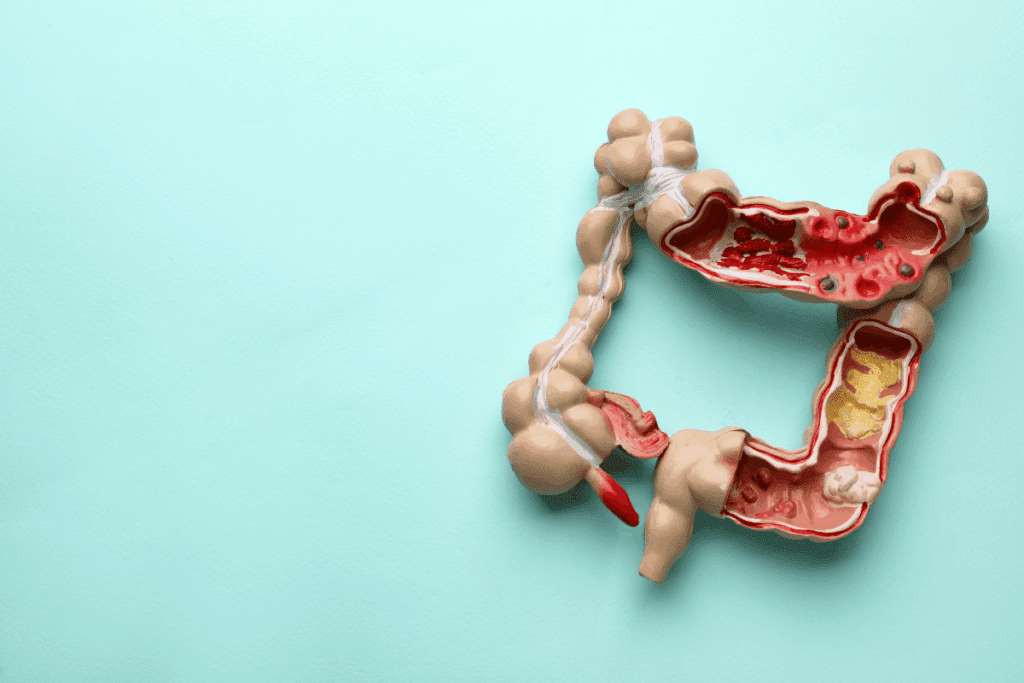
The rectum is a key part of our digestive system. It’s the last part of the large intestine. It comes from the Latin word for ‘straight intestine.’ It holds feces temporarily before we get rid of it.define rectumCan Benign Tumors Become Cancerous? Understanding Malignant Tumor Risks and Meanings
It’s important to know about the rectum’s function and anatomy. The rectum is the last part of the large intestine. It’s about 12-15 centimeters long. It stores waste until it’s time to get rid of it.
Understanding the rectum is key to our digestive health. Knowing how it works helps us notice health issues. It also helps us make smart choices about our health.
Key Takeaways
- The rectum is the final segment of the large intestine.
- It serves as a temporary storage site for feces.
- Understanding the rectum’s function is vital for digestive health.
- The rectum is approximately 12-15 centimeters in length.
- Proper care and understanding can lead to better health decisions.
The Medical Definition of Rectum

It’s key to know what the rectum is for our health. It’s a big part of our digestive system. Knowing its role helps doctors and people understand their health better.
Etymology and Origin of the Term
The word ‘rectum’ comes from Latin, meaning ‘straight intestine.’ This shows how it was seen in the past. It was first used in the 15th century, starting its use in medical books.
Ever after, it’s been a key term in talking about the body. This shows how important it is in medical talks.
Basic Anatomical Description
The rectum is the last part of the large intestine. It goes from the sigmoid colon to the anal canal. It holds feces until they leave the body.
The rectum’s shape helps it do this job. It has muscles that push out feces. Knowing about the definition for rectum helps us see its role in digestion.
To spell rectum right is R-E-C-T-U-M. It’s a key word in health talks. The rectum’s role is often talked about in health issues. This shows why we need to understand it well.
In short, the medical meaning of the rectum includes its shape, role in digestion, and where it comes from. Knowing what the rectum means helps us see its value in health. It shows why we should take care of it.
Anatomical Location and Structure

The rectum is between the sigmoid colon and the anal canal. It’s a key part of the digestive process. It’s in the pelvic cavity and is the most back part of the pelvic viscera. We’ll look at its place in the digestive system and its ties to other organs.
Position Within the Digestive System
The rectum starts where the sigmoid colon ends. It gets feces from the colon. It ends at the anal canal, where we get rid of waste. Its main job is to hold waste until we go to the bathroom.
The rectum is part of the large intestine. It helps absorb water and salts from waste. This makes the waste more concentrated before it’s thrown out.
Relationship to Surrounding Organs
The rectum is close to many organs, but this changes between men and women. Behind it, there’s fatty tissue between it and the sacrum and coccyx. In men, it’s near the bladder, seminal vesicles, and prostate. In women, it’s near the vagina and uterus.
Knowing where the rectum is and its connections is key for diagnosing and treating problems. To define rectum right, we must see its role and spot in the digestive system.
The Five Layers of the Rectum
The rectal wall has five layers, each playing a key role in digestion. Knowing about these layers is vital for diagnosing and treating rectal issues.
Mucosa Layer
The mucosa is the innermost layer, a mucous membrane that touches feces. It absorbs water and hosts lymphoid tissue, essential for health.
Submucosa Layer
Under the mucosa is the submucosa, full of blood vessels, lymphatic vessels, and nerves. It supports the mucosa and helps with nutrient and waste exchange.
Muscularis Layer
The muscularis propria, or muscular layer, has smooth muscle cells in circular and longitudinal layers. It helps move feces by contracting and relaxing.
Serosa and Adventitia Layers
The outer layers are the serosa and adventitia. The serosa is covered by visceral peritoneum, while the adventitia is connective tissue. They offer extra support and protection.
To understand the rectal wall better, let’s look at the layers in a table:
Layer | Description | Function |
Mucosa | Mucous membrane lining the rectal lumen | Absorbs water, houses lymphoid tissue |
Submucosa | Layer rich in blood vessels, lymphatic vessels, and nerve fibers | Supports mucosa, facilitates nutrient and waste exchange |
Muscularis Propria | Layer of smooth muscle cells | Enables contraction and relaxation for feces movement |
Serosa/Adventitia | Outermost layers providing support and protection | Protects the rectum, provides additional support |
Key Anatomical Features
The rectum is a key part of our digestive system. It has important features that help it work well. Knowing about these features helps us understand how the rectum keeps us healthy.
Houston’s Valves (Transverse Rectal Folds)
Houston’s valves, or transverse rectal folds, are a key feature of the rectum. There are usually three of these folds. They help partially compartmentalize the rectum, keeping feces stored until it’s time to go.
“The rectal valves are significant because they help to support the rectal contents and prevent involuntary defecation,” as noted in various medical literature.
Houston’s valves are not just interesting structures. They have a purpose. They create small compartments in the rectum. This helps manage fecal matter, keeping it stored until it’s time to go.
Rectal Ampulla
The rectal ampulla is another important feature. It’s an expanded part at the end of the rectum. This ampulla acts as a temporary storage for feces before they leave the body.
The rectal ampulla is key for storing and then getting rid of feces. Its shape allows it to hold fecal matter, making it essential for controlled bowel movements.
“The rectal ampulla serves as a critical site for storing feces, playing a vital role in defecation.”
In summary, the rectum’s main features, like Houston’s valves and the rectal ampulla, are vital. They help us understand how the rectum works and its role in our health.
How to Define Rectum in Clinical Medicine
The rectum is a key part of our digestive system. It’s important to know what it is for medical reasons. This is true, like when doctors do a digital rectal exam.
To define the rectum right, we need to look at both medical terms and body landmarks. This way, doctors can be clear and precise in their work.
Standard Medical Terminology
In medical talk, the rectum is the last part of the large intestine. It goes from the rectosigmoid junction to the anal canal. Knowing this helps doctors understand its role in digestion and diagnose problems.
The word “rectum” comes from Latin, meaning “straight intestine.” Even though it’s not perfectly straight, this history helps us understand it better.
“The rectum is a complex structure with both anatomical and functional significance in the gastrointestinal tract.”
— Clinical Gastroenterology
Anatomical Landmarks for Identification
Landmarks are key for finding the rectum during exams. Important ones are the rectosigmoid junction and the anorectal junction. These spots help doctors know where the rectum starts and ends.
Landmark | Description |
Rectosigmoid Junction | Transition from sigmoid colon to rectum |
Anorectal Junction | End of rectum, start of anal canal |
Houston’s Valves | Transverse rectal folds within the rectum |
These landmarks are vital for exams like digital rectal exams and proctoscopy. Knowing where the rectum is helps doctors do their job right.
By using both medical terms and body landmarks, doctors can define and find the rectum accurately. This is key for good diagnosis and treatment.
The Rectum’s Role in Digestion
The rectum is key in our digestive system. It mainly holds fecal matter until it’s time to go. Knowing how the rectum works helps us understand digestion better.
Storage of Fecal Matter
The main job of the rectum is to hold waste until it’s time to go. This is important for regular bowel movements and good gut health. The rectum acts like a tank, letting the body decide when to go.
Water Absorption Process
The rectum also absorbs extra water from the stool. This makes the stool easier to pass. The lining of the rectum can take in water and salts, making the stool solid.
This water absorption is key to avoiding diarrhea. It keeps the stool just right, not too loose or too hard.
Learning about the rectum’s role in digestion is enlightening. It shows how the rectum stores waste and absorbs water. This knowledge helps us see why keeping the rectum healthy is so important.
Neurological Control of the Rectum
It’s key to know how the rectum works for digestion. The rectum’s actions are managed by a mix of nerve signals. These signals help control when we go to the bathroom and keep us from going too often.
Sensory Receptors and Nerve Pathways
The rectum has special sensors that feel when it’s stretched or when pressure changes. These sensors start the process of going to the bathroom. The nerves that control the rectum include both automatic and voluntary systems. They work together to manage how the rectum functions.
The automatic nervous system handles things we can’t control, like when the rectal muscles contract or relax. The voluntary system, though, lets us choose when to squeeze the muscles around the anus.
Defecation Reflex Mechanism
The process of going to the bathroom starts when the rectum is stretched by feces. This stretching sends signals to the brain and spinal cord. It makes the muscles inside the anus relax and the rectal muscles contract, helping to push out feces.
We can summarize the key components of the defecation reflex mechanism in the following table:
Component | Function |
Sensory Receptors | Detect stretch and pressure in the rectal wall |
Autonomic Nervous System | Controls involuntary actions of rectal muscles |
Somatic Nervous System | Regulates voluntary control over the external anal sphincter |
Defecation Reflex | Initiates the process of feces elimination |
The way the rectum is controlled by nerves shows how complex our digestive system is. Knowing about these systems helps us see why keeping the rectum healthy is so important.
Differences Between the Rectum and Anal Canal
The rectum and anal canal are closely related but have key differences. Knowing what the rectum is and how it relates to the anal canal is important. This knowledge helps both doctors and patients.
Anatomical Distinctions
The rectum is the last part of the large intestine. It holds feces until they are passed. It is straight and has a fatty tissue around it, called the mesorectum.
The anal canal is at the end of the GI tract, linking the rectum to the anus. It has muscles that help control when you go to the bathroom. The anal canal is short and has different types of skin lining.
Functional Differences
The rectum stores feces until it’s time to go. Its muscles help keep things inside until you’re ready. This helps you control when you go to the bathroom.
The anal canal is key for the last part of going to the bathroom. Its muscles and skin help you feel when it’s time to go. This is important for controlling when you go.
Key differences between the rectum and anal canal include:
- The rectum stores feces, while the anal canal is for the final stage of going to the bathroom.
- The rectum has the mesorectum, while the anal canal has muscles that control going to the bathroom.
- The rectum and anal canal have different skin linings, showing their different roles.
Knowing these differences helps doctors treat problems like hemorrhoids and rectal prolapse. It’s important for understanding and treating health issues in these areas.
Common Medical Conditions Affecting the Rectum
It’s key to know about common medical issues that hit the rectum. This part of our digestive system can face many problems. These issues can mess with its function and health.
Inflammatory Conditions
Inflammatory issues in the rectum can really hurt and cause health problems. Proctitis is one, caused by infections, radiation, or inflammatory bowel disease. It brings pain, bleeding, and diarrhea. Spotting these signs early is vital.
Ulcerative proctitis is another issue, a type of ulcerative colitis that only affects the rectum. It leads to inflammation and ulcers, causing bleeding and urgency.
Structural Abnormalities
Structural problems can also trouble the rectum. Rectal prolapse happens when the rectum slips out of its place. It’s often due to constipation, diarrhea, or weak muscles.
Hemorrhoids are another issue. They are swollen veins in the lower rectum or anus. They can hurt and bleed when you go to the bathroom.
Cancerous Conditions
Cancer is a big worry, like rectal cancer. It starts in the rectum, often from a polyp or abnormal cells. Catching it early is key to treating it well.
Regular screening for rectal cancer is a must, for those with a family history or other risks. New tests help us find and treat cancer better.
Diagnostic Procedures for Rectal Examination
Many diagnostic techniques are used to check the rectum for issues. These methods are key for looking at rectal health and finding various conditions that might affect it.
Digital Rectal Examination
A digital rectal examination (DRE) is a basic test. A healthcare provider manually checks the rectum. They use a gloved, lubricated finger to feel for problems like masses or tenderness.
This simple test helps in the first look. It lets doctors check the rectal mucosa and feel for pain or discomfort. They also look for any masses or lesions.
Proctoscopy and Sigmoidoscopy
Proctoscopy and sigmoidoscopy are more detailed tests. They use a scope to see inside the rectum and sigmoid colon. Proctoscopy looks at the rectum, while sigmoidoscopy checks the rectum and sigmoid colon.
These tests are great for seeing the rectal mucosa and finding lesions. They help diagnose issues like hemorrhoids, polyps, and rectal bleeding.
Advanced Imaging Techniques
Advanced imaging like MRI and CT scans give detailed views of the rectum and nearby areas. These tools are key for checking rectal cancer and planning treatment.
For example, MRI is good at showing how far rectal tumors are and how they relate to nearby tissues. This info is important for surgery planning and choosing the best treatment.
Diagnostic Procedure | Description | Primary Use |
Digital Rectal Examination (DRE) | Manual examination of the rectum | Initial assessment, detecting masses or tenderness |
Proctoscopy | Visual examination of the rectum using a scope | Diagnosing rectal conditions, visualizing lesions |
Sigmoidoscopy | Visual examination of the rectum and sigmoid colon | Identifying polyps, hemorrhoids, and rectal bleeding causes |
MRI/CT Scans | Detailed imaging of the rectum and surrounding structures | Staging rectal cancer, assessing disease extent |
Maintaining Rectal Health and Prevention
Keeping our rectum healthy is key to feeling good. We need to watch what we eat and get regular check-ups. Taking care of our rectum can help avoid big problems.
Dietary Considerations
Eating foods high in fiber is important. Fiber keeps our bowels regular and stool soft. We should eat lots of fruits, veggies, and whole grains.
Drinking enough water is also key. Water helps prevent constipation by making stool softer. We should drink water all day to stay hydrated.
Screening Recommendations
Getting regular screenings is vital for catching rectal cancer early. People over 45 should get screened, as their doctor suggests. Screenings can find polyps that could turn into cancer before they do.
Screening Method | Frequency | Age Group |
Fecal Immunochemical Test (FIT) | Annually | 45+ |
Colonoscopy | Every 10 years | 45+ |
“Regular screenings can significantly reduce the risk of rectal cancer by detecting precancerous polyps early.”
Medical Expert, Gastroenterologist
By eating right and getting screenings, we can keep our rectum healthy. It’s important to stay informed and proactive about our rectal health.
Conclusion
We’ve looked into the rectum’s anatomy, functions, and health issues. It’s key to the digestive system, helping with storing and passing waste. Knowing about the rectum is vital for good gut health.
Understanding the rectum’s role in digestion and its control by the nervous system is important. It helps us see how complex our bodies are. Knowing about the rectum helps us prevent problems in the digestive system.
Keeping the rectum healthy is important for our overall health. Eating well and knowing about screenings can lower the risk of problems. We hope this detailed look at the rectum has given you useful insights and the importance of caring for it.
FAQ:
What is the rectum and its function in the human body?
The rectum is a part of the large intestine. It holds feces temporarily before they are eliminated. It’s key for storing and getting rid of waste.
What is the origin of the term ‘rectum’?
The word ‘rectum’ comes from the Latin. It means ‘straight intestine.’
What are the layers of the rectum?
The rectum has several layers. These include the mucosa, submucosa, muscularis propria, and serosa or adventitia. Each layer has a specific role in the rectum’s structure and function.
What is the rectal ampulla?
The rectal ampulla is the widened end of the rectum. It’s where feces gather before they are eliminated.
How is the rectum defined in clinical medicine?
In medicine, the rectum is defined by specific terms and landmarks. These are important for tests like digital rectal exams and proctoscopy.
What is the role of the rectum in digestion?
The rectum acts as a reservoir for feces. It absorbs water to keep stool consistent.
What is the defecation reflex mechanism?
The defecation reflex is a complex process. It involves sensory receptors, nerve pathways, and the coordination of defecation. It’s vital for maintaining continence.
What are the differences between the rectum and anal canal?
The rectum and anal canal are different. The rectum stores feces, while the anal canal is where feces are eliminated.
What are some common medical conditions that affect the rectum?
Common issues include inflammatory conditions like proctitis, structural problems like rectal prolapse, and cancerous conditions like rectal cancer.
What diagnostic procedures are used to examine the rectum?
Tests include digital rectal exams, proctoscopy, sigmoidoscopy, and advanced imaging. These are key for diagnosing and treating rectal conditions.
How can rectal health be maintained?
Good rectal health comes from a diet rich in fiber and enough water. Regular screenings also help prevent and detect conditions like rectal cancer.
What does rectum mean?
‘Rectum’ refers to the last part of the large intestine. It goes from the sigmoid colon to the anal canal.
How is the rectum related to the surrounding organs?
The rectum is near the sacrum and coccyx at the back. Its position varies between males and females.
What is the definition of the rectum in medical terms?
In medicine, the rectum is the part of the large intestine for temporary feces storage. It’s essential for waste storage and elimination.
References:
National Center for Biotechnology Information. Rectum: Definition, Function, and Anatomy. Retrieved from https://www.ncbi.nlm.nih.gov/books/NBK537245/