Dentistry focuses on diagnosing, preventing, and treating conditions of the teeth, gums, and oral structures, supporting oral health and overall well-being.
Send us all your questions or requests, and our expert team will assist you.

Digital dentistry means using computer-controlled tools and digital technology in dental care, changing how dentists diagnose, restore, and perform surgery. At Liv Hospital, this approach moves away from manual methods to more precise, automated systems that improve results and patient comfort. Digital dentistry includes technologies like Cone Beam Computed Tomography (CBCT), intraoral scanning, CAD/CAM, and 3D printing. These tools help create a “Virtual Patient,” a digital copy that combines detailed tissue and movement data. With this digital model, dentists can plan treatments, design accurate prosthetics, and create custom scaffolds for each patient’s needs.

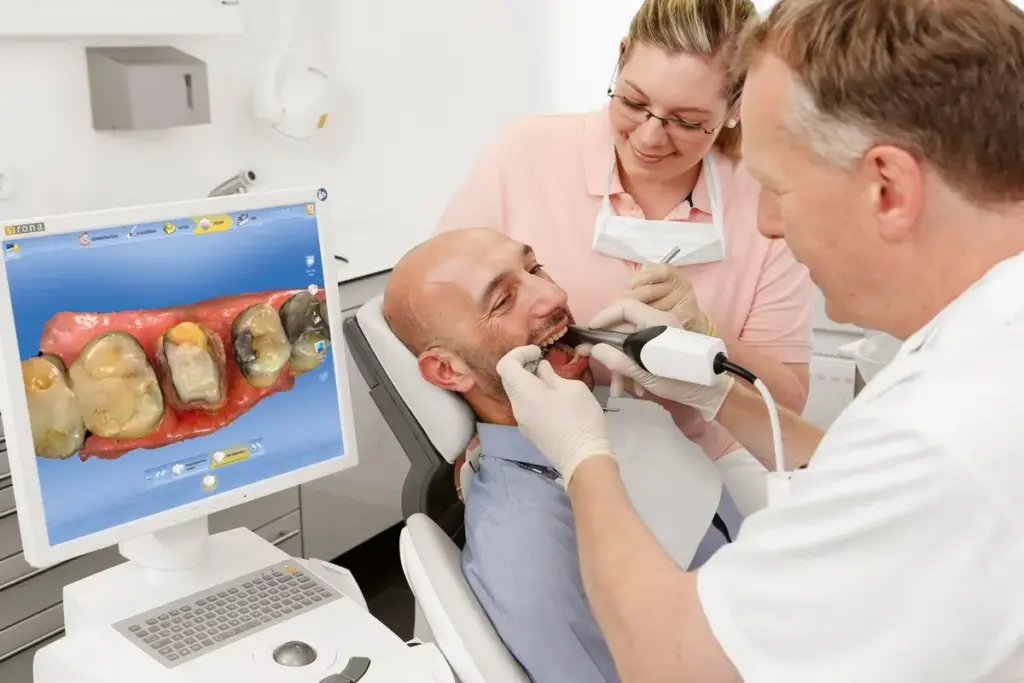
Principles of Intraoral Digitization
Digital dentistry starts by turning physical features in the mouth into digital data. Intraoral scanners do this by using advanced optical technology to map the teeth and soft tissues.
Light Projection and Triangulation
Structured Light Scanning: Modern scanners shine a pattern of light, like grids or lines, onto the teeth. Cameras capture how this pattern changes on the tooth’s surface. Software then calculates the distance to each point, creating a digital map of the teeth.
Confocal Microscopy: This method uses a laser or LED light focused through a small opening to scan at different depths. By quickly taking images at various layers, the scanner creates a 3D model of the teeth without needing to coat them, and it stays accurate even if there is saliva.
Active Wavefront Sampling: This technique uses moving 3D video to measure how out-of-focus an image is, which helps quickly scan the entire dental arch.
Stitching Algorithms: The software combines thousands of images or video frames to create a complete digital model. Accurate stitching is important because mistakes can affect the fit of the final dental work.

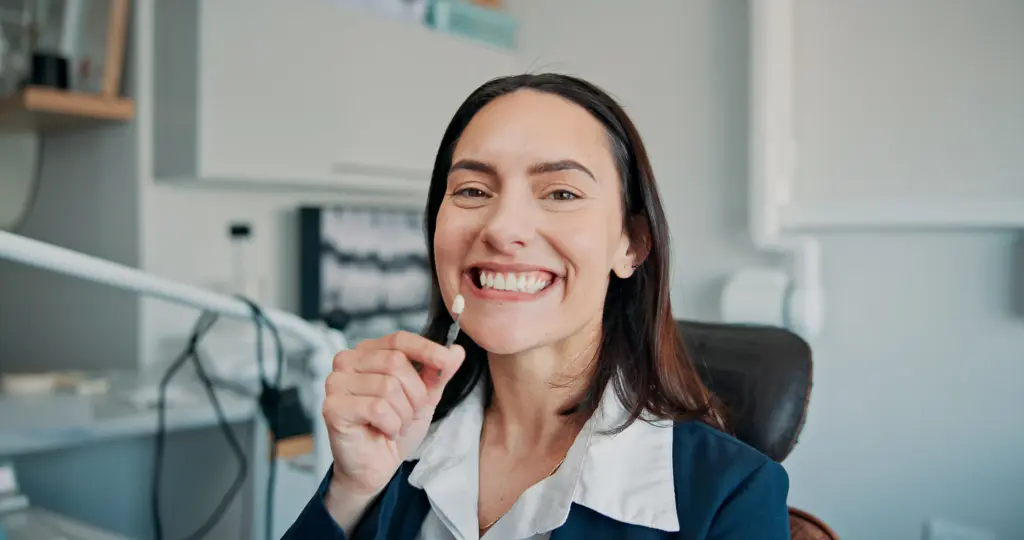
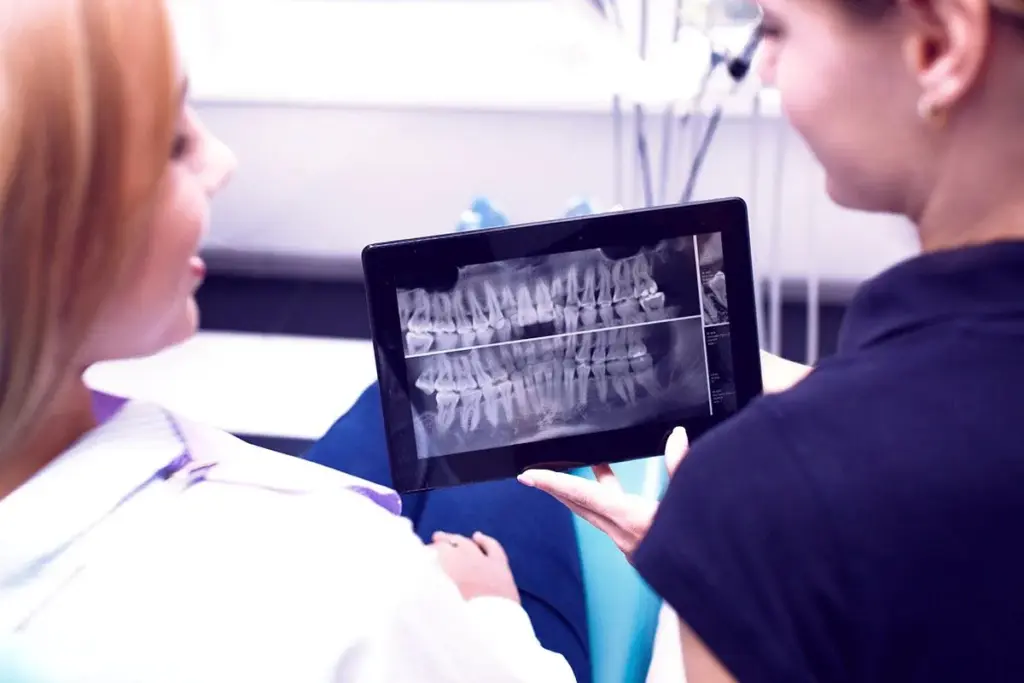
Cone Beam Computed Tomography (CBCT) has taken the place of regular 2D X-rays for complex cases, giving a 3D view of the bones in the head and face.
Voxel Isotropy: CBCT scans use tiny cubes called voxels that are the same size in every direction. This makes measurements accurate in any view, which is important for planning implants.
Field of View (FOV): Dentists can adjust how much of the mouth is scanned to limit radiation. A small FOV shows one tooth in detail, while a large FOV can capture the whole jaw and face for surgery planning.
Hounsfield Unit Approximation: CBCT does not give exact bone density numbers like medical CT, but new software can estimate bone quality. This helps dentists check if the bone is strong enough for implants and spot weaker areas.
Artifact Reduction: Special software reduces image problems caused by metal fillings or crowns, making it easier to see the tooth and bone underneath clearly.
The Virtual Engineering of Prosthetics
Once data is acquired, CAD software is used to design restorations, surgical guides, and orthodontic appliances. This phase integrates biological parameters with engineering principles.
Finite Element Analysis (FEA): Advanced CAD software can simulate the stress distribution on a proposed restoration. By applying virtual occlusal forces, the design can be modified to thicken areas prone to fracture, ensuring the longevity of the material.
Virtual Articulation: Digital articulators simulate the patient’s specific jaw movements (excursions). This ensures that the designed crowns or bridges do not create interferences that could damage the temporomandibular joint or the opposing dentition.
Biomimetic Design Libraries: Software databases contain thousands of natural tooth morphologies. Algorithms can select a tooth shape that fits the patient’s age, gender, and facial type, adapting the contacts and margins to the specific preparation.
Margin Identification: Automated edge detection algorithms identify the finish line of the tooth preparation. However, the clinician can manually refine this to ensure the restoration seals ideally, preventing bacterial ingress and recurrent decay.
Subtractive manufacturing involves carving a restoration from a pre-fabricated block of material using computer-controlled burs.
Zirconia Milling: Zirconia is milled in a “green” or pre-sintered state when it is soft and chalk-like. It is then sintered in a furnace, where it shrinks by approximately 20% to reach full density and hardness. This process aligns the crystalline structure, providing exceptional fracture toughness.
Glass-Ceramics: Materials like Lithium Disilicate are milled in a “blue” state (intermediate crystallization). A secondary firing cycle crystallizes the glass matrix, achieving the final shade and strength (approx. 400-500 MPa).
Hybrid Ceramics: These blocks consist of a ceramic network infiltrated with polymer. They are milled to the final size without firing. Their modulus of elasticity mimics natural dentin, providing a shock-absorbing effect that is beneficial for implant restorations.
Tool Path Strategies: The CAM software calculates the most efficient path for the milling burs. Strategies such as “climb milling” or “conventional milling” are selected based on material properties to minimize surface microcracks in the restoration.
3D printing builds objects layer by layer, allowing for complex geometries that are impossible with milling.
Stereolithography (SLA): A laser beam cures liquid resin layer by layer. This technology is highly accurate and is the standard for printing surgical guides and dental models.
Digital Light Processing (DLP): Similar to SLA, but uses a projector to cure an entire layer at once. This is significantly faster and is used for printing occlusal splints and denture bases.
Selective Laser Melting (SLM): High-powered lasers fuse metal powder (titanium or cobalt-chrome) to create partial denture frameworks or custom implant abutments. This results in a highly dense, non-porous metal structure.
Bioprinting Potential: Research is advancing toward printing scaffolds seeded with stem cells. These biodegradable structures can be printed in the exact shape of a bone defect, releasing growth factors to stimulate regeneration before dissolving.
AI is rapidly becoming a “second opinion” and an automation tool in digital dentistry.
Pathology Detection: Convolutional Neural Networks (CNNs) are trained on millions of radiographs to detect caries (cavities) and periapical lesions (infections) with sensitivity often exceeding that of human observers.
Automated Segmentation: AI can automatically segment the teeth, bone, and nerves in a CBCT scan, speeding up the planning process for implants and orthodontics.
Generative Design: In CAD software, AI can propose the optimal design for a crown or bridge based on the surrounding teeth and the opposing occlusal relationship, reducing the time required for manual design.
Predictive Analytics: AI models can analyze patient data to predict the progression of periodontal disease or the likelihood of implant failure, allowing for proactive preventive measures.

Send us all your questions or requests, and our expert team will assist you.
Digital impressions eliminate the discomfort of gag-inducing putty, are faster to capture, and allow immediate quality assessment on the screen.
Yes, a CBCT scan uses more radiation than a single small dental X-ray, but significantly less than a medical CT scan; the dose is justified by the 3D diagnostic information it provides.
With chairside CAD/CAM technology, a crown can often be designed, milled, and cemented in a single appointment, typically taking about two hours.
Yes, resins used for dental applications are biocompatible and FDA-cleared; they undergo strict post-processing to ensure no toxic uncured material remains.
Absolutely; digital planning allows for the creation of surgical guides that ensure the implant is placed in the exact position, depth, and angle planned on the computer.


Leave your phone number and our medical team will call you back to discuss your healthcare needs and answer all your questions.
Your Comparison List (you must select at least 2 packages)