Early detection of skin cancer is key to successful treatment. Dermoscopy, a method using a dermatoscope, lets doctors see the skin’s surface and what’s beneath. It shows important patterns that help spot melanoma and other cancers.
Skilled dermatologists can spot melanoma up to 5.7 times better with . It points out special signs of skin cancers, like odd pigment patterns and streaks.
Dermoscopy makes it easier to get a correct diagnosis. This helps doctors make better, informed choices.
Key Takeaways
- Dermoscopy enhances the diagnosis of skin cancer.
- Melanoma and other skin cancers show distinct features under a dermatoscope.
- Experienced dermatologists can diagnose melanoma more accurately using dermoscopy.
- Dermoscopy is key for early detection and effective treatment.
- Advanced visualization supports data-driven medical decisions.
The Rising Importance of Skin Cancer Detection
Skin cancer rates are going up fast. Early detection is key. Skin cancer is common worldwide and getting more common. It’s now a big health worry globally.
Global Skin Cancer Statistics
Skin cancer is a big health problem worldwide. Millions get it every year. Keratinocyte skin cancers are the most common and are getting more common too.
These cancers affect a lot of people globally. The rates vary by region. Understanding these numbers shows how big the problem is. It highlights the need for better detection and treatment.
- Over 1 million new cases of skin cancer are diagnosed annually worldwide.
- Keratinocyte skin cancers, including basal cell carcinoma (BCC) and squamous cell carcinoma (SCC), are the most common types.
- Dermoscopy has emerged as a critical tool in the early detection of skin cancer, with high sensitivity and specificity.
The Critical Role of Early Detection
Early detection is key in fighting skin cancer. Dermoscopy is a non-invasive way to look at skin lesions closely. It lets doctors spot skin cancer early, which helps patients a lot.
Dermoscopy is very good at finding basal cell carcinoma (BCC). It’s 98.8% sensitive and 94.8% specific. This means it’s very good at spotting skin cancer early. Early detection means better treatment and outcomes.
- Early detection improves treatment outcomes and survival rates.
- Dermoscopy enhances the accuracy of skin cancer diagnosis.
- Timely intervention can prevent the progression of skin cancer to more advanced stages.
What is a Dermatoscope?
A dermatoscope is a handheld tool used by dermatologists. It helps them see skin structures that are not visible to the naked eye. We will look into its definition, history, and the parts of modern dermatoscopes.
Definition and Basic Functionality
A dermatoscope is a tool for examining skin lesions in detail. It uses light and magnification to show features not seen by the naked eye. Its main functions are:
- Light emission to illuminate the skin lesion
- Magnification to enlarge the lesion for detailed examination
- Polarized light to reduce reflection and enhance visualization
Historical Development of Dermatoscopy
Dermatoscopy has come a long way. It started in the late 20th century and is now key in dermatology. It has seen many improvements, making it better for diagnosis. Important milestones include:
- The first dermatoscope was introduced in the 1980s
- Advances in light technology and magnification
- Integration with digital imaging for better analysis
Components of Modern Dermatoscopes
Today’s dermatoscopes have advanced features like polarized light, high-resolution imaging, and different interfaces. These parts work together to give a full view of skin lesions. Some main components are:
- Polarized light systems to reduce glare
- High-resolution cameras for detailed imaging
- Cross-polarization to enhance subsurface visualization
Types of Dermatoscopes and Their Features
Dermatoscopes are key tools in dermatology, available in different types. Each type has unique features for specific needs. This variety helps doctors pick the best tool for their work, improving care and accuracy.
Contact vs. Non-contact Dermatoscopes
Dermatoscopes can be contact or non-contact. Contact dermatoscopes need to touch the skin, using gel or liquid to see better. Non-contact dermatoscopes let you look without touching, good for sensitive areas or certain situations.
Contact dermatoscopes give clearer images because they reduce reflection. But, non-contact ones are easier to use and safer against germs.
Digital vs. Analog Devices
Dermatoscopes are also digital or analog. Digital dermatoscopes take pictures you can save and analyze. This helps doctors make better diagnoses. in-person exams with dermoscopy are more accurate for skin cancer.
|
Feature |
Digital Dermatoscope |
Analog Dermatoscope |
|---|---|---|
|
Image Capture |
Electronic image capture |
Direct visual observation |
|
Data Storage |
Digital storage and transfer |
No digital storage |
|
Image Analysis |
Compatible with image analysis software |
Limited to visual inspection |
Polarized vs. Non-polarized Light Systems
Dermatoscopes also differ in light use. Polarized dermatoscopes use filters to see deeper skin layers. Non-polarized ones might need a liquid to see as well.
Polarized light is great for looking at blood vessels and deeper skin. It’s useful without needing a liquid, making it a versatile tool.
The Science Behind Dermatoscopy
Dermatoscopy is a big step forward in dermatology. It lets doctors see skin lesions in detail. This is thanks to epiluminescence microscopy, which shows skin structures we can’t see normally.
Principles of Epiluminescence Microscopy
Epiluminescence microscopy uses a dermatoscope to look at the skin. A liquid medium, like oil or gel, is used to cut down light reflection. This makes it easier to see what’s under the skin’s surface.
This method helps doctors spot skin cancers early. It works by reducing light reflection. This lets us see deeper into the skin.
Light-Skin Interaction and Visualization
Light acts differently when it hits the skin. It can be absorbed, scattered, or reflected. Dermatoscopy uses polarized light to see what’s under the surface.
Understanding how light interacts with skin is key. It helps us make sense of dermoscopic images.
Magnification and Image Quality Factors
Several things affect how clear a dermoscopic image is. Magnification, light, and the type of light used matter a lot. More magnification means we can see more details. The right light makes things stand out better.
|
Factor |
Description |
Impact on Image Quality |
|---|---|---|
|
Magnification |
The power to enlarge the image |
Higher magnification provides more detail |
|
Illumination |
The light used to visualize the skin |
Adequate illumination enhances contrast |
|
Light Type |
Polarized or non-polarized light |
Polarized light reduces surface reflection |
Knowing what affects image quality helps us use dermatoscopy better. We choose the right magnification and light for each skin condition.
Melanoma Under the Dermatoscope
Under the dermatoscope, melanoma shows clear signs that help doctors diagnose it. Dermoscopy is a key tool in dermatology. It lets doctors see skin lesions in more detail.
Abnormal Pigment Network Patterns
One key sign of melanoma is abnormal pigment network patterns. These patterns show that the skin’s normal structure is disrupted. Studies have shown that looking at these patterns can make diagnosis more accurate .
Irregular Spots and Globules
Melanomas often have irregular spots and globules. These spots are not symmetrical and can be different sizes and colors. These are important signs that help doctors tell melanoma apart from harmless spots.
Color and Structure Variations
Melanoma also shows color and structure variations. Dermoscopy lets doctors see many colors in a spot and irregular patterns. These are warning signs for melanoma.
The Multicomponent Pattern in Melanoma Detection
Dermoscopy has changed how we look at skin lesions. It lets us see details without cutting into the skin. This helps us spot melanoma early, which is good for patients.
The multicomponent pattern is key in finding melanoma. It shows up as different parts in one skin spot.
Identifying the 38% of Melanomas with Multicomponent Patterns
About 38% of melanomas have this pattern. Knowing how to see it is important. It means looking for different colors and shapes in a spot.
Seeing this pattern means we need to check the spot more closely. Sometimes, we might need to take a sample for a biopsy.
ABC Rule in Dermoscopy
There are other ways to check for melanoma too. The ABCD rule looks at asymmetry, border, color, and structures. It helps us decide if a spot needs more looking into.
The seven-point checklist is another tool. It looks at big and small signs to guess if a spot might be cancer. Using these tools together makes us better at finding melanoma.
By using dermoscopy and knowing about patterns like the multicomponent pattern, we can do a better job. This helps us take care of patients who might get melanoma.
Basal Cell Carcinoma Through the Dermatoscope
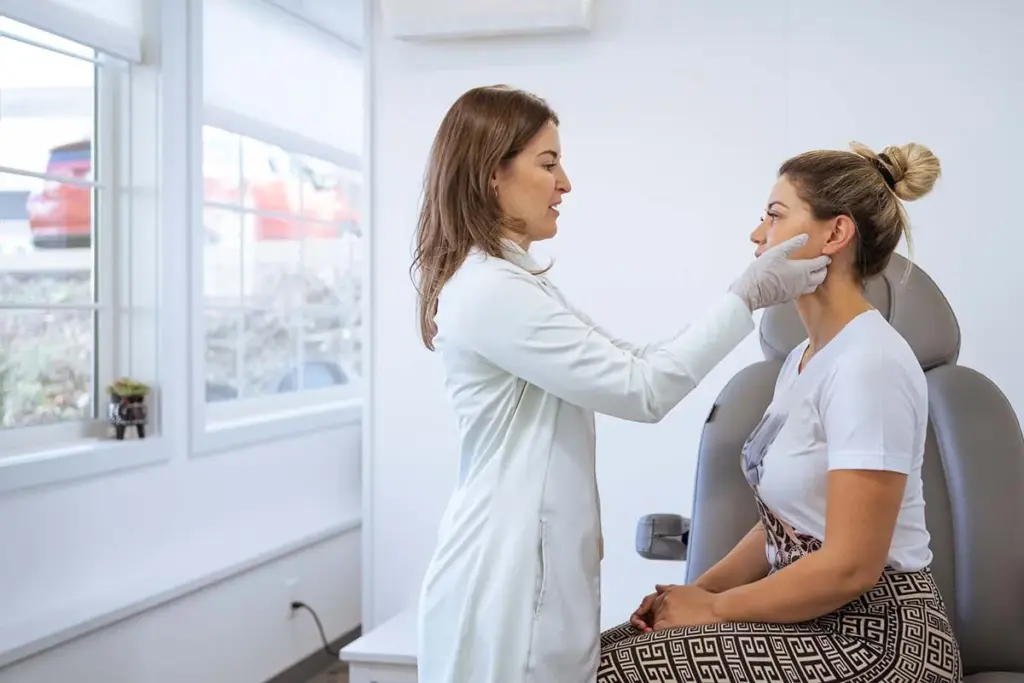
Dermatoscopy has changed how we spot basal cell carcinoma. It gives us a close look at skin lesions.
Arborizing Vessels and Telangiectasia
Arborizing vessels are a key sign of basal cell carcinoma. They look like trees because of their branching shape. Telangiectasia, or widened blood vessels, is also common.
Ulceration and Erosion Patterns
Ulcers are often seen in basal cell carcinoma. Dermatoscopy helps us see ulceration patterns. These patterns can tell us if it’s BCC or not.
Leaf-like Areas and Blue-Gray Ovoid Nests
BCC lesions also have leaf-like areas and blue-gray ovoid nests. Leaf-like areas look like leaves and are lighter than the skin. Blue-gray ovoid nests are round and look blue or gray, showing pigmented BCC.
|
Dermoscopic Feature |
Description |
Significance in BCC Diagnosis |
|---|---|---|
|
Arborizing Vessels |
Tree-like branching vessels |
Highly suggestive of BCC |
|
Ulceration |
Formation of ulcers or erosions |
Common in BCC, aids in diagnosis |
|
Leaf-like Areas |
Areas resembling leaves |
Characteristic of BCC, particularlly pigmented BCC |
|
Blue-Gray Ovoid Nests |
Rounded, blue or gray structures |
Indicative of pigmented BCC |
Squamous Cell Carcinoma Dermoscopic Features
When we look at squamous cell carcinoma under a dermoscope, we see important signs. “Dermoscopy has changed how we spot skin cancers, including squamous cell carcinoma,” it gives us a close-up look at the lesion’s details.
Characteristic Dermoscopic Features
Glomerular Vessels and Hairpin Vessels
Glomerular vessels are a key sign of squamous cell carcinoma. They look like coiled or twisted structures in the lesion. Also, hairpin vessels show up as looped or hairpin-like shapes. A study on says these patterns help tell squamous cell carcinoma apart from other skin issues.
Keratin and Scale Patterns
Squamous cell carcinoma also shows keratin and scale patterns under the dermoscope. Keratin looks like white or yellowish structures, and scales appear as surface scaling or crusting. These signs are key in diagnosing squamous cell carcinoma and telling it apart from other skin cancers.
Differentiating from Other Lesions
Dermoscopy helps not just in spotting squamous cell carcinoma but also in telling it apart from other skin issues. By looking at features like glomerular vessels, hairpin vessels, and keratin patterns, doctors can make more precise diagnoses. Experts say, “The use of dermoscopy has greatly boosted the accuracy of skin cancer diagnosis.”
Rare Skin Cancers Under Dermatoscopy
Dermatoscopy is key in spotting rare skin cancers that are hard to diagnose. It helps doctors see details of skin lesions that we can’t see with our eyes.
We’ll look at the signs of Merkel cell carcinoma, dermatofibrosarcoma protuberans, and cutaneous lymphomas under dermatoscopy. Knowing these signs is vital for correct diagnosis and treatment.
Merkel Cell Carcinoma Features
Merkel cell carcinoma is a fast-growing skin cancer that looks like a firm, painless bump. Dermatoscopy shows it has distinctive features like a milky-red or pink color. It might also show signs of ulceration or bleeding. This helps doctors catch it early.
Dermatofibrosarcoma Protuberans
Dermatofibrosarcoma protuberans is a rare skin cancer that looks like a firm, flat patch. Dermatoscopy shows a characteristic “honeycomb” or “lattice-like” pattern. This pattern is important for telling it apart from other skin issues.
Cutaneous Lymphomas
Cutaneous lymphomas are a group of non-Hodgkin lymphomas that mainly affect the skin. Dermatoscopy might show prominent vascular patterns, scaling, and crusting. Because of this variety, it’s important to do a thorough check to make sure of the diagnosis.
In summary, dermatoscopy is a vital tool for finding rare skin cancers. It lets doctors see the details of lesions, helping them spot these cancers early. This improves treatment results for patients.
Clinical Benefits of Using a Dermatoscope
Dermatoscopy is a key tool in skin exams, bringing many benefits. It helps us spot skin problems more accurately. This leads to better care for our patients.
Earlier Detection of Thinner Melanomas
Dermatoscopy helps find melanomas early, when they’re easier to treat. Early detection is key to lowering melanoma deaths. Finding melanomas early means better chances for patients.
A study in the Journal of the American Academy of Dermatology showed its power. Dermatoscopy helped doctors spot thin melanomas. These are melanomas under 1 mm thick, which have a good outlook.
Reduction in Unnecessary Biopsies
Dermatoscopy also cuts down on unneeded biopsies. It gives a closer look at skin spots, helping us tell the difference between harmless and harmful ones. This means fewer biopsies, less pain for patients, and lower costs.
|
Lesion Type |
Pre-Dermoscopy Biopsy Rate |
Post-Dermoscopy Biopsy Rate |
|---|---|---|
|
Benign Lesions |
40% |
15% |
|
Malignant Lesions |
60% |
85% |
Improved Patient Monitoring Over Time
Dermatoscopy makes it easier to watch patients with many skin spots over time. We can see changes that might mean cancer is starting. This is very helpful for people with a history of skin cancer or lots of moles.
As shown in the image below, dermatoscopy gives a detailed look at skin spots. This helps us make more accurate diagnoses.
Special Applications of Dermatoscopy
Dermatoscopy has grown beyond its old uses. It now helps in many tricky clinical situations. We use it to get better at diagnosing in hard-to-see spots.
Dermatoscopy in Difficult-to-Examine Areas
Some parts of the body are hard to check because of their shape or how sensitive they are. Dermatoscopy is a big help here. It lets us see skin lesions up close.
- It helps us look at spots in hard-to-see places
- It makes us more sure about what we see in sensitive areas
- It lets us see skin details without needing a biopsy
Use of Dermatoscopes for Genital Lesions
Genital lesions are tricky to diagnose because they’re sensitive and can be many things. Dermatoscopy helps tell the difference between harmless and serious lesions. This helps us decide the best treatment.
Key benefits include:
- It makes diagnosing genital lesions more accurate
- It means we don’t always need to do invasive tests
- It makes the exam more comfortable for the patient
Scalp, Nail, and Mucosal Surface Examination
Dermatoscopy is also good for checking the scalp, nails, and mucous membranes. These areas are hard to see with just our eyes. It helps find problems that we might miss at first glance.
For example, dermatoscopy can help:
- Find scalp issues like melanoma or other pigmented spots
- Look at nails for signs of melanoma or other problems
- Check mucous membranes for spots that need more looking into
Digital Dermatoscopy and Artificial Intelligence
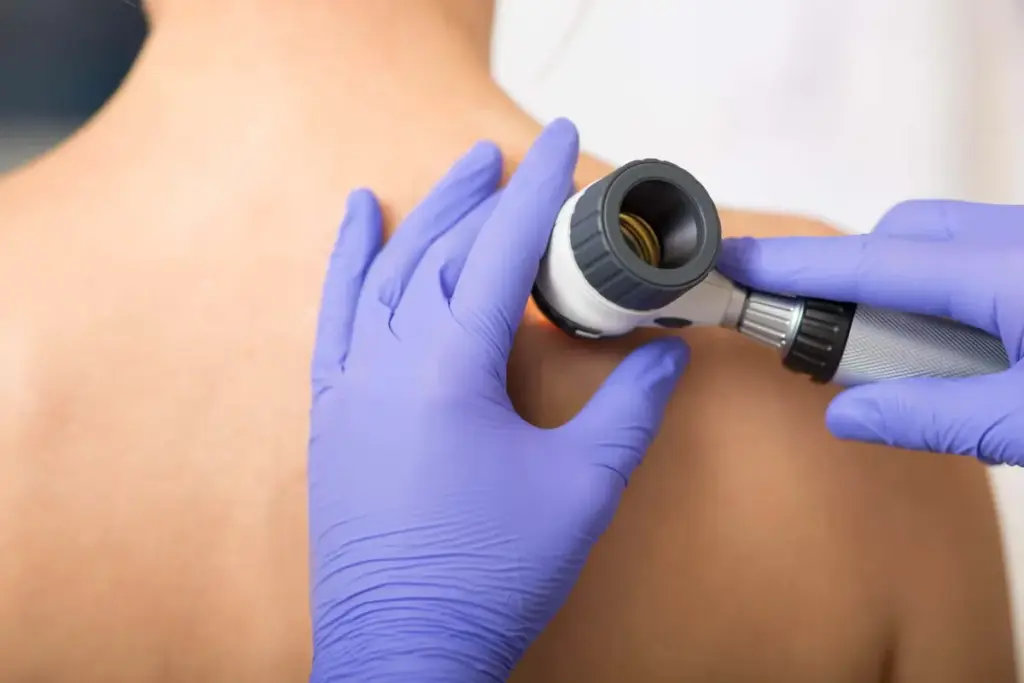
Digital dermatoscopy and artificial intelligence (AI) are changing dermatology. This tech boost is making diagnoses more accurate and making work easier for doctors.
Computer-Aided Diagnosis Systems
Computer-aided diagnosis (CAD) systems are becoming popular in dermatology. They use smart algorithms to look at skin images. This helps doctors make better diagnoses.
Thanks to machine learning and deep learning, these systems spot things doctors might miss. They help find skin cancers early, which can save lives.
Machine Learning Algorithms in Lesion Classification
Machine learning is key in sorting out skin lesions. It trains on lots of images to tell the difference between safe and dangerous spots. Convolutional neural networks (CNNs) are great at this because they can handle complex images.
Our doctors and data scientists are working together. They’re making these algorithms better for use in real-world medicine.
Total Body Photography and Mole Mapping
Total body photography and mole mapping help catch skin cancer early. They create a detailed picture of a patient’s skin. This lets doctors watch for changes over time.
These tools help us give better care. They let us track skin changes closely. This means we can act fast when needed.
Training and Expertise Requirements
Effective dermatoscopy needs both technical knowledge and clinical skills. It has changed how we diagnose skin diseases. But, it works best when the person using it is skilled.
Learning Curve for Dermatologists
Learning to use dermatoscopy well is challenging. Dermatologists must learn about epiluminescence microscopy and skin patterns. They also need to know the difference between harmless and dangerous skin conditions.
Studies show that with the right training, doctors can get much better at spotting problems. We suggest that dermatologists take part in detailed training programs. These should include both learning the theory and getting hands-on practice.
The 5.7x Better Detection Rate by Experienced Users
Experienced dermatologists can spot melanoma up to 5.7 times better with dermatoscopy. This shows how important it is to be good at using it. Being able to read dermoscopic images well is key to catching skin cancer early.
To get better, dermatologists need to keep practicing. They should also see many different cases. Workshops, online courses, and peer review can help with this.
Certification and Continuing Education
Getting certified in dermatoscopy is a big step for dermatologists. It shows they are skilled. There are many international programs that offer this. Keeping up with new developments is also important.
- Take part in workshops and conferences to learn the latest.
- Join online forums and discussion groups to share and learn.
- Look into advanced training in digital dermatoscopy and AI-assisted diagnosis.
By investing in good training and ongoing learning, dermatologists can improve their skills. This leads to better care for their patients.
Patient Experience During Dermatoscopic Examination
Knowing what to expect during a dermatoscopic examination can make you feel less anxious. We aim to make your experience clear and comforting. We know medical exams can be worrying, and we’re here to help.
What to Expect During a Session
A dermatologist will use a dermatoscope to look closely at your skin lesions. This method is non-invasive and uses a liquid or cross-polarized light to see more clearly. The whole process is usually painless and quick. Our doctors will walk you through each step to keep you informed and at ease.
Follow-up Procedures and Monitoring
After the exam, we’ll talk about what we found. If a lesion looks suspicious, we might suggest a biopsy or other tests. Regular checks are important for catching problems early. We’ll create a plan just for you, so you know what to do next.
Patient Education About Findings
We believe that educating our patients significantly contributes to their care. We’ll explain your exam results in a way you can understand. Knowing your diagnosis and treatment options helps you take charge of your health. Our team is here to support and educate you.
Choosing us for your dermatoscopic examination is a big step towards better skin health. We’re committed to top-notch care and support for our international patients.
Implementing Advanced Dermatoscopy Protocols
Liv Hospital is leading the way in skin cancer detection with advanced dermatoscopy protocols. We believe these protocols are key to better patient care.
Liv Hospital’s Approach to Dermoscopy
At Liv Hospital, we use the latest technology and techniques in dermoscopy. Our dermatologists get thorough training to master dermatoscopes and read results accurately.
This approach has greatly improved our ability to catch skin cancer early. We see more cases and do fewer unnecessary biopsies.
Global Best Practices in Skin Cancer Screening
Worldwide, dermoscopy’s role in skin cancer screening is becoming more recognized. International guidelines now recommend it as a primary tool for checking pigmented skin lesions.
Some global best practices include:
- Using standardized dermoscopic criteria for diagnosing melanoma and other skin cancers.
- Keeping dermatologists up-to-date with the latest techniques through regular training and education.
- Using digital dermoscopy and artificial intelligence to improve diagnostic accuracy.
|
Best Practice |
Description |
Benefit |
|---|---|---|
|
Standardized Dermoscopic Criteria |
Using established criteria for diagnosing skin cancers. |
Improved diagnostic accuracy. |
|
Regular Training and Education |
Continuous education for dermatologists on latest techniques. |
Enhanced proficiency in dermoscopy. |
|
Digital Dermoscopy and AI |
Integration of digital technology and AI for lesion analysis. |
Increased precision in diagnosis. |
Quality Assurance in Dermatoscopic Diagnosis
Quality assurance is vital in dermatoscopic diagnosis. We have strict quality control measures to ensure top-notch examinations.
These measures include:
- Regular calibration and maintenance of dermatoscopic equipment.
- Continuous monitoring of diagnostic accuracy and consistency.
- Participation in international quality assurance programs.
By using these advanced dermatoscopy protocols, we offer our patients accurate and reliable diagnoses. This improves their treatment outcomes.
Future Trends in Dermatoscopy
The future of dermatoscopy looks bright, with new tech like AI, telemedicine, and portable devices. These advancements will change how we find and treat skin cancer.
Emerging Technologies and Innovations
Artificial Intelligence (AI) and Machine Learning (ML) are big in dermatoscopy now. They make skin checks more accurate, helping doctors spot cancer early. AI tools can look at pictures, find patterns, and even suggest what to do next.
Also, better image tech is making skin exams more reliable. With new tools and software, doctors can see more clearly and make better diagnoses.
Integration with Telemedicine and Remote Diagnosis
Telemedicine is changing healthcare, and dermatoscopy is part of it. Now, you can get skin checks and diagnoses online. This is great for people who live far away or have trouble getting to doctors.
Telemedicine with dermatoscopy also lets doctors keep an eye on your skin over time. This means they can catch problems sooner and you might not have to go to the doctor as often.
Portable Consumer Dermatoscopes
There’s a new trend in dermatoscopy: portable consumer dermatoscopes. These let people check their skin at home. They can take pictures of moles and share them with doctors. While they’re not a full replacement for a doctor, they help people stay on top of their skin health.
As tech keeps getting better, we’ll see even more cool things in dermatoscopy. Expect devices that are easier to carry, smarter AI, and better connections to health apps.
Conclusion
We’ve looked into how important dermatoscopy is for finding skin cancer. It’s a key tool for doctors to spot skin problems early. This helps in catching cancers before they grow too big.
Using a dermatoscope has changed how we fight skin cancer. It lets doctors find thin melanomas sooner. This means fewer biopsies are needed, making treatment easier.
As we keep improving dermatoscopy, we’ll see better results for patients. Adding dermatoscopy to our work helps find cancer early. This means better health and happier lives for those affected.
It’s vital to keep learning about dermatoscopy. This way, doctors can give the best care to their patients. Training in this area is key to helping more people.
FAQ
What is dermoscopy and how does it help in diagnosing skin cancer?
Dermoscopy is a way to look at skin without cutting it. It uses a special tool called a dermatoscope. This tool shows details that we can’t see with our eyes. It helps doctors find skin cancer early and accurately.
What are the different types of dermatoscopes available?
There are many kinds of dermatoscopes. Some touch the skin and others don’t. Some show pictures and others don’t. Each one is good for different things.
How does dermoscopy aid in the early detection of melanoma?
Dermoscopy helps find melanoma early by showing special signs. These signs include strange patterns and colors in the skin. This lets doctors catch it before it gets worse.
Can dermoscopy be used to examine skin lesions in difficult-to-examine areas?
Yes, dermoscopy can look at hard-to-see spots. This includes places like the genital area and scalp. It helps doctors get important information.
What is the role of digital dermatoscopy and artificial intelligence in dermatology?
Digital dermatoscopy and artificial intelligence are big in dermatology. They help computers make diagnoses and learn from pictures. This makes doctors better at helping patients.
What training and expertise are required for dermatoscopy?
Doctors need special training to use dermoscopy. They must learn about skin and how to see cancer. They also need to keep up with new methods.
How does dermoscopy impact patient experience during skin examination?
Dermoscopy makes skin checks better for patients. It lets doctors find problems early and treat them right away. This means patients don’t have to get biopsies as often.
What are the future trends in dermatoscopy?
Dermoscopy is getting even better. New tech and telemedicine are coming. Soon, we’ll have small devices that can check skin at home.
Are dermatoscopes used for monitoring patients over time?
Yes, dermatoscopes help watch patients over time. Doctors can see if skin lesions change. This helps catch cancer early.
Can dermoscopy reduce the number of unnecessary biopsies?
References
- Gamo, R., et al. (2020). Dermoscopy in General Dermatology. Retrieved from https://pmc.ncbi.nlm.nih.gov/articles/PMC5659633/
- Cancer Therapy Advisor. (2024). In-person Exam with Dermoscopy Yields More Accurate Skin Cancer Diagnosis. Retrieved from https://www.cancertherapyadvisor.com/news/in-person-exam-with-dermoscopy-yields-more-accurate-skin-cancer-diagnosis/
- JAMA Dermatology. (2002). Accuracy of In Vivo Confocal Microscopy for the Diagnosis of Basal Cell Carcinoma. Retrieved from https://jamanetwork.com/journals/jamadermatology/fullarticle/392759
- Nature. (2024). A large-scale dermatoscopic image dataset for skin cancer detection. Retrieved from https://www.nature.com/articles/s41597-024-03387-w
- Carrera, C., et al. (2024). Dermoscopy for the diagnosis of pigmented skin lesions. Retrieved from https://pmc.ncbi.nlm.nih.gov/articles/PMC11460753/