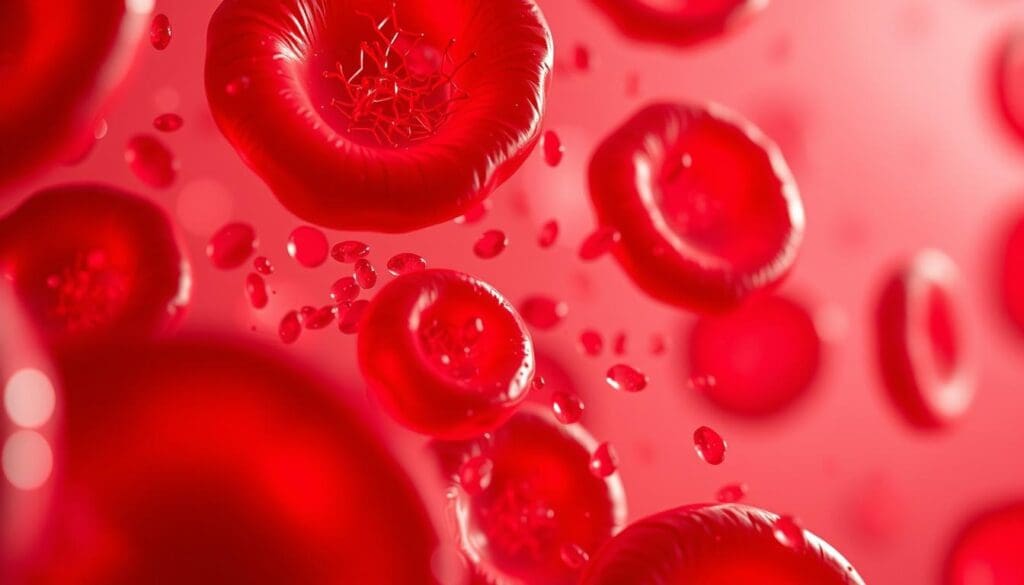
We dive into the world of red blood cells, also called erythrocytes or red blood corpuscles. These cells are key in carrying oxygen to our body’s tissues. A special feature of mature red blood cells is that they don’t have a nucleus. This lets them hold more hemoglobin, the protein that carries oxygen.
The shape of red blood cells is unique, helping them work well. Knowing about their makeup and features helps us see how vital they are for our health.
Key Takeaways
- Mature red blood cells lack a nucleus.
- The absence of a nucleus allows for more hemoglobin.
- Red blood cells have a distinctive biconcave disk shape.
- They play a critical role in oxygen delivery.
- Their unique structure is essential for their function.
The Unique Nature of Red Blood Cells
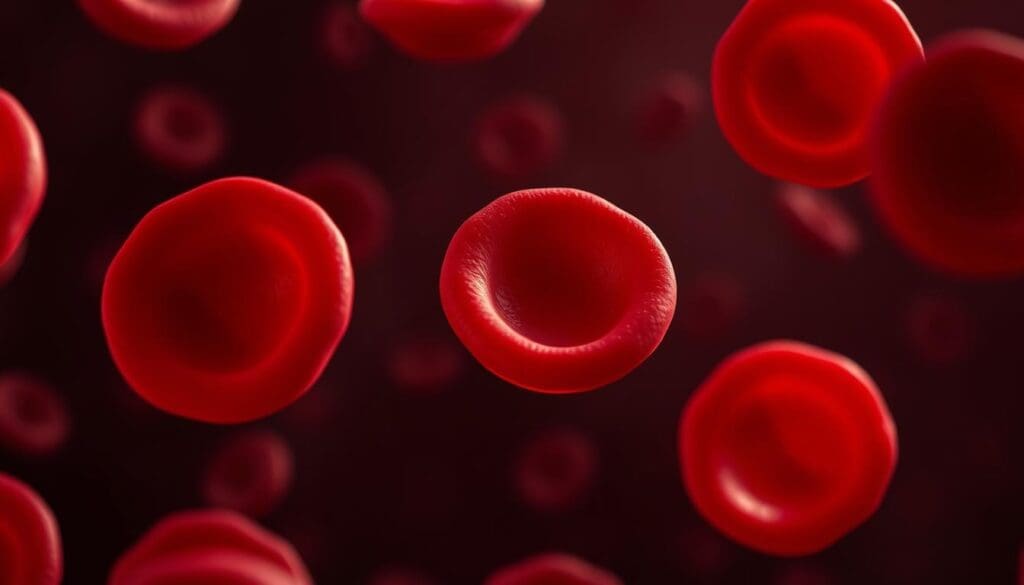
Red blood cells, also known as erythrocytes, are the most common type of blood cell in humans. They are vital for delivering oxygen to our tissues and organs. This makes them key to our body’s function.
What Are Red Blood Cells?
Red blood cells are made to carry oxygen from our lungs to our body’s tissues. They are created in the bone marrow and travel through our blood. Their main job is to carry hemoglobin, a protein that holds onto oxygen.
Key characteristics of red blood cells include:
- They are disk-shaped, which increases their surface area for gas exchange.
- They lack a nucleus, allowing for more space for hemoglobin.
- They are highly flexible, enabling them to navigate through narrow capillaries.
Alternative Names: Erythrocytes and Red Blood Corpuscles
Red blood cells are also called erythrocytes or red blood corpuscles. The term “erythrocyte” comes from Greek words for “red” and “cell.” This name shows their red color from hemoglobin.
“The red blood cell is a highly specialized cell that has evolved to perform a single function: to deliver oxygen to the tissues.”
The different names for red blood cells are often used in the same way in medical texts. Knowing these terms helps in understanding their role in health and disease.
| Term | Description |
| Red Blood Cells | Common name for cells that carry oxygen |
| Erythrocytes | Medical term derived from the Greek |
| Red Blood Corpuscles | Another term used to describe these cells |
Do RBCs Have a Nucleus? The Definitive Answer
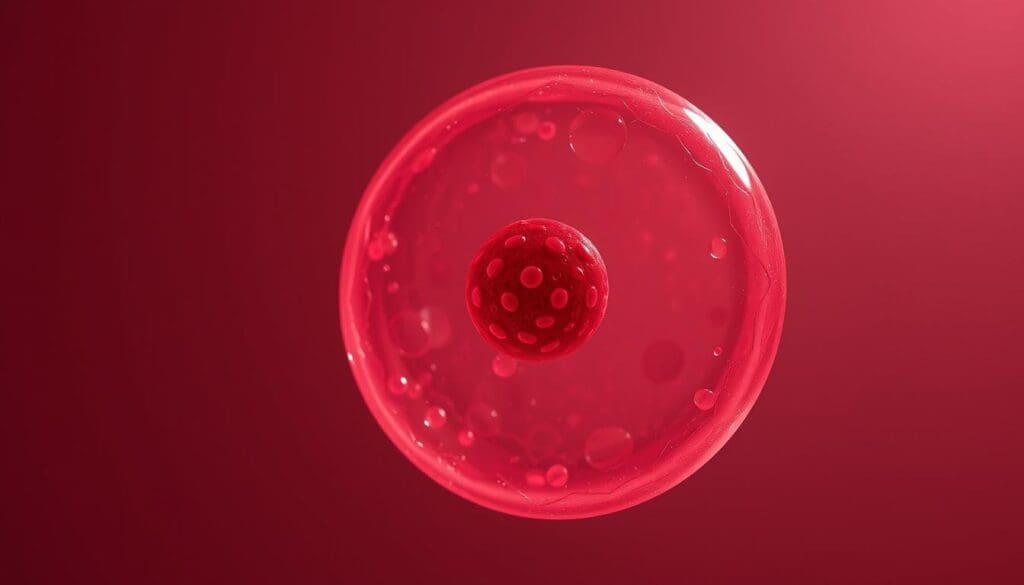
Mature human red blood cells don’t have a nucleus. This is key to their job and comes from how they mature.
The Anuclear State of Mature Human RBCs
Mature human red blood cells are anucleate, lacking a nucleus. This happens in the bone marrow during maturation. The cell gets rid of its nucleus to make room for more hemoglobin.
This lets red blood cells carry more oxygen. The lack of a nucleus also makes them more flexible. This flexibility helps them get through narrow capillaries to deliver oxygen to tissues.
Evolutionary Advantage of Nucleus Removal
Not having a nucleus is an advantage that evolved. It lets them carry more hemoglobin, which is vital for oxygen transport. This is important for bigger, more complex bodies.
- Increased hemoglobin content for enhanced oxygen transport
- Improved flexibility for navigating narrow capillaries
- Optimized cell shape for gas exchange efficiency
The lack of a nucleus in mature human RBCs shows how our bodies have adapted to deliver oxygen. Understanding this helps us appreciate the biology of red blood cells and their vital role in our health.
The Development of Red Blood Cells in Bone Marrow
In the bone marrow, red blood cells go through big changes as they grow. This is key to their job and health. We’ll look at how red blood cells develop and grow in the bone marrow. We’ll focus on erythropoiesis and the maturation process.
From Nucleated to Anuclear: The Maturation Process
Red blood cells change from having a nucleus to not having one during erythropoiesis. This change is vital for carrying oxygen. As they grow, they lose their nucleus and most organelles. This makes room for more hemoglobin.
The maturation process has several stages, from the first cells to the final reticulocyte stage. At each stage, the cells change a lot. These changes lead to the creation of a mature red blood cell.
The Role of Erythropoiesis
Erythropoiesis is how red blood cells are made. It’s a complex process that needs many growth factors and hormones. Erythropoietin, a hormone from the kidneys, is key in controlling erythropoiesis.
During erythropoiesis, stem cells turn into erythroblasts. These then become reticulocytes and then red blood cells. This process is carefully managed to make healthy red blood cells.
The Distinctive Shape of Red Blood Cells
Red blood cells have a unique shape, known as a biconcave disk. This shape is key to their job of carrying oxygen around the body.
The Biconcave Disk Structure
The biconcave disk shape has a depression in the center of each side. It looks like a disk with a curved bottom. This shape is formed in the bone marrow during the final stages of development.
This shape is important for red blood cells to work properly. It helps them do their job well.
- Increased Surface Area: The biconcave shape lets red blood cells exchange gases more efficiently.
- Flexibility: The shape lets red blood cells bend and go through tight spaces. This ensures oxygen gets to all parts of the body.
- Optimized Volume-to-Surface-Area Ratio: The shape helps with gas exchange by balancing volume and surface area.
Functional Advantages of This Shape
The biconcave disk shape of red blood cells has many benefits. These benefits are key to their role in oxygen transport. Some of these advantages include:
- Enhanced Oxygen Exchange: The shape’s increased surface area and volume-to-surface-area ratio help with oxygen exchange.
- Improved Navigability: The shape’s flexibility lets red blood cells go through tight spaces. This ensures they can reach all parts of the body.
- Stable Cell Membrane: The shape helps keep the red blood cell membrane strong. This reduces the chance of the cell breaking down during circulation.
In conclusion, the biconcave disk shape of red blood cells is vital for their function. It helps them carry oxygen efficiently around the body. Knowing about the structure and benefits of red blood cells gives us insight into their role in health.
Size Matters: Dimensions of Human Red Blood Cells
Understanding the size of red blood cells is key to knowing their role in our bodies. Their size helps them move through our blood and carry oxygen to our tissues.
Diameter of a RBC: 7-8 Micrometers
Human red blood cells, or erythrocytes, are about 7-8 micrometers wide. This size lets them move easily through blood vessels, even the smallest capillaries. Their average width is important for their job of delivering oxygen well.
Thickness Measurements: Edge vs. Center
Red blood cells are about 2.6 micrometers thick at the edge and thinner in the middle. Their biconcave disk shape helps them exchange gases like oxygen and carbon dioxide. Their unique shape and size are adaptations that make them work better.
How RBC Size Enables Passage Through Capillaries
The size of red blood cells lets them go through capillaries, which are often smaller. Their flexibility and size help them change shape to fit through these narrow spaces. This is key for delivering oxygen to all parts of the body.
In short, the size of red blood cells is essential for their job in our blood. Their dimensions show how well our bodies are designed to meet different needs.
The Composition of Red Blood Cells
Red blood cells have a cell membrane rich in proteins and lipids. They also have a cytoskeleton that gives them structure. This unique mix helps them carry oxygen.
The Cell Membrane: Proteins and Lipids
The cell membrane of red blood cells is made mostly of proteins and lipids. It keeps the cell together and lets gases and substances pass through. The lipid bilayer provides the structural framework, while proteins handle transport and signaling.
Experts say, “The red blood cell membrane is a dynamic structure that plays a critical role in maintaining the cell’s shape and function.”
Source: Journal of Biological Chemistry
The Cytoskeleton: Maintaining RBC Shape
Underneath the cell membrane is the cytoskeleton, a network of proteins. It keeps the red blood cells in their biconcave disk shape. The cytoskeleton is composed mainly of spectrin, actin, and other proteins that make it strong yet flexible.
This special structure lets red blood cells change shape to fit through tight spaces. Then, they go back to their original shape. The cytoskeleton is key to the cell’s survival and function.
Hemoglobin: The Oxygen-Carrying Protein
Hemoglobin carries oxygen from the lungs to the body’s tissues. It’s essential for life. This protein is complex and plays a key role in the respiratory process.
Structure and Function of Hemoglobin
Hemoglobin has four protein subunits: two alpha-globin and two beta-globin chains. Each subunit has a heme group that binds oxygen. This structure lets hemoglobin change shape to carry oxygen from high to low concentration areas.
Hemoglobin does more than just carry oxygen. It also helps transport carbon dioxide back to the lungs. This is important for keeping the body’s acid-base balance.
Key aspects of hemoglobin’s structure and function include:
- The ability to bind to oxygen in the lungs and release it in the tissues.
- The capacity to transport carbon dioxide from the tissues to the lungs.
- A complex structure that involves four protein subunits and four heme groups.
Why Are RBCs Red? The Role of Iron
The red color of red blood cells comes from hemoglobin’s iron. Iron is key for oxygen to bind to hemoglobin. It’s what makes both hemoglobin and red blood cells red.
The role of iron in hemoglobin is multifaceted:
- It enables the binding of oxygen to hemoglobin.
- It facilitates the transport of oxygen throughout the body.
- It gives red blood cells their distinctive red color.
In summary, hemoglobin is vital for oxygen transport in red blood cells. It’s what gives them their red color due to iron. Understanding hemoglobin’s structure and function is key to grasping oxygen delivery in the human body.
The Absence of Organelles in Mature RBCs
Mature red blood cells (RBCs) are special because they don’t have most organelles. This is key to their job in gas exchange. It makes them different from many other cells in our bodies.
Do Red Blood Cells Have Organelles?
When RBCs start in the bone marrow, they have organelles. But as they grow, they lose these parts, like the nucleus and mitochondria. This change is important for their final form and how they work.
The lack of organelles lets RBCs be better at carrying gases. The space where organelles would be is filled with hemoglobin. This protein carries oxygen and carbon dioxide.
How This Absence Enhances Gas Exchange Efficiency
Without organelles, RBCs can carry more oxygen and carbon dioxide. They have more room for hemoglobin. This helps them move oxygen from the lungs to the body’s tissues and carbon dioxide back to the lungs.
The table below shows the main benefits of RBCs not having organelles:
| Feature | Benefit |
| Increased hemoglobin capacity | Enhanced oxygen and carbon dioxide transport |
| Optimized cell shape | Improved flexibility and ability to navigate through capillaries |
| Reduced cellular complexity | Increased efficiency in gas exchange processes |
Understanding how RBCs are structured helps us see how they efficiently exchange gases. This is essential for life.
Comparing Human RBCs to Other Species
Red blood cells (RBCs) are key to the circulatory system. Their structure varies across species, adapting to each organism’s needs.
Nucleus Presence in Non-Mammalian Vertebrates
Unlike humans, many non-mammals have RBCs with a nucleus. Birds and reptiles are examples. A study on PMC shows this nucleus offers unique benefits.
“The nucleus in non-mammalian RBCs supports complex cellular functions,” studies say. This is linked to their unique oxygen needs and metabolism.
Size and Structural Variations Across Species
RBC sizes and shapes differ among species. Humans have RBCs about 7-8 micrometers in diameter. This fits their capillary network well. Other species have RBCs that are larger or smaller, suited to their needs.
- Birds have larger, more elliptical RBCs than humans.
- Fish have bigger, more varied RBCs.
- Some salamanders have the biggest RBCs among vertebrates.
Evolutionary Perspectives on RBC Development
The evolution of RBCs is tied to their metabolic and oxygen needs. The loss of the nucleus in mammals allows for more hemoglobin, boosting oxygen transport.
Studying RBC evolution helps us understand their role in life. It shows how form and function are linked in nature.
The Lifecycle of Red Blood Cells
Red blood cells go through a life cycle. They are made in the bone marrow, move through the blood, and then break down in the spleen. This cycle is key to understanding their role in health.
Production and Circulation
In the bone marrow, red blood cells are made through erythropoiesis. These cells, called reticulocytes, grow and enter the blood. There, they carry oxygen to all parts of the body.
Red blood cell production never stops. The bone marrow makes millions every day to replace old or damaged cells.
Red Blood Cell Breakdown: Hemolysis in the Spleen
After about 120 days, red blood cells are broken down in the spleen. This process, called hemolysis, removes old or damaged cells from the blood.
During hemolysis, the parts of red blood cells are reused. Iron from hemoglobin is used to make new hemoglobin. Other parts are either excreted or reused.
The 120-Day Lifespan and Component Recycling
Red blood cells live for about 120 days. This time, let’s them deliver oxygen without getting damaged.
The recycling of red blood cell parts is very efficient. Iron is a key part reused in making new red blood cells. This is important for keeping healthy red blood cell counts and overall health.
| Stage | Description | Location |
| Production | Erythropoiesis, the creation of new red blood cells | Bone Marrow |
| Circulation | Delivery of oxygen to tissues and organs | Bloodstream |
| Breakdown | Hemolysis, recycling of red blood cell components | Spleen |
Knowing how red blood cells live helps us understand their importance in health and disease. Each part of their life cycle is essential for our body’s needs.
Conclusion
We’ve looked into red blood cells, their shape, size, and what they’re made of. It’s key to know they don’t have a nucleus. This helps us see how they work to carry oxygen.
The unique shape of red blood cells lets them move through tiny spaces in our body. This is thanks to their flexible outer layer and inner structure. A diagram of a red blood cell shows these details, helping us understand how they work.
Red blood cells are made in the bone marrow and broken down in the spleen. This shows how they play a big part in keeping our body’s oxygen levels right. By learning about their life cycle and how they work, we see how important they are for our health.
Our study of red blood cells shows their key role in getting oxygen to our body’s cells. Their special design makes them very good at this job.
FAQ
What are red blood cells also known as?
Red blood cells are also known as erythrocytes or red blood corpuscles.
Do mature human red blood cells have a nucleus?
No, mature human red blood cells do not have a nucleus. This allows them to carry more hemoglobin. Hemoglobin helps deliver oxygen better.
What is the shape of red blood cells?
Red blood cells have a unique biconcave disk shape. This shape increases their surface area. It helps them deliver oxygen and move through narrow capillaries.
How big are human red blood cells?
Human red blood cells are about 7-8 micrometers in diameter. Their size lets them pass through narrow capillaries. This makes it easier to deliver oxygen to tissues.
What is the composition of red blood cells?
Red blood cells are made of a cell membrane and a cytoskeleton. The cell membrane is proteins and lipids. The cytoskeleton keeps the cell’s shape.
Why are red blood cells red?
Red blood cells are red because of hemoglobin. Hemoglobin contains iron. The iron gives them their red color.
Do red blood cells have organelles?
Mature red blood cells do not have organelles. Without organelles, they can better exchange gases like oxygen and carbon dioxide.
How do red blood cells develop?
Red blood cells develop in the bone marrow. This process is called erythropoiesis. It turns nucleated cells into anucleate red blood cells.
What is the lifespan of red blood cells?
The average lifespan of red blood cells is about 120 days. After that, they are broken down in the spleen. Their parts are then recycled.
How do red blood cells deliver oxygen?
Red blood cells deliver oxygen with the help of hemoglobin. Hemoglobin binds to oxygen in the lungs. Then, it releases oxygen to tissues.
What happens to red blood cells at the end of their lifecycle?
At the end of their lifecycle, red blood cells are broken down in the spleen. This process is called hemolysis. Their components are then recycled.
Reference:
PubMed Central. Structural and mechanical properties of red blood cells.