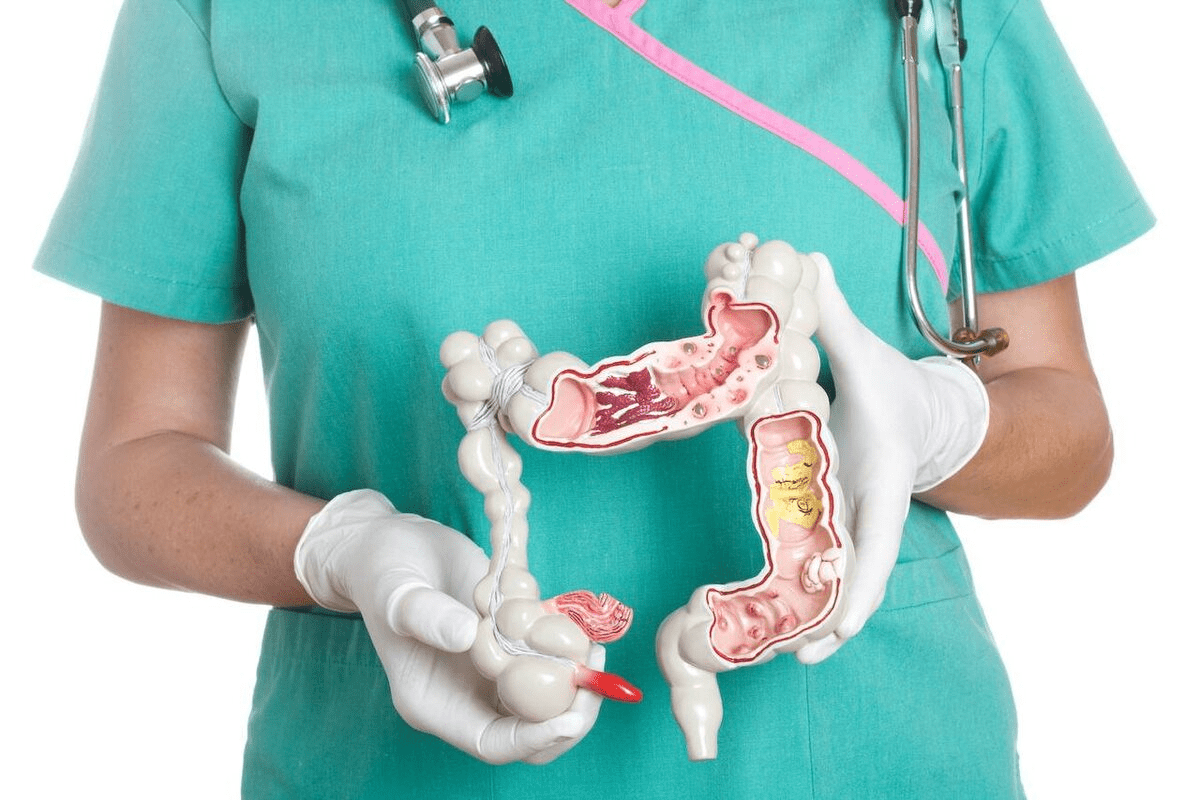
We often wonder about our digestive system, like how long our intestines are. The intestines, both small and large, are key for absorbing nutrients and keeping us healthy.
The intestines are about 25 feet long when stretched out. This is a big deal, showing how complex our digestive system is. The Institute of Human Anatomy says this length is important for absorbing nutrients well.
Learning about our digestive system is fascinating. It shows how our bodies are designed to work well. The length of our intestines, when stretched out, is a sign of this amazing design.
Key Takeaways
- The human intestines measure approximately 25 feet when fully extended.
- The small intestine makes up the majority of the intestines’ length.
- The intestines’ length is key for absorbing nutrients well.
- Understanding our digestive system’s design is impressive.
- The intestines are vital for our digestive health.
The Amazing Length of Human Intestines

The human intestines are truly amazing, stretching to surprising lengths when fully extended. The small and large intestines together form a key part of our digestive system.
Total Length in Perspective
The small intestine is the longest part, stretching about 20 feet (6 meters) when extended. The large intestine is much shorter, at about 5 feet (1.5 meters). Together, they are as tall as a two-story building.
Intestine Type | Average Length (feet) | Average Length (meters) |
Small Intestine | 20 | 6 |
Large Intestine | 5 | 1.5 |
Total | 25 | 7.5 |
Why Intestinal Length Matters for Digestion
The length of our intestines is key for digestion. The small intestine’s long length helps absorb nutrients efficiently. This is why it’s so long, as the Institute of Human Anatomy explains.
The large intestine, though shorter, is important for removing water and storing waste. Its lining’s folds increase the surface area for better absorption.
Knowing about our intestines’ length and function helps us understand the importance of a healthy digestive system.
Small Intestine vs. Large Intestine: A Size Comparison

The human digestive system has many parts, like the small and large intestines. They are different in size and what they do. Learning about their sizes helps us understand their roles in digestion.
The names “small” and “large” refer to the diameter, not length. The small intestine is about 1 inch wide. The large intestine is wider, around 3 inches.
Small Intestine: Long but Narrow
The small intestine is very long, stretching to about 20 feet. It’s actually longer than the large intestine. Its narrow width is key for absorbing nutrients. Medical Expert, a gut health expert, says,
“The small intestine is where most nutrient absorption happens. Its length and structure are vital for health.”
We’ll see how its length helps with digestion. The small intestine’s long length means it has a big surface area. This area is even bigger thanks to villi and microvilli, helping to absorb nutrients better.
Large Intestine: Short but Wide
The large intestine is shorter, about 5 feet long. It’s wider than the small intestine, making it look more noticeable. It’s important for absorbing water and storing waste. The Institute of Human Anatomy explains,
“The transition from the small intestine to the large intestine marks a shift from absorption to water removal and waste storage.”
The large intestine is shorter and wider for its job. It absorbs water and electrolytes, stores waste, and hosts gut microbiota.
The Small Intestine: Your 20-Foot Digestive Powerhouse
The small intestine is a big deal, even though it’s called small. It’s key to our health because it absorbs most of our nutrients. This makes it a vital part of our digestive system.
The small intestine has three main parts: the duodenum, jejunum, and ileum. Each part does a different job in breaking down food. Together, they turn food into nutrients our body can use.
Duodenum: The First 10 Inches
The duodenum is the first part of the small intestine, about 10 inches long. It’s where most chemical digestion happens. Bile from the gallbladder and enzymes from the pancreas break down food into smaller bits.
Jejunum: The Middle 8 Feet
The jejunum is about 8 feet long and focuses on nutrient absorption. Its walls have tiny projections called villi. These increase the surface area for better absorption.
Ileum: The Final 12 Feet
The ileum is the last part, about 12 feet long. It absorbs vitamin B12 and bile salts. These are important for our body’s functions.
To understand these sections better, let’s look at a comparison table:
Section | Length | Primary Function |
Duodenum | 10 inches | Chemical digestion |
Jejunum | 8 feet | Nutrient absorption |
Ileum | 12 feet | Absorption of vitamin B12 and bile salts |
Knowing about the small intestine’s structure and function is important. It helps us see how vital it is for our health. By understanding the roles of the duodenum, jejunum, and ileum, we can better grasp how our body processes food and absorbs nutrients.
The Large Intestine: 5 Feet of Finishing Touches
The large intestine is about 5 feet long and is key to our digestive system. It absorbs water, stores waste, and does other important jobs. These help our digestion process.
Sections of the Large Intestine
The large intestine has different parts, each with its own job. These include:
- The cecum, which is the pouch-like start of the large intestine
- The colon, split into the ascending, transverse, descending, and sigmoid colon
- The rectum, where feces wait to be pushed out
- The anal canal, the last part of the large intestine
Together, these parts help move and process waste.
Functions Related to Its Length
The large intestine’s length helps it do its job well. Its main tasks are:
- Water absorption: It takes water from waste, making feces more solid
- Waste storage: It holds waste until it’s time to get rid of it
- Fermentation: It has microbes that break down some substances
The Institute of Human Anatomy says the large intestine’s role changes. It moves from absorbing to removing water and storing waste. This shows how important it is for our health.
How Long Are Your Intestines? Individual Variations
The length of our intestines varies from person to person. It’s not the same for everyone. This shows how complex our digestive system is.
Many factors affect how long our intestines are. We’ll look at these factors and how they change our intestinal length.
Factors Affecting Intestinal Length
Genetics, age, height, and health all play a part in intestinal length. Genetics are a big factor in determining our intestinal length. Age, height, and health also have an impact.
Research shows that intestinal length can change with age. It might get a bit shorter as we get older. Taller people usually have longer intestines.
Gender Differences in Intestinal Length
Studies have found gender differences in intestinal length. Men generally have longer intestines than women. This is because of body size and muscle mass differences.
Knowing these gender differences is key for doctors and researchers. It helps in diagnosing and treating stomach problems.
Measuring Techniques: How Scientists Determine Intestinal Length
Scientists need to measure intestinal length accurately to understand digestive health. They have developed different methods over time. These range from traditional post-mortem measurements to modern in vivo imaging techniques.
In Vivo vs. Post-Mortem Measurements
Before, scientists measured intestinal length during autopsies. But these measurements might not be right for living people. This is because the body changes after death.
In vivo measurements are taken in living subjects. They use imaging technologies. For a living person, the small intestine is usually between 10 to 16 feet long.
Studies show in vivo measurements are much different from post-mortem ones. This shows how important modern imaging is for accurate measurements.
Modern Imaging Technologies
Modern imaging has changed gastroenterology by making in vivo measurements possible. CT scans, MRI, and endoscopy help see the intestines clearly. These tools are key in both research and clinical practice.
- CT scans give detailed cross-sectional images.
- MRI offers high-resolution images without radiation.
- Endoscopy lets us see the intestinal lumen directly.
Visualizing 25 Feet of Intestines
The intestines stretch out a lot when they’re fully extended. It’s hard to picture without comparing them to everyday things. We can see how they fit inside our belly by looking at their length and how they’re arranged.
Everyday Objects for Comparison
Imagine the intestines as long as a school bus or a bit longer than a bowling lane. These comparisons help us see how big our digestive tract is. We can also think of it as the length of several refrigerators or the height of a two-story building on its side.
How They Fit in Your Abdomen: The Folding Mechanism
Our body cleverly fits 20+ feet of intestines in our belly. They’re folded and coiled like origami. This way, they save space and help digest food efficiently.
The Institute of Human Anatomy says this is key for our digestive system. The intestines’ folding and coiling save space and help food move through our body.
The Surface Area Advantage: Beyond Just Length
The length of our intestines is impressive, but it’s the surface area that really matters. The intestinal lining is designed to maximize nutrient uptake. This is thanks to structures called villi and microvilli.
Villi and Microvilli: Increasing Absorption Surface
The small intestine’s inner surface is not smooth. Instead, it’s covered in finger-like projections called villi. These projections greatly increase the surface area for absorption. Each villus is about 0.5 to 1.5 mm long and has blood vessels and a lymphatic vessel called a lacteal.
Also, the cells lining these villi have even smaller projections called microvilli. These form a brush border that boosts the absorptive capacity even more.
“The presence of villi and microvilli increases the intestinal surface area by a factor of about 600,” says medical knowledge. This makes it roughly the size of a tennis court. This adaptation allows for efficient nutrient absorption from the food we eat.
Total Absorption Surface Area
The combined effect of the intestinal length, villi, and microvilli results in a huge absorption surface area. The total absorption surface area of the small intestine is about 250 square meters (or about 2,700 square feet). This is roughly the size of a singles tennis court.
This extensive surface area enables efficient nutrient absorption. It ensures our bodies can use the food we eat well.
We can appreciate the detailed design of our digestive system. The length and surface area work together for optimal nutrient absorption.
Evolutionary Perspective: Why Such Long Intestines?
The human intestines are quite long, and it’s interesting to see why. We look into why they are so long, comparing us to other animals. We also see how our intestines have changed to fit our diet.
Comparison with Other Animals
Looking at human intestines and those of other animals, we see a big difference. Herbivores, like cows, have longer intestines to digest plants. Carnivores, such as lions, have shorter intestines because they eat meat that’s easy to digest. Humans have intestines that are in between, showing our varied diet.
Adaptation to Human Diet
Our intestines have grown longer to better absorb nutrients from our food. A longer small intestine means more surface area for nutrient absorption. This is key for our diet’s complexity.
This adaptation helps us get as many nutrients as possible from our food. It supports our health and well-being.
By understanding why our intestines are long, we see the amazing adaptations for human health.
Medical Conditions Affecting Intestinal Length
Some medical conditions can really change how our intestines work. These issues can cause health problems.
Short Bowel Syndrome
Short bowel syndrome happens when a big part of the intestine is missing or not working. This can be due to surgery, disease, or injury. It makes it hard for the body to absorb nutrients because there’s not enough intestine left.
Surgical Implications and Intestinal Resection
When part of the intestine is removed during surgery, it can make the intestine shorter. This surgery is done to get rid of diseased parts. But, it can lead to short bowel syndrome. Knowing how surgery affects the intestine is key for helping patients recover.
It’s important to think about these things when looking at the health of our intestines. This is true, even more so for people who have had surgery or have diseases affecting their intestines.
Conclusion
We’ve looked into the human intestines, finding out how long and important they are for our health. They stretch out a lot, showing how key they are for absorbing nutrients and keeping us well.
The length of the intestines is vital for digestion. The small intestine is where most nutrients are absorbed. The large intestine helps with water absorption and managing waste. Knowing how important intestinal health is helps keep our digestive system balanced.
Understanding our intestines helps us see why a healthy gut is so important. The Institute of Human Anatomy says our intestines are essential for our health. As we learn more about our bodies, it’s clear that our intestines are key to staying healthy.
FAQ
How long are your intestines when stretched out?
When fully extended, your intestines are about 25 feet long.
What is the length of the small intestine?
The small intestine is the longest part, stretching about 20 feet.
How long is the large intestine?
The large intestine is about 5 feet long. It’s key for removing water and storing waste.
Which is longer, the small or large intestine?
The small intestine is longer, at about 20 feet. The large intestine is 5 feet long.
How do the intestines fit within the abdominal cavity?
The intestines fold up to fit in the abdominal cavity. This makes them compact and efficient.
What is the role of villi and microvilli in the intestines?
Villi and microvilli increase the surface area. This helps in absorbing nutrients more efficiently.
What is short bowel syndrome?
Short bowel syndrome is a condition affecting the length of the intestines. It can result from surgery or other factors.
How do modern imaging technologies measure intestinal length?
Modern imaging technologies have made measuring intestinal length more accurate. They allow for precise in vivo measurements.
What factors affect intestinal length?
Several factors can influence intestinal length. These include individual variations and certain medical conditions.
Why is intestinal length important for digestion?
Intestinal length is vital for digestion. It ensures maximum nutrient absorption and efficient waste storage.
How much intestine does a human have?
Humans have intestines that are about 25 feet long when fully extended.
How far do your intestines stretch?
Your intestines can stretch up to 25 feet. Yet, they are stored compactly in the abdominal cavity.
How long are human intestines stretched out?
Human intestines are roughly 25 feet long when stretched out.
How long are your long intestines?
The small intestine is about 20 feet long. It’s the longer of the two intestines.
How long is the human intestine stretched out?
The human intestine is about 25 feet long when stretched out.
What is the length of large intestine and small intestine?
The small intestine is about 20 feet long. The large intestine is roughly 5 feet long.
References
National Center for Biotechnology Information. Intestine Length: Small and Large Bowel Measurement. Retrieved from https://pubmed.ncbi.nlm.nih.gov/12497219/