Did you know that radiosurgery has changed how we treat brain tumors and other neurological issues? This method was first developed by Lars Leksell, a Swedish neurosurgeon, in the mid-20th century. Learn who invented radiosurgery. Understand the contribution of Lars Leksell to the field clearly.
Leksell’s groundbreaking work in stereotactic radiosurgery changed neurosurgery forever. It offered a precise and effective way to treat brain conditions without the need for open surgery. As the radiosurgery inventor, Leksell’s contributions have greatly influenced modern medicine.
Key Takeaways
- Lars Leksell pioneered radiosurgery in the mid-20th century.
- Radiosurgery is a non-invasive alternative to traditional brain surgery.
- Leksell’s work revolutionized the treatment of brain tumors and neurological conditions.
- Stereotactic radiosurgery provides precise and effective treatment.
- The development of radiosurgery has had a lasting impact on modern medicine.
The Birth of a Revolutionary Medical Technique
Radiosurgery started as a search for better, less invasive medical treatments. It was created to find safer ways to treat brain disorders.
The Need for Non-Invasive Brain Treatments
Old surgical methods for brain issues were risky. They could cause infections, bleeding, and harm to nearby brain areas. So, scientists looked for new ways, like using focused radiation to target brain spots.
Early Concepts of Focused Radiation
At first, radiosurgery used many beams of radiation to hit a specific brain spot. This method let doctors give high doses of radiation to the right area without harming the rest.
| Year | Development |
| 1951 | Lars Leksell conceptualized radiosurgery |
| 1968 | First Gamma Knife prototype developed |
The stereotactic radiosurgery has grown a lot. Now, it’s a key part of brain surgery. It’s a safe and effective way to treat many brain problems.
Who Invented Radiosurgery: The Pioneering Work of Lars Leksell
In the early 1950s, Lars Leksell started working on a new surgical method. This method, called radiosurgery, was meant to be non-invasive. It marked the start of a new era in neurosurgery, thanks to Leksell’s creativity and commitment to better patient care.
Early Life and Medical Education
Lars Leksell was born in Sweden and always wanted to help people through medicine. His education in medicine was the first step towards his future in neurosurgery. He saw the flaws in old surgical methods and wanted to find new ways to help patients.
Career at Karolinska Institute
Leksell’s time at the Karolinska Institute was key to radiosurgery’s development. As a neurosurgeon and researcher, he combined his clinical skills with scientific curiosity. The institute was a place of innovation, and Leksell’s work there greatly influenced neurosurgery.
| Year | Event |
| 1951 | Leksell conceptualized radiosurgery |
| 1968 | First Gamma Knife prototype developed |
The Conceptualization of Radiosurgery in 1951
In 1951, Leksell came up with the idea of radiosurgery. He wanted a way to precisely target brain areas with radiation, without harming the rest. This idea was groundbreaking and paved the way for radiosurgery as a treatment for many neurological issues.
Creating radiosurgery wasn’t easy for Leksell. He faced many technical and scientific obstacles. But his determination and creativity led to the birth of a new neurosurgery field.
Lars Leksell’s Biography and Contributions to Medicine
Lars Leksell made a big impact on medicine, not just with radiosurgery. His work on stereotactic techniques and research changed neurosurgery for good.
Scientific Background and Influences
Leksell’s medical education at the Karolinska Institute was tough but rewarding. He learned from many medical fields and new techniques. This shaped his neurosurgery approach.
He created the stereotactic frame. This device helped him treat brain targets with great precision.
Major Publications and Research
Leksell was a top researcher in neurosurgery. His papers covered radiosurgery and stereotactic techniques. His work was highly respected by doctors worldwide.
He focused on using stereotactic radiosurgery for different brain conditions. His research was groundbreaking.
Awards and Recognition
Leksell won many awards for his medical work. His radiosurgery invention and the Gamma Knife got him global fame. He was a true pioneer in radiosurgery.
His work is a big part of today’s neurosurgery. Leksell’s legacy shows how innovation and hard work can improve health.
The Development of the Stereotactic Frame
Lars Leksell’s invention of the stereotactic frame changed neurosurgery. It gave a precise way to find brain structures. This was key for radiosurgery to grow.
Creating Precision in Neurosurgery
The stereotactic frame made precise targeting of brain areas possible. Leksell’s design made it useful for many neurosurgical tasks. This made it very helpful.
The Arc-Centered Calculation System
The arc-centered calculation system was a big part of Leksell’s frame. It helped with precise calculations for radiosurgery. This made radiation delivery more accurate.
Impact on Stereotactic Localization
The stereotactic frame greatly improved stereotactic localization. It brought a new level of precision. This allowed neurosurgeons to hit their targets more accurately.
The invention of the stereotactic frame was a major breakthrough. It made radiosurgery more precise. It also pushed neurosurgical innovation forward.
The First Radiosurgery Experiments
The first radiosurgery experiments were done on animals to check if it was safe and worked well. Lars Leksell and his team at the Karolinska Institute led these important studies.
Early Animal Studies at Karolinska Institute
These early tests used animals to see how focused radiation affected living tissues. They were key in finding the right dose and checking for side effects. As Leksell said,
“The use of stereotactic radiosurgery in animal experiments opened new avenues for understanding the biological effects of radiation.”
Transition to Human Applications
After proving radiosurgery was safe and effective in animals, Leksell and his team started using it on humans. They planned carefully and aimed precisely at the areas to treat. The first use of radiosurgery on humans was a big step forward.
Documentation and Scientific Validation
The results of animal and early human radiosurgery were well recorded and checked closely. They compared these results with other treatments and made the technique better. This validation was key for radiosurgery to be accepted by doctors.
The pioneering work on radiosurgery experiments showed its promise. It made radiosurgery a trusted treatment in neurosurgery. Leksell and his team worked hard to prove its value.
The Invention of the Gamma Knife
Lars Leksell’s work led to the Gamma Knife in the late 1960s. This device used cobalt-60 sources for precise radiation therapy. It was a big step forward in radiosurgery.
Engineering Challenges and Solutions
Creating the Gamma Knife was tough. The main challenge was focusing many radiation beams on one spot. Leksell’s team solved this with a complex system that aimed radiation from different angles.
The First Gamma Knife Prototype in 1968
The first Gamma Knife was made in 1968. It was the result of years of hard work. This device could treat brain problems without surgery, with great accuracy.
Cobalt-60 Sources and Radiation Physics
The Gamma Knife used cobalt-60 for its therapy. Its design focused many beams on one spot. This reduced harm to nearby tissue.
Focusing Multiple Beams
The Gamma Knife’s power came from focusing many beams on one spot. This was done with a system of radiation sources and collimators.
Minimizing Collateral Damage
The Gamma Knife was great at avoiding damage to healthy tissue. It focused radiation on the target, protecting nearby areas.
The Gamma Knife’s invention was a big step in radiosurgery history. It opened the door for today’s treatments of brain disorders.
- The Gamma Knife was invented by Lars Leksell.
- Cobalt-60 sources were used for radiation therapy.
- The device minimized collateral damage through precise beam focusing.
Clinical Applications of Radiosurgery
Radiosurgery is a precise treatment for many medical conditions. It’s used for tumors and functional disorders. This method delivers high doses of radiation to specific areas, protecting nearby tissues.
Treatment of Functional Disorders
Radiosurgery helps treat various functional disorders. It offers relief to those with severe conditions.
Trigeminal Neuralgia
Trigeminal neuralgia causes intense facial pain. Radiosurgery is a non-invasive way to target the trigeminal nerve. It helps reduce pain.
Movement Disorders
Movement disorders, like Parkinson’s disease, can be treated with radiosurgery. It targets specific brain areas to lessen symptoms.
Tumor Treatment
Radiosurgery is a precise, non-invasive tumor treatment. It’s an alternative to traditional surgery.
Brain Metastases
Brain metastases are secondary tumors. Radiosurgery is effective for treating them, even with multiple metastases.
Meningiomas and Acoustic Neuromas
Meningiomas and acoustic neuromas are benign tumors. Radiosurgery treats them with precision, preserving nearby neural structures.
Vascular Malformation Management
Vascular malformations, like AVMs, can be treated with radiosurgery. The goal is to replace the malformation with normal blood vessels.
Arteriovenous Malformations
AVMs are abnormal blood vessel connections. Radiosurgery targets the AVM’s nidus with high radiation. This promotes its obliteration.
| Condition | Treatment Outcome | Benefits |
| Trigeminal Neuralgia | Pain relief | Non-invasive, precise |
| Brain Metastases | Tumor control | Effective for multiple metastases |
| Arteriovenous Malformations | Obliteration of AVM | Minimally invasive, reduced risk |
Radiosurgery is a versatile treatment for complex medical conditions. Its precision and non-invasive nature make it appealing to patients and doctors.
The Evolution of Radiosurgery Technology
Radiosurgery technology has grown a lot. It’s now more precise, safe, and effective. New imaging and computer tech have made it better.
Improvements in Imaging Integration
Today’s radiosurgery uses advanced imaging like MRI and CT scans. These tools give detailed pictures of the body. This helps doctors target tumors more accurately.
Enhanced Targeting Systems
New targeting systems have made radiosurgery more precise. They use smart algorithms and live images. This ensures the radiation hits the right spot.
Computer-Assisted Planning
Computer planning is key in radiosurgery now. Special software helps create detailed treatment plans. These plans are made just for each patient.
Quality Assurance Protocols
Quality checks are vital for safe radiosurgery. They test and validate the equipment and plans. This reduces risks and improves results.
Key advancements in radiosurgery technology include:
- Improved imaging integration for precise targeting
- Enhanced targeting systems for increased accuracy
- Computer-assisted planning for personalized treatment
- Quality assurance protocols for safe and effective delivery
Other Pioneers in Radiosurgery Development
Lars Leksell is often credited with inventing radiosurgery. But many others have also played key roles in its growth. Their work has made radiosurgery a precise and effective medical tool.
Contributors to the Field
Many individuals have made big contributions to radiosurgery. Those who worked with Leksell at the Karolinska Institute are among them. Their efforts have shaped radiosurgery as we know it today.
International Adoption and Advancement
Thanks to global teamwork, radiosurgery has spread worldwide. Researchers and institutions around the globe have helped improve it. They’ve made it work for many different medical needs.
The Role of Karolinska Institute
The Karolinska Institute has been vital in radiosurgery’s growth. It’s where Leksell and his team worked. The institute remains a leader in radiosurgery research and use.
| Institution | Contribution | Year |
| Karolinska Institute | Development of the first Gamma Knife | 1968 |
| University of California | Advancements in LINAC-based radiosurgery | 1980s |
| Stanford University | Development of CyberKnife technology | 1990s |
Alternative Radiosurgery Systems
Over time, radiosurgery has evolved with new systems. The Gamma Knife is a key player, but others have joined the field. These new technologies offer different ways to treat various health issues.
Linear Accelerator (LINAC) Based Systems
LINAC-based radiosurgery uses a linear accelerator to make high-energy X-rays. These systems are flexible and treat many conditions, from small tumors to big ones. LINAC systems are widely adopted for their flexibility and precise radiation delivery.
CyberKnife Development
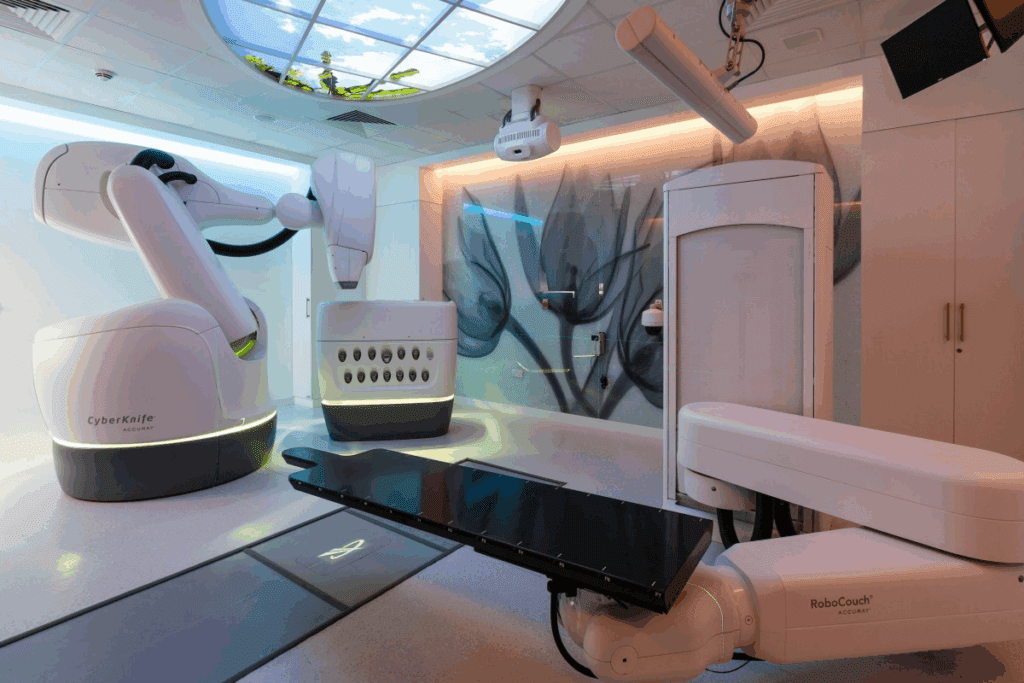
The CyberKnife is a robotic system that guides radiation in real-time. It’s great for hard-to-reach tumors or those near important areas. The CyberKnife’s flexibility makes it possible to create complex treatment plans with high accuracy.
Proton and Carbon Ion Radiosurgery
Proton and carbon ion radiosurgery use charged particles instead of X-rays. They deliver a precise dose to the target, protecting nearby tissues. Proton therapy is known for safely treating tumors in sensitive areas.
Comparative Advantages and Limitations
Each radiosurgery system has its own strengths and weaknesses. It’s important to compare them to find the best treatment for a specific condition.
| System | Advantages | Limitations |
| LINAC | Versatile, widely available | May require additional imaging |
| CyberKnife | Real-time image guidance, precise | Complex treatment planning |
| Proton/Carbon Ion | Highly conformal dose, minimal side effects | Limited availability, high cost |
The Impact of Radiosurgery on Modern Medicine
Radiosurgery has changed modern medicine, mainly in neurosurgery. It’s a non-invasive method that has made treating brain and nervous system issues easier.
Transforming Neurosurgical Practice
Radiosurgery has changed neurosurgery for the better. It offers a precise and effective way to treat hard-to-manage conditions. This precision has reduced the risk of complications, making it safer than traditional surgery.
Patient Benefits and Outcomes
There are many patient benefits from radiosurgery. It’s a non-invasive treatment with minimal recovery time, so patients can quickly get back to their lives. It’s also very effective in treating tumors, vascular malformations, and functional disorders, leading to better patient outcomes.
Cost-Effectiveness and Healthcare Impact
Radiosurgery is also good for healthcare economics. It reduces the need for long hospital stays and lowers the risk of complications. This makes it cost-effective compared to traditional surgery.
Training and Specialization in Radiosurgery
More people are using radiosurgery, which means more training is needed. Specialized programs have been created to teach healthcare professionals how to use this advanced treatment.
In summary, radiosurgery has greatly impacted modern medicine. It has changed neurosurgery, improved patient outcomes, and is a cost-effective option. As the field grows, training and specialization will be key to fully using radiosurgery’s benefits.
Conclusion: The Lasting Legacy of Radiosurgery Invention
Lars Leksell’s invention of radiosurgery has changed how we treat brain disorders. It has made treatments more precise and non-invasive. This has greatly improved how patients recover.
The legacy of radiosurgery keeps growing, shaping today’s neurosurgery. Leksell’s work has inspired many neurosurgeons and researchers. They keep pushing the field forward with new ideas.
Radiosurgery’s impact is clear in how widely it’s used and the better care it offers. It shows Leksell’s vision is alive and well in neurosurgery. This field is always evolving thanks to his invention.
Lars Leksell radiosurgery is known for its precision and success. It shows the lasting effect of his work on medicine.
FAQ
Who is credited with inventing radiosurgery?
Lars Leksell, a Swedish neurosurgeon, is credited with inventing radiosurgery. He developed the concept and the first Gamma Knife unit at the Karolinska Institute.
What is radiosurgery?
Radiosurgery is a medical procedure that uses focused radiation. It treats various conditions like tumors and vascular malformations. It does this without the need for traditional surgical incisions.
What was the significance of Lars Leksell’s work in radiosurgery?
Lars Leksell’s work revolutionized neurosurgery. He introduced a non-invasive treatment option. This option minimized risks and improved patient outcomes.
What is the Gamma Knife, and how does it work?
The Gamma Knife is a radiosurgery unit developed by Lars Leksell. It uses multiple cobalt-60 sources. These sources deliver focused gamma radiation to a target area, minimizing damage to surrounding tissue.
What are the clinical applications of radiosurgery?
Radiosurgery is used to treat various conditions. These include brain tumors, arteriovenous malformations, and trigeminal neuralgia. It also treats acoustic neuromas, pituitary adenomas, and meningiomas, among others.
How has radiosurgery technology evolved over time?
Advances in imaging integration and targeting systems have improved radiosurgery. Computer-assisted planning and quality assurance protocols have also enhanced its precision, safety, and effectiveness.
Are there alternative radiosurgery systems beside the Gamma Knife?
Yes, there are alternative systems. These include linear accelerator (LINAC) based systems, CyberKnife, proton radiosurgery, and carbon ion radiosurgery. Each has its technical characteristics, advantages, and limitations.
What is the impact of radiosurgery on modern medicine?
Radiosurgery has transformed neurosurgical practice. It has improved patient outcomes and reduced healthcare costs. It provides a minimally invasive treatment option for various conditions.
What is the role of the Karolinska Institute in the development of radiosurgery?
The Karolinska Institute played a key role in the development of radiosurgery. It was where Lars Leksell worked and conducted his pioneering research. This research significantly advanced the field.
What kind of training and specialization is required for radiosurgery?
Radiosurgery requires specialized training and expertise. This includes neurosurgery, radiation oncology, and medical physics. Strict quality assurance protocols must also be followed to ensure safe and effective treatment delivery.
References
National Center for Biotechnology Information. Evidence-Based Medical Insight. Retrieved from https://pubmed.ncbi.nlm.nih.gov/14754298/