A neurological examination is key for diagnosing and managing neurological conditions. These conditions affect millions globally.
This exam checks many aspects of neurological function. It looks at mental status, cranial nerves, motor and sensory systems, and coordination. A detailed assessment helps doctors spot issues and create treatment plans.
Knowing how to do a neurological assessment is vital for healthcare providers. It ensures they give the best care to their patients.
Key Takeaways
- Understand the importance of a comprehensive neurological examination.
- Learn the key components of a neurological assessment.
- Discover how to assess cranial nerve function.
- Identify the role of neurological examination in patient care.
- Recognize the benefits of a thorough neurological examination.
The Fundamentals of Neurological Assessment

Healthcare professionals need to know about neurological assessment basics. It helps them diagnose and manage neurological conditions well. These assessments give a full picture of a patient’s neurological health, guiding treatment plans.
Purpose and Clinical Significance
Neurological assessments check the nervous system’s function and health. They are key in spotting neurological problems, like stroke or brain injury. They also help track how a patient is doing over time.
Studies show certain proteins are vital for brain health. For example, the 14-3-3 protein family is important. Mutations in the YWHAG gene, which codes for 14-3-3γ, can cause neurological issues like seizures and developmental delays (Guella et al., 2017).
When to Perform Neurological Checks
Neurological checks are needed in many situations. This includes when a patient first comes in, during acute events, and for those with ongoing neurological conditions. Quick assessments are key for catching changes early and acting fast.
Components of a Complete Assessment
A full neurological assessment covers several areas. These are:
- Level of consciousness evaluation
- Cranial nerve assessment
- Motor system examination
- Sensory function testing
- Reflex testing
- Coordination and cerebellar function evaluation
- Gait and balance assessment
| Component | Description | Clinical Significance |
| Level of Consciousness | Evaluation of the patient’s alertness and responsiveness | Indicates the patient’s overall neurological status |
| Cranial Nerve Assessment | Examination of the 12 cranial nerves | Identifies deficits in specific cranial nerves |
| Motor System Examination | Assessment of muscle strength, tone, and reflexes | Detects motor dysfunction or weakness |
Healthcare professionals can do detailed neurological assessments by knowing these components. This helps them better diagnose and manage neurological conditions.
Essential Equipment for a Thorough Neuro Exam
Healthcare professionals need the right tools and a good environment for a thorough neuro exam. A detailed neurological examination is key to diagnosing and managing neurological conditions.
Basic Tools and Their Functions
The basic tools for a neurological examination include a reflex hammer, tuning fork, ophthalmoscope, and otoscope. The reflex hammer tests deep tendon reflexes. The tuning fork checks vibration sense. The ophthalmoscope and otoscope examine the eyes and ears, respectively.
A neurological pin or sharp object tests pain sensation. A cotton swab is used for light touch assessment. These tools are vital for a complete cranial nerve assessment and neurological evaluation.
Creating an Optimal Examination Environment
An optimal examination environment is essential for a successful neuro exam. The room should be well-lit, quiet, and at a comfortable temperature. Good lighting is important for eye exams with the ophthalmoscope.
Reducing distractions and ensuring patient privacy are also important. This helps in reducing anxiety and allows for a more accurate assessment.
Patient Preparation and Positioning
Patient preparation is a critical step in the neurological examination process. Patients should be informed about the procedures and the importance of their cooperation. They should be comfortably positioned, either sitting or lying down, depending on the specific components of the examination being performed.
Proper patient positioning is important for accurate assessment. For example, sitting or standing can help assess gait and balance. Lying down may be more suitable for certain cranial nerve and sensory examinations.
Mental Status and Cognitive Function Assessment
It’s important to understand a patient’s mental state and cognitive abilities. This helps in diagnosing and managing neurological disorders. It’s a key part of a full neurological check-up.
Level of Consciousness Evaluation
The level of consciousness shows how well a patient’s brain is working. Doctors use the Glasgow Coma Scale (GCS) to check this. It looks at eye opening, talking, and movement.
If a patient’s consciousness is low, they might need urgent care. The GCS score goes from 3 to 15. A higher score means better brain function.
| GCS Component | Score | Description |
| Eye Opening | 1-4 | 1 = No response, 4 = Spontaneous |
| Verbal Response | 1-5 | 1 = No response, 5 = Oriented |
| Motor Response | 1-6 | 1 = No response, 6 = Obeys commands |
Orientation and Attention Testing
Knowing a patient’s sense of time, place, and person is key. Doctors ask them their name, the date, and where they are.
Attention is tested with tasks like serial sevens. This is subtracting 7 from 100 over and over.
“The assessment of orientation and attention is fundamental in determining a patient’s cognitive status and ability to interact with their environment.”
Memory and Higher Cognitive Functions
Memory tests check both short-term and long-term memory. Patients might be asked to recall words or events.
Higher brain functions like language, spatial skills, and executive functions are also tested. For example, naming objects and following commands.
Doing a full check of mental status and cognitive function is key. It helps in making the right diagnosis and managing neurological conditions well.
Cranial Nerve Assessment: A Systematic Approach
Assessing cranial nerves in a systematic way is key to spotting neurological issues. It helps doctors check the nervous system’s health and find any problems.
Testing Cranial Nerves I-VI
The first six cranial nerves handle important tasks like smelling, seeing, and moving the eyes. Doctors use specific tests to check these nerves:
- Olfactory Nerve (I): Test the patient’s sense of smell using familiar scents, such as coffee or vanilla.
- Optic Nerve (II): Evaluate visual acuity using a Snellen chart and assess visual fields by confrontation.
- Oculomotor (III), Trochlear (IV), and Abducens (VI) Nerves: Examine eye movements, pupil size, and reactivity to light.
Examining Cranial Nerves VII-XII
The last six cranial nerves manage other vital functions like facial expressions, hearing, and swallowing. Here are tests for these nerves:
- Facial Nerve (VII): Evaluate facial symmetry, strength, and expressions.
- Vestibulocochlear Nerve (VIII): Assess hearing using a tuning fork or whisper test.
- Glossopharyngeal (IX) and Vagus (X) Nerves: Examine gag reflex, swallowing, and vocal quality.
- Accessory Nerve (XI): Test shoulder shrug and sternocleidomastoid strength.
- Hypoglossal Nerve (XII): Evaluate tongue movements and strength.
By using this method, doctors can thoroughly check the nervous system. They can then spot any neurological problems.
Motor System Examination Techniques
A detailed check of the motor system helps doctors spot problems and find the cause of neurological issues. This check is key to seeing if the motor pathways are working right. It also helps find any damage or lesions.
Muscle Bulk and Tone Assessment
Checking muscle bulk means looking at and feeling the muscles for any odd shapes or sizes. Muscle tone is tested by seeing how much resistance there is when moving the muscle. If the tone is off, like being too tight or too loose, it might point to a neurological problem.
Strength Grading on the 0-5 Scale
Muscle strength is rated from 0 to 5. A 0 means no movement at all, and a 5 is normal strength. This scale helps measure how weak muscles are and track any changes. Getting the strength right is important for diagnosing and treating motor system issues.
Testing Major Muscle Groups by Region
Checking major muscle groups means testing the strength of specific muscles in different parts of the body. This includes the arms, legs, face, and eyes. Doing this in a methodical way makes sure no important weaknesses are missed.
In summary, a complete motor system check is essential for diagnosing and treating neurological problems. By looking at muscle bulk and tone, grading strength, and testing muscle groups, doctors can learn a lot about the nervous system’s health.
Comprehensive Sensory Function Testing
Sensory function testing checks how well the nervous system works. It looks at the sensory pathways. This is key to finding sensory problems and helping patients.
Light Touch and Pain Sensation Assessment
Testing light touch and pain helps see if the sensory pathways are working right. For light touch, a soft brush or cotton wisp is used on the skin. The patient says when they feel it.
For pain, a sharp object is used carefully. The patient tells the difference between sharp and dull.
Temperature and Vibration Sense Evaluation
Testing temperature uses cold and hot water. The patient says what they feel. Vibration sense is tested with a tuning fork. The fork is placed on bones, and the patient reports when they feel it.
Proprioception and Discriminative Sensation
Proprioception checks how well the body knows its position. The patient’s fingers or toes are moved, and they say the direction. Two-point discrimination and stereognosis are also tested.
Two-point discrimination uses calipers to see how close two points can be felt. Stereognosis is identifying objects in the hand without seeing them.
| Sensory Modality | Testing Method | Clinical Significance |
| Light Touch | Cotton wisp or soft brush | Assesses integrity of posterior column-medial lemniscus pathway |
| Pain Sensation | Sterile needle or sharp object | Evaluates spinothalamic tract function |
| Temperature | Cold and hot water containers | Assesses spinothalamic tract function |
| Vibration Sense | 128 Hz tuning fork | Evaluates posterior column-medial lemniscus pathway |
| Proprioception | Movement of fingers or toes | Assesses posterior column-medial lemniscus pathway |
Deep Tendon and Pathological Reflex Testing
Neurological tests often check deep tendon and pathological reflexes. These tests show how well the nervous system is working. They help doctors find and track neurological problems.
Upper and Lower Extremity Reflexes
Deep tendon reflexes are tested in arms and legs. In arms, the biceps and triceps reflexes are checked. In legs, the patellar and Achilles reflexes are looked at. A reflex hammer strikes the tendon to test each reflex.
These tests help find out if there’s a problem with the nerves. For example, if reflexes are too strong, it might mean a nerve issue. If they’re too weak or missing, it could point to another problem.
Reflex Grading Scale and Interpretation
Reflexes are graded from 0 to 4+, with 2 being normal. This scale helps measure how strong reflexes are:
| Grade | Interpretation |
| 0 | Absent reflex |
| 1+ | Diminished reflex |
| 2+ | Normal reflex |
| 3+ | Brisk reflex |
| 4+ | Very brisk, hyperactive reflex with clonus |
Knowing the grading scale is key to understanding reflex test results. It helps match the results with what the doctor finds.
Coordination and Cerebellar Function Evaluation
Neurological assessments focus on checking coordination and cerebellar function. This is key to understanding patient outcomes. It helps doctors diagnose and manage neurological conditions.
Finger-to-Nose Test Procedure
The finger-to-nose test checks coordination and cerebellar function. The patient touches their nose with their index finger and then the examiner’s finger. This is done several times.
Key aspects to observe during the finger-to-nose test include:
- Smoothness and accuracy of movement
- Presence of tremors or dysmetria
- Ability to correct movements
Heel-to-Shin Test Technique
The heel-to-shin test evaluates coordination and cerebellar function in the lower extremities. The patient lies down and lifts one heel, placing it on the opposite knee. Then, they slide it down towards the ankle.
Observations during the heel-to-shin test may reveal:
- Coordination and smoothness of the movement
- Presence of ataxia or dysmetria
- Ability to control the heel as it moves down the shin
Rapid Alternating Movements Assessment
Rapid alternating movements (RAMs) test the patient’s quick movement skills. They are asked to rapidly supinate and pronate their hands or tap their fingers in an alternating pattern.
| Test | Observation | Clinical Significance |
| Finger-to-Nose | Smoothness, accuracy, presence of tremors | Cerebellar function, coordination |
| Heel-to-Shin | Coordination, presence of ataxia | Lower extremity coordination, cerebellar function |
| Rapid Alternating Movements | Speed, accuracy, presence of dysdiadochokinesia | Cerebellar function, motor control |
These tests are part of a detailed neurologic exam. They help doctors understand a patient’s coordination and cerebellar function. This information is key for diagnosis and treatment.
Gait and Balance Assessment Methods
Assessing gait and balance is key to checking neurological health. These tests give important info about a patient’s brain function. They can show if there are issues that need more looking into.
Normal Gait Cycle Evaluation
A normal gait cycle is smooth and efficient. It’s about how well a person walks. Look for any odd movements like limping or stumbling.
The cycle has two main parts: the stance phase and the swing phase. The stance phase is when the foot touches the ground. The swing phase is when it doesn’t.
Important things to check during gait evaluation include:
- Stride length and width
- Cadence (steps per minute)
- Base of support
- Arm swing
- Posture and balance during walking
Romberg Test and Modified Versions
The Romberg test is a simple way to check balance. It asks the patient to stand with feet together, first with eyes open, then closed. If they sway or lose balance with eyes closed, it means they might have problems with balance or inner ear function.
There are also modified versions of the Romberg test:
- Tandem Romberg: Standing with one foot in front of the other
- Single-leg stance: Standing on one leg
Tandem Walking and Get-Up-and-Go Test
Tandem walking is when a person walks in a line, with one foot in front of the other. It checks balance, coordination, and complex motor skills.
The Get-Up-and-Go test looks at how well a person can get up, walk a bit, turn, and sit back down. It checks mobility, balance, and fall risk.
Both tests are great for spotting fall risks and tracking changes in mobility and balance.
Performing a Complete Neuro Exam in Clinical Practice
Doing a thorough neurological exam is key in clinical practice. It helps check a patient’s neurological health well. This exam gives important info for diagnosing and treating many neurological issues.
Systematic Approach to Neurological Assessment
A systematic approach to neurological assessment makes sure all important parts are checked. This includes looking at mental status, cranial nerves, motor and sensory systems, reflexes, coordination, and gait.
The mental status examination checks a patient’s consciousness, orientation, and thinking skills. It’s important to see if a patient can follow commands and talk.
Time-Efficient Examination Techniques
Quick examination techniques are key in busy clinics. Healthcare workers can adjust their methods to focus on what’s most important for the patient’s symptoms.
For example, the NIH Stroke Scale quickly checks for neurological problems in stroke patients. It looks at consciousness, vision, speech, and motor skills, among others.
| NIH Stroke Scale Component | Description | Score Range |
| Level of Consciousness | Checks how alert the patient is | 0-3 |
| Visual Function | Looks at visual fields and gaze | 0-3 |
| Motor Function | Checks strength in arms and legs | 0-4 |
Adapting the Exam for Different Settings
Neurological exams need to change for different places and patients. For example, in emergencies, a quick check is needed to decide on treatment fast.
In outpatient settings, a detailed exam can be done. The exam should match the patient’s needs and complaints.
By being flexible and systematic, healthcare workers can do a complete neuro exam well in many settings.
Red Flags in Neurological Examination
Red flags in neurological exams are important signs that help find and treat serious brain disorders early. These signs mean a patient needs quick attention and more tests to avoid serious problems.
Critical Findings Requiring Immediate Action
Some findings in a neurological exam need quick action to help patients fast. These include:
- Acute changes in mental status: Sudden confusion, disorientation, or a drop in consciousness.
- Severe headache: A sudden, very bad headache, often called “the worst headache of my life.”
- Neurological deficits: Sudden weakness, numbness, or paralysis, usually on one side of the body.
Spotting these signs is key for doctors to start the right emergency steps.
Subtle Neurological Signs Not to Miss
Some neurological signs are obvious, but others are subtle yet important. It’s important not to miss:
- Mild cognitive impairments: Early signs of brain decline that might show neurodegenerative diseases.
- Slight motor abnormalities: Small changes in muscle tone or strength that could hint at neurological issues.
Keeping an eye out for these subtle signs can help catch problems early and start treatment sooner.
When to Escalate Care or Obtain Imaging
Deciding when to step up care or get imaging is key in neurological exams. This choice depends on:
| Clinical Indicator | Action |
| Worsening neurological status | Escalate care and consider imaging |
| Presence of red flags | Immediate imaging and consultation |
| Unclear diagnosis | Further diagnostic testing, including imaging |
Doctors must use their best judgment to know when a patient needs more tests or higher care.
Knowing about red flags and when to act helps doctors improve patient care in neurology.
Specialized Neuro Checks for Specific Conditions
Specialized neuro checks are key in diagnosing certain neurological conditions. They help doctors give the right care and treatments.
Stroke Assessment Protocols
Stroke assessment is vital for quick action in treating stroke patients. The National Institutes of Health Stroke Scale (NIHSS) is a main tool for checking stroke severity. It looks at things like consciousness, vision, speech, and muscle strength.
Quick and detailed checks are important. Doctors use the NIHSS to see how bad the stroke is. This helps decide on treatments, like clot-busting drugs.
Traumatic Brain Injury Evaluation
Traumatic brain injury (TBI) checks are detailed after a head injury. The Glasgow Coma Scale (GCS) helps measure TBI severity. It checks eye opening, speech, and movement.
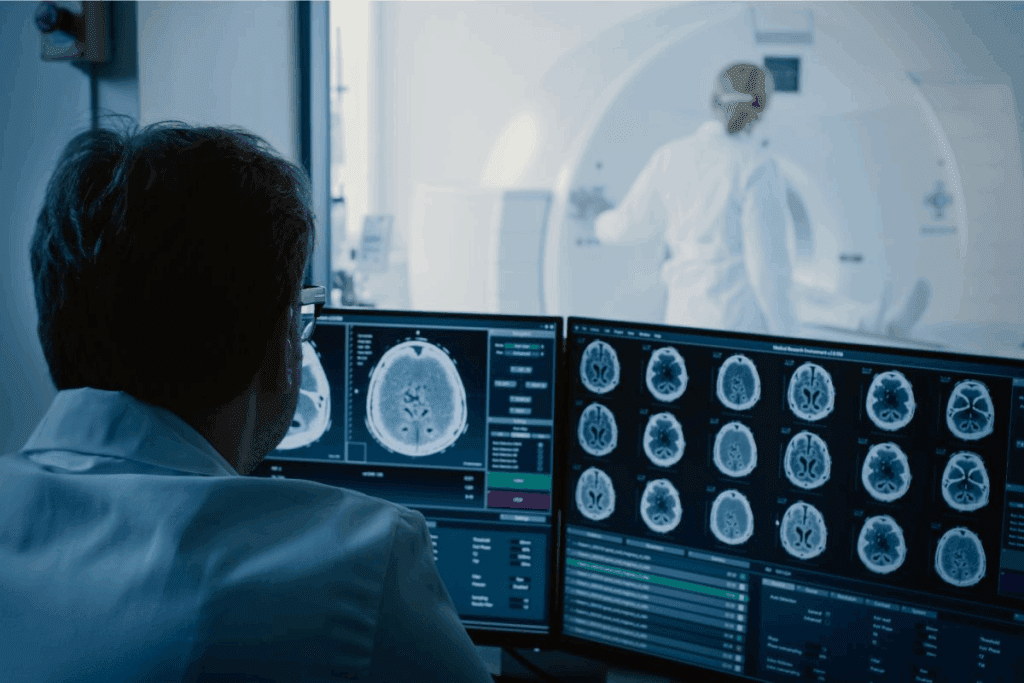
Checking for signs of brain pressure is also part of TBI evaluation. Symptoms like headaches and changes in thinking are looked for. CT or MRI scans help find injuries.
Spinal Cord and Peripheral Nerve Assessment
Checking the spinal cord and nerves is important for diagnosing issues. A detailed check is done to see how nerves and muscles work below the injury.
The American Spinal Injury Association (ASIA) scale is used for spinal cord injuries. It rates injury severity. Nerve checks look at muscle strength, reflexes, and feeling in the nerve area.
Documentation and Interpretation of Neuro Exam Findings
Getting neuro exam findings right is key for good patient care and smart decisions. The neurological exam is complex. Its results need to be recorded and looked at carefully.
Standardized Documentation Methods
Using the same methods for documenting neuro exams helps keep things clear and consistent. This is done with structured templates and electronic health records (EHRs). They help healthcare providers get all the important details.
Important things to write down include:
- Patient’s level of consciousness and orientation
- Cranial nerve function
- Motor strength and tone
- Sensory function
- Reflexes
- Coordination and balance
Interpreting Patterns of Neurological Deficits
Understanding the patterns of neurological deficits is key to finding where problems are and what they might be. Healthcare providers must put together info from different parts of the neuro exam. This helps spot patterns that point to specific problems.
For example, weakness on one side of the body could mean a problem in the opposite side of the brain or the nerve that connects it to the rest of the body. Also, issues with cranial nerves can help find where problems are in the brainstem.
Communicating Findings to the Healthcare Team
Telling the healthcare team about neuro exam findings is important for working together and making smart decisions. Clear and easy-to-understand documentation helps a lot with this.
When sharing findings, it’s important to be clear about what’s wrong and why it matters. This can be done with both detailed notes and structured data in EHRs.
Special Population Considerations in Neurological Assessment
Understanding the unique needs of special populations is key when assessing their neurological function. These assessments are vital for diagnosing and managing neurological conditions in different patient groups.
Pediatric Neuro Exam Modifications
Adapting techniques for neurological exams in children is essential. The pediatric neuro exam focuses on reflexes, muscle tone, and developmental milestones. This approach helps tailor the assessment to the child’s age and developmental stage.
| Age Group | Key Assessment Areas | Notable Reflexes |
| Infants (0-12 months) | Primitive reflexes, muscle tone | Moro, rooting reflex |
| Toddlers (1-3 years) | Developmental milestones, gait | Tonic labyrinthine reflex |
| Children (4-12 years) | Cognitive function, coordination | None (primitive reflexes should be integrated) |
Geriatric Assessment Challenges
Geriatric patients face unique challenges due to age-related changes and comorbid conditions. The geriatric assessment must account for these factors when evaluating neurological function.
Common challenges include:
- Cognitive decline
- Decreased muscle mass and strength
- Impaired balance and coordination
Examining Patients with Communication Barriers
Patients with communication barriers, such as language disorders or hearing impairments, need special attention. Adaptations may include using alternative communication methods or involving interpreters.
Strategies for assessing these patients include:
- Using non-verbal cues and gestures
- Employing visual aids
- Collaborating with family members or caregivers
Conclusion
A thorough neurological examination is key for healthcare pros to check the nervous system’s health. It helps spot any issues early. By learning the methods in this guide, doctors can do a detailed neuro exam. This way, they can make better choices for their patients.
The neurological examination is complex. It needs a careful plan, focus on details, and a deep understanding of the methods. By using what they learned here, doctors can find small problems and give top-notch care.
To wrap it up, a good neurological assessment is vital for diagnosing and treating neurological issues. By sticking to the advice in this article, doctors can get better at doing a full neuro exam. This helps improve patient results.
FAQ
What is a neurological exam?
A neurological exam checks the nervous system. It looks at mental status, cranial nerves, and motor and sensory systems. It also checks coordination.
What are the components of a complete neurological assessment?
A complete assessment looks at mental status and cranial nerves. It also checks motor and sensory systems, reflexes, coordination, and gait and balance.
How do you test cranial nerve 5?
Cranial nerve 5, or the trigeminal nerve, is tested by checking facial sensation. This includes light touch, pain, and temperature. It also checks the strength of the masseter and temporalis muscles.
What is the finger-to-nose test?
The finger-to-nose test checks coordination. It involves touching the tip of the nose with the index finger. It tests cerebellar function and fine motor control.
How do you grade strength on a neuro exam?
Strength is graded from 0 to 5. 0 means no contraction. 1 is a flicker of contraction. 2 means movement with gravity eliminated.
3 means movement against gravity. 4 means movement against resistance. 5 means normal strength.
What is the Romberg test?
The Romberg test checks balance. It involves standing with feet together, eyes closed. It tests the ability to maintain posture, checking proprioception and vestibular function.
How do you assess gait and balance?
Gait and balance are checked by evaluating the normal gait cycle. The Romberg test is also used. Functional tests like tandem walking and the get-up-and-go test are performed.
What are red flags in neurological examination?
Red flags include severe headache, sudden weakness, or loss of consciousness. They require immediate action. Subtle signs like changes in mental status or cranial nerve abnormalities should not be missed.
How do you document neurological assessment findings?
Findings are documented using standardized methods. This includes detailed descriptions of the examination and results. It helps communicate with the healthcare team effectively.
What are the unique considerations for assessing different populations?
Assessing different populations, like pediatric and geriatric patients, requires adapting the examination. It takes into account developmental stage, cognitive function, and communication abilities.
References
National Institutes of Health. Evidence-Based Medical Insight. Retrieved from https://www.ninds.nih.gov/health-information/diagnostic-tests/neurological-examination