
In medical emergencies, O-negative blood is very important. It can be given to anyone because it matches all blood types. This rare blood type is found in about 7% of people in the U.S.
It’s important to know the differences between blood types for safe transfusions. O-negative blood is key in emergency medicine. It can be given to anyone in need, no matter their blood type.
Liv Hospital follows international standards. This ensures patients get the best care, including safe blood transfusions.
Key Takeaways
- OO-negative bloodis the universal donor type, compatible with all other blood types.
- About 7% of the U.S. population has OO-negative blood
- Understanding blood types is key to safe transfusions.
- O-negative blood is very important in emergency medicine.
- Liv Hospital follows international standards for blood transfusions.
The Science Behind Blood Types and Their Classification

Blood types are classified based on specific antigens on red blood cells. This system is key to safe blood transfusions.
Understanding the ABO Blood Group System
The ABO system is the main way to classify blood types. It divides blood into four types: A, B, AB, and O. Type A blood has A antigens, Type B has B antigens, Type AB has both, and Type O has neither.
This system is vital for knowing your blood type and who you can safely receive blood from. It helps doctors ensure blood transfusions are safe.
The Role of Antigens and Antibodies
Antigens on red blood cells can trigger an immune response. In blood types, A and B antigens are key. Antibodies are proteins that recognize and bind to specific antigens. Mixing incompatible blood types can cause a bad reaction because of this.
How antigens and antibodies interact is key to understanding blood type compatibility. For example, someone with Type A blood has anti-B antibodies. These will react with B antigens on Type B or Type AB red blood cells.
Blood Types 1, 2, 3, 4: Decoding the Numerical Classification
The numerical classification of blood types (1, 2, 3, 4) is used in some medical or historical contexts. It usually matches the ABO system: Type 1 = O, Type 2 = A, Type 3 = B, and Type 4 = AB. This system is not as common today,, but can be seen in older medical texts or research.
Knowing how the numerical system relates to the ABO system is important. It helps in understanding older medical records or research. This ensures accuracy and continuity in patient care and research.
What Makes O Negative the Universal Blood Donor Type
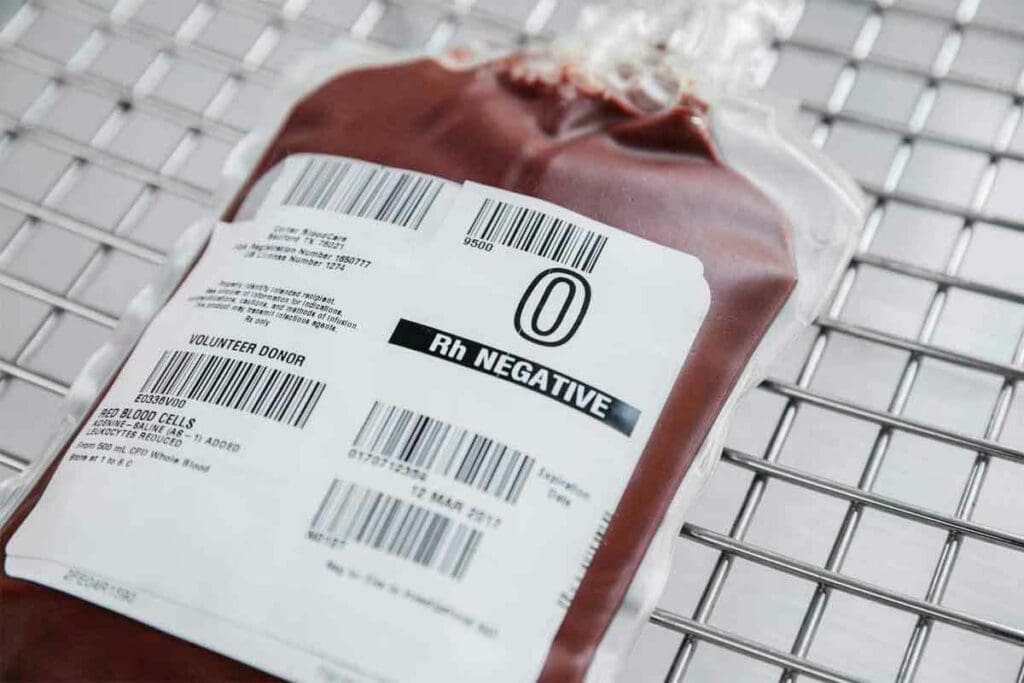
O-negative blood is special in healthcare. It’s the universal donor type because it doesn’t have certain antigens. This makes it safe for all blood types.
The Absence of A, B, and Rh Antigens
OO-negativbloodd is unique because it doesn’t have A, B, or Rhh antigens. These antigens can cause an immune response. In blood transfusions, the wrong antigens can lead to serious reactions.
Because OO-negative bloodlacks these antigens, it’s safe for anyone. This is key in emergencies when time is of the essence.
Why O Negative Blood Can Be Safely Transfused to Anyone
OO-negative blblood safe for anyone because it doesn’t have harmful antigens. It’s perfect for emergencies and trauma care. It’s also great when blood typing is not possible.
Limitations of O Negative Recipients
While O-negative blood is safe for anyone, O-negative individuals can only receive O-negative blood. They have antibodies against A and B antigens. Receiving blood with A or B antigens can cause a hemolytic reaction.
| Blood Type | Can Receive From | Can Donate To |
| O Negative | O Negative | All Blood Types (A+, A-, B+, B-, AB+, AB-, O+, O-) |
| O Positive | O Positive, O Negative | O+, O-, A+, A-, B+, B- |
| A Negative | A Negative, O Negative | A-, A+, AB-, AB+ |
This table shows how O-negative blood works with other blood types. It shows its value as a donor and the challenges faced by O-negative recipients.
The Rarity of O Negative Blood in the Population
In the United States, about 7% of people have O-negative blood. This shows how rare this blood type is. It’s very important for medical emergencies because it can be given to anyone.
Statistical Prevalence in the United States
O-negative blood is a big deal in the U.S. for donating and transfusions. Blood banks all over the country say about 7% of people have this blood type.
Let’s look at how blood types are spread in the U.S.:
| Blood Type | Percentage of Population |
| O Positive | 37% |
| O Negative | 7% |
| A Positive | 33% |
| A Negative | 6% |
| B Positive | 9% |
| B Negative | 2% |
| AB Positive | 3% |
| AB Negative | 1% |
Global Distribution Patterns
O-negative blood is spread differently around the world. In some places, it’s more common than in others. For example, in Europe, it’s a bit more common than in some Asian countries.
Challenges This Rarity Creates for Blood Banks
The rarity of O-negative blood is a big problem for blood banks. They need to keep a steady supply of this blood. This requires help from donors and smart management by blood banks.
Key challenges include:
- Maintaining an adequate supply to meet emergency demands
- Encouraging regular donations from OO-negative individuals
- Managing inventory effectively to prevent shortages
It’s very important to solve these problems. This way, patients who need blood can get it.
Critical Importance in Emergency Medicine
OO-negative blooblood issal in emergency medicine. It’s the first choice in urgent situations. Medical teams often can’t check a patient’s blood type right away.
When There’s No Time for Blood Typing
In trauma cases, time is everything. Negative blood is used because it can be given right away. This is key when a patient is badly hurt or can’t talk.
Key benefits of using OO-negative blood in emergencies include:
- Immediate availability for transfusion
- Compatibility with all ABO blood types
- Reduced risk of adverse reactions
Trauma Care and Disaster Response ApplicationsOO-negative blood is essential in trauma care and disaster responses. Hospitals keep it ready for emergencies. In big disasters, the need for O-negative blood goes up a lot.
Special Significance for Neonatal Care
OO-negative blblood isslso key for newborns needing blood transfusions. Newborns’ immune systems are not fully developed. This makes blood safer for them.
| Application | Significance of O Negative Blood |
| Emergency Transfusions | Universally compatible, reducing the risk of adverse reactions |
| Trauma Care | Critical for immediate transfusions in severe injury cases |
| Neonatal Care | Safe for newborns with immature immune systems |
O Positive: America’s Most Common Blood Type
O Positive is the most common blood type in the United States. It makes up about 37% of the population. This makes it very important for the nation’s blood supply.
Prevalence and Distribution
O Positive blood type is found all over the U.S. population. About 37% of Americans have this blood type. It’s the most common among the eight main blood types.
Distribution by Ethnicity: O Positive is common across different ethnic groups. It’s one of the most prevalent types in various populations.
Compatibility Profile: Who Can Receive O+ Blood
O Positive blood can be given to people with O Positive, A Positive, B Positive, and AB Positive blood types. This is because these individuals have the Rh factor. O Positive blood is compatible with:
- O Positive (O+)
- A Positive (A+)
- B Positive (B+)
- AB Positive (AB+)
This makes O-positive blood very useful in medical settings. It’s very helpful in emergencies where time is limited to find out a patient’s blood type.
Differences Between O+ and the Universal Blood Donor Type
O Positive is the most common blood type, but O Negative is the universal donor type. The main difference is the Rh factor. O Negative lacks the Rh antigen, making it compatible with all blood types. O Positive has the Rh antigen.
| Blood Type | Rh Factor | Compatibility |
| O Positive | Positive | O+, A+, B+, AB+ |
| O Negative | Negative | All Rh+, All Rh- |
O-negative blood is very valuable in emergencies. There’s no time to find out a patient’s blood type. O Positive blood is also valuable but not as universally compatible because it’s Rh Positive.
The Genetic Inheritance of Blood Types
Blood type inheritance is a fascinating genetic trait. It’s controlled by genes from our parents. The ABO blood group system categorizes blood into four types: A, B, AB, and O. This system is managed by a single gene with three alleles: A, B, and O.
How Blood Type Is Determined by Parental Genes
Our blood type comes from our parents’ genes. Each parent gives one of their two ABO alleles to their child. The mix of these alleles decides the child’s blood type. For example, inheriting an A allele from one parent and an O allele from the other makes the child’s blood type A.
Dominant and Recessive Blood Group Traits
The A and B alleles are codominant, while the O allele is recessive. This means that inheriting an A and a B allele results in AB blood type. If an individual has an A or B allele with an O allele, their blood type will be A or B, respectively. The O allele only results in O blood type if an individual is OO, inheriting an O allele from both parents.
Predicting a Child’s Blood Type
To predict a child’s blood type, we need to know the parents’ genotypes. By understanding the alleles each parent can give, we can guess the child’s possible blood types. The table below shows how different parental genotypes can lead to various offspring genotypes and phenotypes.
| Parental Genotypes | Possible Offspring Genotypes | Possible Offspring Phenotypes (Blood Type) |
| AO x BO | AB, AO, BO, OO | AB, A, B, O |
| AA x BO | AB, AO | AB, A |
| OO x AB | AO, BO | A, B |
Understanding blood type inheritance is key to knowing our own blood type. It also helps in medical fields like blood transfusions and organ donations.
Ethnic and Geographic Variations in Blood Type Distribution
Blood types vary a lot across different ethnic and geographic groups. This is due to genetics, history, and environment.
Blood Type Prevalence Across Different Populations
Studies show that blood types differ among ethnic groups. For example, the O blood type is common in some indigenous groups. On the other hand, the A blood type is more common in Europeans.
| Ethnic Group | O Blood Type (%) | A Blood Type (%) | B Blood Type (%) | AB Blood Type (%) |
| European | 43 | 40 | 12 | 5 |
| African | 51 | 26 | 19 | 4 |
| Asian | 40 | 28 | 25 | 7 |
| Indigenous American | 79 | 16 | 4 | 1 |
The table shows how blood types vary among ethnic groups. It highlights the diversity in blood type prevalence.
Historical Migration Patterns and Blood Type Distribution
Migration has shaped blood type distribution. As people moved, they carried their genes to new places. This changed the local gene pool.
Migration mixed genetic material, leading to today’s diverse blood type distribution. For example, the O blood type’s high frequency in some groups comes from their ancestors.
Why O Type Is the Most Common Globally
O blood type is the most common worldwide. It’s found in many populations. One reason is that it was one of the first blood types in humans.
Key factors contributing to the prevalence of O blood type include:
- Genetic adaptability
- Historical migration patterns
- Evolutionary advantages
The O blood type’s widespread presence shows its importance. It’s also the universal donor type.
AB Blood Types: The Universal Plasma Donors
AB blood types are special because they can donate plasma to anyone. Plasma is important for patients needing blood transfusions. It helps with clotting and carries antibodies. AB plasma is great because it works with all blood types, which is very helpful in emergencies.
Why AB Plasma Works for Everyone
AB plasma is special because it doesn’t have antibodies against A or B antigens. This means it can be given to anyone without causing problems. So, AB plasma donors are very important for keeping blood supplies ready for medical needs.
The Difference Between Universal Blood and Plasma Donation
O Negative red blood cells are the universal donor type for blood transfusions. ButAB plasma is the universal donor type for plasma. The main difference is what is being donated: red blood cells or plasma. Knowing this helps manage blood supplies better.
AB- Blood: Rarity and Donation Compatibility
AB- blood is very valuable because it lacks the Rh antigen. People with ABbod can donate plasma to anyone. But, he recipient’s Rh type is matched when possible. Here’s a table showing who can receive AB plasma donations.
| Donor Blood Type | Compatible Recipient Types |
| AB+ | AB+, AB-, A+, A-, B+, B-, O+, O- |
| AB- | AB-, A-, B-, O- |
Understanding the role of AB blood types as universal plasma donors is key. It shows how important diverse blood donations are for saving lives.
Blood Type Compatibility Charts: Who Can Donate to Whom
Blood type compatibility charts are key in figuring out who can give blood to whom. They are vital for safe blood transfusions. They help doctors match donors with the right recipients based on blood types.
Red Blood Cell Donation Compatibility
Red blood cell donation depends on the ABO blood group system and the Rh factor. People with O-negative blood can donate to anyone. Here’s a chart for red blood cell donations:
| Recipient’s Blood Type | Can Receive From |
| A+ | A+, A-, O+, O- |
| O- | O- |
| AB+ | AB+, AB-, A+, A-, B+, B-, O+, O- |
Plasma Donation Compatibility
Plasma donation is different from red blood cells. People with AB blood type can donate plasma to anyone. Here’s a chart for plasma donations:
| Recipient’s Blood Type | Can Receive Plasma From |
| A | A, AB |
| O | O, A, B, AB |
| AB | AB |
Special Considerations for Platelet Donations
Platelet donations have their own rules, even though they have a short life. Platelet donations are less strict than red blood cells. Buit’s’s important too match donors and recipients to avoid bad reactionsDoctorsrs need to know these charts for safe blood transfusions. Matching donors with recipients by blood type helps prevent bad reactions. This saves lives.
Evolutionary Origins of Blood Type Diversity
Different blood types in humans likely came from adapting to various pathogens and environments. This isn’t just a human thing; many species have blood type variations. It shows a long and complex evolutionary history.
Theories on the Existence of Multiple Blood Types
There are many theories about why we have different blood types. One idea is that they helped us fight off diseases. For example, some blood types might protect against certain infections. Research links blood type evolution to adapting to environments and pathogens.
Protective Benefits Against Different Diseases
Different blood types affect how we get sick. For instance, Type O blood might lower the risk of severe malaria. On the other hand, Type A blood could have a different risk for heart diseases. This shows blood types evolved to help us deal with different diseases.
Blood Types and Natural Selection
Natural selection played a big role in blood type distribution. In places with certain diseases, people with protective blood types were more likely to live and have kids. This passed on the beneficial blood type to future generations.
| Blood Type | Disease Association | Potential Benefit |
| Type O | Lower risk of severe malaria | Protection against malaria |
| Type A | Different risk profiles focardiovascular diseasesses | Potential cardiovascular benefits |
| Type AB | Increased risk of certain infections | Possible immune system modulation |
The history of blood types is complex. It’s shaped by genetics, environment, and disease. Knowing this history helps us understand human health and disease risks.
The Ongoing Need for Universal Blood Donor Type DonationsO-negativee blood is always in demand. It’s key in emergencies when time is short. This shows the constant need for donations of this type.
Current Challenges in Blood Supply Management
Blood banks struggle to keep up with OOOO-negativ bloodeood blood. They face:
- Keeping enough O-negative blood on hand
- Managing how long blood products last
- Ensuring blood is safe and of good quality
To tackle these issues, blood banks and healthcare groups are teaming up. They aim to make donating easier and raise awareness.
Technological Advances in Blood Typing and Storage
New tech has made blood typing and storage safer and more efficient. Some key advancements are:
- Automated systems that cut down on mistakes
- Methods to keep blood fresh for longer
- Systems to better track and manage blood supplies
These innovations improve blood transfusion safety and help manage supplies better.
How to Determine If You’re an O Negative Donor
Want to donate blood and think you might be O negative? Here’s how to check:
- Look in your medical records or ask your doctor about your blood type
- Donate blood and get typed during the process
- Join blood typing events or drives for free typing
Knowing your blood type is a big step. It’s even more important if you’re O negative.
Conclusion: The Life-Saving Impact of Blood Donation
Blood donation, mainly from those with O-negative blood, saves lives. This blood type is rare but very useful. It’s key in emergencies, trauma care, and during disasters.
O-negative blood is special because it can be given to anyone. This makes it very important for blood banks and hospitals. It’s perfect for emergencies where time is of the essence.
Knowing how vital blood donation is can inspire more people to give. This way, we can keep a steady supply of this lifesaving resource.
The impact of blood donation is clear. The universal blood donor type is essential in healthcare. By donating, individuals can greatly help their community and beyond.
FAQ
What is OO-negative blood and why is it considered the universal donor type?
O-negative blood is the universal donor type. It has no A, B, or Rh antigens. This makes it safe for all blood types. Learn more.
What determines a person’s blood type?
A person’s blood type is based on antigens on their red blood cells. These are controlled by their genes.
Is O+ a universal donor blood type?
No, O+ is not universal. It has the Rh antigen, causing issues with Rh-negative blood. BButt’s safe for those with positive Rh blood.
What are the different blood types, and how are they classified?
Blood types are A, B, AB, and O. They’re classified as positive or negative based on the Rh antigen. This gives us eight main types.
Can individuals with ABlood donate to anyone?
No, AB- blood can’t be donated to just anyone. But, it can bebevens plasma to anyone. This is because AB plasma lacks A and B antibodies.
What percentage of the U.S. population has O-negative
About 7% of Americans have OO-negative blood
Why is O-negative blood critical in emergency medicine?
OO-negatbloodoodn emergencies. It can be given to anyone quickly, without knowing their blood type.
How do parental genes determine a child’s blood type?
A child’s blood type comes from their parents’ genes. Each parent gives one of their two ABO genes to the child.
What is the most common blood type in America?
In America, O positive is the most common. It’s found in about 37% of the population.
Why do different blood types exist, and what are their evolutionary benefits?
Blood types vary due to genetics. Some research suggests they might protect against certain diseases. This could be due to natural selection.
How can I determine if I’m an O-negative donor?
Check your donor card to see if you’re O negative. You can also contact your local blood center or donate blood to find out.
What is the difference between universal blood donation and plasma donation?
Universal blood donation gives red blood cells that can go to anyone. This is usually O negative. Plasma donation is giving plasma to anyone. This is usually from AB blood type donors.
References
- Raichoudhury, R. (2021). Treatment of anemia in difficult-to-manage patients with chronic kidney disease. Current Opinion in Nephrology and Hypertension, 30(2), 141–148. https://www.ncbi.nlm.nih.gov/pmc/articles/PMC7983023/