
Brain MRI scans can show black or dark spots, which can worry people. At Liv Hospital, we focus on finding and treating these issues. These spots might mean tissue damage, scarring, or blood vessel problems.
Studies show that Multiple Sclerosis (MS) can cause dark spots on MRI scans. These spots, called “black holes,” show brain damage that won’t heal. For more on MS lesions, check out Medical News Today.
It’s key to know what these spots mean for your health. Our team at Liv Hospital is here to help. We offer care and support every step of the way.
Key Takeaways
- Black or dark spots on brain MRIdark spots on brain MRI scans can indicate tissue damage, scarring, or blood vessel injury.
- Conditions like Multiple Sclerosis (MS) can cause lesions that appear as dark spots on MRI scans.
- The appearance of new or expanding lesions may signal disease progression.
- Advanced imaging techniques, such as FLAIR sequencing, are used to improve lesion detection.
- Accurate diagnosis and management of these conditions require expert care and support.
Understanding Brain MRI Scans and Imaging Interpretation
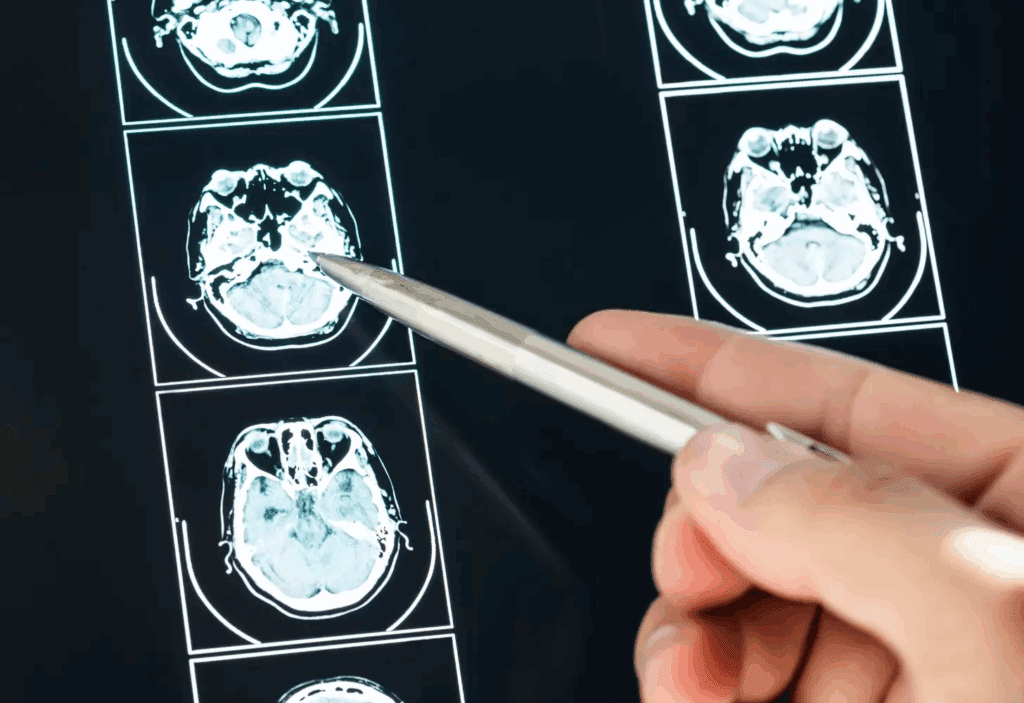
Understanding brain MRI scans is key. It involves knowing MRI technology and what the colors mean. MRI scans help doctors see the brain’s structure and function.
MRI technology uses strong magnetic fields, radio waves, and computers to create brain images. It aligns hydrogen atoms, then disturbs them with radio waves. This creates signals for the MRI image.
How MRI Technology Creates Brain Images
Creating brain images with MRI involves several steps:
- Signal Generation: Hydrogen atoms in the brain are aligned and then disturbed, creating signals.
- Signal Detection: These signals are detected by the MRI machine.
- Image Construction: Computer algorithms process the detected signals to create detailed images.
Knowing these steps helps in understanding the images. It’s important for spotting black spots in brain or dark spot brain areas.
What Different Colors and Shades Represent on Brain MRIs
The colors on an MRI scan show different tissue types and conditions. For example:
- T1-weighted images: Fat appears bright, while water appears dark.
- T2-weighted images: Water appears bright, making it ideal for detecting edema and lesions.
- FLAIR sequences: Helpful in identifying lesions and abnormalities, specially in the brain.
Understanding these colors helps doctors spot black dots on brain MRI. They can then understand their importance.
Black Spots on Brain: What They Actually Indicate
Seeing black or dark spots on brain MRI images is a big deal. Radiologists must carefully look at these spots. They can mean different things, from normal parts of the brain to serious problems.
The Significance of Dark Areas in Neuroimaging
Dark spots on brain MRI scans might show tissue damage, scarring, or blood vessel issues. Not all dark spots are a worry, as some are just part of aging. But, some spots could mean serious issues like brain lesions or ischemia.
We’ll look at the different kinds of dark spots and what might cause them. The spot’s size, location, and how it looks are key to figuring out what it means.
How Radiologists Interpret Black or Dark Spots
Radiologists have a method to understand dark spots on brain MRI scans. They look at where the spot is, how big it is, and what it looks like. They might use special imaging to learn more.
The table below shows what radiologists check when they see dark spots on brain MRI:
| Factor | Description | Clinical Significance |
| Location | Area of the brain affected | Different locations may indicate different conditions |
| Size | Dimension of the dark spot | Larger spots may be more clinically significant |
| Signal Intensity | Brightness or darkness on MRI | Variations can indicate different tissue characteristics |
By studying these details, radiologists can give important clues about dark spots on brain MRI scans. This helps doctors figure out what’s going on and how to treat it.
Common Causes of Dark Spots on the Brain in MRI Results
Dark spots on brain MRI images can come from many sources. Some are harmless, while others might be signs of health problems. It’s key to know the difference between normal brain features and possible health issues.
Normal Anatomical Structures That May Appear Dark
Some normal parts of the brain can look dark on MRI scans. For example, the ventricles and sulci look dark because they’re filled with cerebrospinal fluid (CSF). This fluid has different signals on MRI. Also, areas with lots of blood vessels or bony structures can appear darker due to how MRI works.
Knowing about these normal variations helps avoid mistaking them for serious problems. Radiologists are trained to spot these and tell them apart from real issues.
Pathological Conditions Associated with Dark Spots
Many health problems can cause dark spots on brain MRI. Here are some common ones:
- Multiple Sclerosis (MS) Lesions: MS can cause lesions in the brain’s white matter, showing up as dark spots on MRI.
- Stroke: Both types of strokes can show up as dark spots on MRI, depending on the type and stage.
- Infections: Certain infections, like abscesses, can appear dark on MRI because of pus or debris.
- Tumors: Some tumors, like those with calcifications or certain cysts, can look dark on MRI.
| Condition | Typical MRI Appearance | Clinical Significance |
| Multiple Sclerosis | Dark spots in white matter | Indicative of demyelinating disease |
| Ischemic Stroke | Dark areas in affected vascular territory | Indicates brain tissue damage |
| Brain Abscess | Dark center with an enhanced rim | Sign of infection needing urgent treatment |
Diagnosing dark spots on brain MRI needs a deep understanding of the patient’s history, symptoms, and other tests. By linking MRI results with the patient’s condition, doctors can decide the best treatment.
Multiple Sclerosis and Black Spots in Brain MRI
Black spots on brain MRI scans can signal multiple sclerosis. This condition harms the central nervous system. It causes nerve damage and various symptoms.
MS Lesions: Appearance and Characteristics
MS lesions, or plaques, damage the brain and spinal cord. They show up as black spots on MRI scans, mainly in T1-weighted images. These spots can be new and inflamed or old and scarred.
The Multiple Sclerosis Trust says lesions can be in different parts of the nervous system. Where and how many lesions are found helps doctors diagnose and understand the disease’s severity.
Smoldering MS Lesions and Their Dark Rim Appearance
Smoldering MS lesions have a dark rim on MRI scans. They show chronic inflammation and are linked to severe disease. The National Institutes of Health says they might mean MS is getting worse.
These lesions are worrying because they show ongoing damage without clear symptoms. The dark rim comes from iron-laden macrophages at the lesion’s edge, seen on specific MRI sequences.
Current Statistics on MS Patients with Visible Lesions
Many MS patients have visible lesions on MRI scans. The exact number depends on the study and diagnosis criteria. MRI is key in diagnosing and tracking MS.
| Study | Prevalence of Lesions | Population |
| Study A | 85% | Newly diagnosed MS patients |
| Study B | 92% | MS patients with relapsing-remitting MS |
| Study C | 78% | MS patients with progressive MS |
These numbers highlight MRI’s role in managing MS. It’s not just for diagnosis but also for tracking the disease and treatment response.
Stroke-Related Dark Spots on Brain Imaging
Dark spots on brain imaging can worry people, mainly when it comes to stroke diagnosis. Strokes can change brain images, like MRI scans, which are key for treating stroke patients.
Strokes can lead to changes seen on MRI, like dark spots or lesions. Knowing about these changes helps doctors diagnose and treat patients right.
Acute vs. Chronic Stroke Lesions
Stroke lesions are divided into acute and chronic stages, each showing different signs on MRI. Acute stroke lesions happen recently, showing up bright on MRI due to swelling or bleeding. On the other hand, chronic stroke lesions are older, appearing dark or showing brain tissue loss on MRI.
Telling acute from chronic lesions is key to figuring out when the stroke happened and how to treat it.
How Ischemic and Hemorrhagic Strokes Appear on MRI
There are two main stroke types: ischemic and hemorrhagic. Ischemic strokes, caused by blocked blood vessels, show up dark on MRI, mainly in the early stages. Hemorrhagic strokes, due to brain bleeding, might look bright on MRI at first but can turn dark as the blood breaks down.
Knowing how these strokes look on MRI is important for correct diagnosis and treatment.
Age-Related Changes That Appear as Black Dots on Brain MRI
As we get older, our brains change in ways that can show up on MRI scans. These changes might look like black dots. They are a normal part of aging but can sometimes look like disease. It’s important to understand these changes to make the right diagnosis and care for patients.
White Matter Changes in Aging Brains
One common change seen on brain MRI scans is in the white matter. White matter is made of nerve fibers that help different parts of the brain talk to each other. As we age, these nerve fibers can break down, causing changes on MRI scans. These changes might look like black dots or dark spots, mainly on certain MRI sequences.
These changes are called white matter hyperintensities (WMH) when they look bright on MRI. But when they look dark, they can mean different things. It’s key to look at the whole picture and the patient’s symptoms to understand these changes.
Distinguishing Normal Aging from Pathological Findings
It can be hard to tell if brain MRI changes are just from aging or if they mean something more serious. Doctors and radiologists look at many things to make this call. They consider where the changes are, how big they are, and how many there are. They also think about the patient’s symptoms and medical history.
For example, some white matter changes are normal in older people. But if a younger person or someone with certain symptoms has similar changes, it might mean a disease like multiple sclerosis or small vessel disease.
To properly diagnose and care for patients, it’s vital to link MRI findings with what the patient is experiencing. This way, doctors can tell the difference between normal aging changes and serious problems.
Migraine and Other Neurological Conditions Causing Black Spots on the Brain
Migraines and other neurological conditions can show up as black spots on brain MRI scans. We’ll look into how these conditions affect brain imaging and why accurate diagnosis is key.
Migraine-Associated Brain Changes
Migraines are more than just severe headaches. They are a neurological condition that can change the brain, visible on MRI scans. Studies show people with migraines might have more white matter lesions. These can look like black spots or dark areas on MRI.
These changes might be linked to migraine’s underlying causes, like inflammation or changes in blood flow. Understanding these changes is vital for telling migraines apart from other neurological conditions.
Other Neurological Disorders with Similar MRI Presentations
Other neurological disorders can also show black spots or dark areas on brain MRI. This makes it hard to tell them apart. Conditions like multiple sclerosis, stroke, and infections can all cause similar changes.
To figure out the right diagnosis, we need a detailed approach. This includes looking at MRI findings, clinical symptoms, medical history, and other tests.
| Condition | Typical MRI Findings | Clinical Characteristics |
| Migraine | White matter lesions, potentially appearing as black spots | Recurring headaches, often with aura, nausea, and sensitivity to light and sound |
| Multiple Sclerosis | Lesions in white matter, often periventricular, appearing as black spots | Variable symptoms including vision problems, muscle weakness, and coordination issues |
| Stroke | Acute: Hyperintensity on DWI; Chronic: Encephalomalacia appearing dark | Sudden onset of focal neurological deficits |
As shown in the table, MRI findings can look similar. But, the clinical context and other factors help tell them apart. Accurate diagnosis is essential for the right treatment.
“The diagnosis of neurological conditions based on MRI findings requires a thorough understanding of both the imaging characteristics and the clinical presentation.”
— Expert in Neurology
By combining MRI findings with clinical evaluation, we can better understand black spots on brain MRI. This helps us provide the right care for patients with neurological conditions.
Infection-Related Dark Spots in Brain MRI
Infections in the brain can show up as dark spots on MRI scans. This can mean different things, like bacterial, viral, fungal, or parasitic infections.
Bacterial and Viral Infections of the Brain
Bacterial infections, like brain abscesses, can look like dark spots on MRI scans. These are pus-filled areas in the brain caused by bacteria. On MRI, they show up as ring-shaped lesions with a dark center.
Viral infections, such as herpes simplex encephalitis, can also change brain MRI images. These changes might look like dark spots or patches on the scan.
Fungal and Parasitic Causes of Dark Lesions
Fungal infections, like cryptococcosis, can cause dark spots on MRI, mainly in people with weakened immune systems. These infections can lead to visible lesions or abscesses on MRI scans.
Parasitic infections, such as neurocysticercosis, can also show up as dark spots on brain MRI. This is caused by the larval stage of the pork tapeworm. It can form cysts in the brain, visible as dark spots on MRI.
It’s important to understand what causes dark spots on brain MRI for accurate diagnosis and treatment. By figuring out the infection, doctors can create a good treatment plan.
Radiation Therapy Effects on Brain MRI Appearance
Radiation therapy is a key treatment for many brain conditions. It can change how brain MRI scans look. Understanding these changes is vital for patient care.
Changes in Brain MRI Following Radiation Treatment
Radiation therapy can make visible changes on MRI scans. These might show as black spots or dark areas. These could be due to necrosis, edema, or changes in white matter.
Research on PubMed Central shows it’s important to know these changes. It helps tell if it’s a treatment effect or if the tumor is coming back.
Timeline of Radiation-Induced Changes
The time it takes for radiation changes to show up can vary. Acute effects might happen right away or soon after treatment. Late effects can appear months or even years later.
Regular MRI scans are key for tracking these changes. This lets doctors adjust treatment plans as needed. It helps ensure the best care for patients.
When Black Spots on Brain MRI Are Concerning vs. Incidental
It’s important to know when black spots on brain MRI are serious. These dark spots can be scary, but their importance depends on many things.
Doctors look at several things to decide if dark spots on brain MRI are important. They check the size, where they are, and how they look. They also look at the patient’s health and any symptoms.
Criteria Doctors Use to Determine Clinical Significance
Doctors use certain criteria to tell if black spots on brain MRI are serious. They look at:
- The number and where the dark spots are
- If the patient has symptoms or problems with their brain
- The patient’s age and health history
- If the spots change on follow-up MRI scans
One study said, “Interpreting white matter lesions on MRI is hard for doctors and patients.”
This shows how tricky it is to understand black spots on brain MRI. It takes careful thought of many factors.
Red Flags That Warrant Further Investigation
Some signs of black spots on brain MRI mean you need to check them more. These warning signs include:
- Spots getting bigger or more in number fast
- Spots in important parts of the brain
- Spots linked to big brain problems
- Other strange things on the MRI
Healthcare providers can figure out if black spots on the brain are just a normal finding or need more tests or treatment.
Diagnostic and Treatment Approaches for Concerning Brain Lesions
When healthcare providers find brain lesions, they use many tools to learn more. This helps them plan the best treatment. It’s all about making sure patients get the best care.
Follow-up Tests and Procedures
Seeing black spots on a brain MRI means more tests are needed. These tests help get a clearer picture of what’s going on.
- Contrast-enhanced MRI scans to highlight specific areas of concern
- Other imaging modalities such as CT scans or PET scans
- Laboratory tests to check for underlying conditions
- Neurological examinations to assess cognitive and motor functions
Table: Common Follow-up Tests for Brain Lesions
| Test | Purpose |
| Contrast-enhanced MRI | To better visualize the lesion and its characteristics |
| CT Scan | To provide additional information on the lesion’s structure |
| PET Scan | To assess metabolic activity within the lesion |
| Laboratory Tests | To check for infections, inflammatory markers, or other conditions |
Treatment Options Based on Underlying Causes
The treatment for brain lesions depends on their cause. For example:
- Multiple sclerosis lesions may be managed with disease-modifying therapies
- Stroke-related lesions often require rehabilitation and management of risk factors
- Infections may necessitate antimicrobial therapy
- Tumors could require surgery, radiation, or chemotherapy
Monitoring Changes Over Time
It’s important to keep an eye on brain lesions over time. This helps see how they’re changing or responding to treatment.
- Serial MRI scans at scheduled intervals
- Clinical evaluations to assess neurological function
- Adjustments to treatment plans as necessary
By using these methods, doctors can manage brain lesions well. This helps improve patient outcomes.
Conclusion: Understanding Your Brain MRI Results
It’s key for patients to understand what black spots on brain MRI scans mean. We’ve looked at why these spots appear and what they might mean. This includes both normal and serious conditions.
These spots can show up in many ways, like in multiple sclerosis or stroke. But, not all spots are a worry. Doctors look closely at these images to decide if they’re important.
Knowing about black spots on brain MRI helps patients make better health choices. It’s important to talk to doctors about MRI results. They can explain what the spots mean and what to do next.
Being in the know about brain MRI results helps patients take charge of their health. We suggest asking doctors about any questions about MRI results.
FAQ
What do black or dark spots on brain MRI scans typically indicate?
Black or dark spots on brain MRI scans can mean different things. They might show tissue damage, scarring, or vascular issues. They could also point to diseases like multiple sclerosis, strokes, or infections.
How do radiologists interpret black or dark spots on brain MRI scans?
Radiologists look at the spots’ location, size, and details. They consider the patient’s history and symptoms to understand their importance.
Can normal anatomical structures be mistaken for pathology on MRI scans?
Yes, sometimes normal parts of the brain can look like problems on MRI scans. This shows why it’s key to have skilled radiologists for accurate readings.
What is the significance of dark rim appearance on MRI in multiple sclerosis patients?
In MS patients, dark rim lesions on MRI suggest active, chronic lesions. These can mean the disease is getting worse and could lead to more disability.
How do ischemic and hemorrhagic strokes appear on MRI scans?
Ischemic strokes show up as areas where diffusion is restricted on MRI. Hemorrhagic strokes appear as bleeding spots. The look changes based on the stroke’s stage and severity.
Are age-related changes on brain MRI a cause for concern?
Age can cause changes on brain MRI, like white matter changes. It’s important to tell normal aging from real problems to understand their impact.
Can migraines cause black spots on brain MRI scans?
Migraines might show up on brain MRI, but these changes are usually mild. They’re not often the main reason for black spots.
What types of infections can cause dark spots on brain MRI scans?
Infections like bacterial, viral, fungal, and parasitic ones can show up as dark spots on MRI. The type and severity of the infection determine the appearance.
How does radiation therapy affect brain MRI appearance?
Radiation therapy can lead to changes on brain MRI, including black spots. This is because it damages brain tissue.
When are black spots on brain MRI considered clinically significant?
Black spots are significant if they cause symptoms, worsen the disease, or show other concerning signs. This calls for more tests and possibly treatment.
What follow-up tests and procedures are used to evaluate concerning brain lesions?
To check on brain lesions, doctors might do more MRI scans, CT scans, or biopsies. These help figure out what’s causing the problem.
What are the treatment options for concerning brain lesions?
Treatment for brain lesions depends on the cause. It can range from medication and surgery to radiation therapy. Accurate diagnosis and personalized care are key.
References:
- MS brain lesions: causes, pictures, symptoms, and MRI scans. Medical News Today. https://www.medicalnewstoday.com/articles/323976
- Smoldering spots in the brain may signal severe MS. NIH News Releases. https://www.nih.gov/news-events/news-releases/smoldering-spots-brain-may-signal-severe-ms
- Varon D, et al. Radiation-related black dots on susceptibility-weighted imaging: an effect of cranial irradiation and potential small vessel damage. PMC. https://pmc.ncbi.nlm.nih.gov/articles/PMC4236872/