Urology treats urinary tract diseases in all genders and male reproductive issues, covering the kidneys, bladder, prostate, urethra, from infections to complex cancers.
Send us all your questions or requests, and our expert team will assist you.

Over the past 25 years, urology has moved from open surgery to minimally invasive endourology. Ureteroscopy (URS) is central to this change, allowing doctors to see and treat the upper urinary tract without making any cuts. At Liv Hospital, the Urology Department uses ureteroscopy not just for diagnosis, but as a main treatment for many conditions, from kidney stones to cancers of the kidney lining. Ureteroscopy involves inserting a special optical tool, called a ureteroscope, through the urethra and bladder into the ureter and up to the kidney. This approach uses the body’s natural openings, helping preserve anatomy and greatly reducing patient risk compared to older surgical methods.
Ureteroscopy focuses on the ureter, the tube that carries urine from the kidneys to the bladder, and the kidney’s collecting system, where urine gathers. The type of ureteroscopy depends on the tool and how far it goes. Semi-rigid ureteroscopy uses a straight scope for the lower and middle ureter. Flexible ureteroscopy, also called Retrograde Intrarenal Surgery (RIRS), uses a bendable scope that can reach the upper ureter and the lower parts of the kidney. This flexibility lets doctors treat almost any area of the urinary tract with great accuracy.

To truly understand the definition of modern ureteroscopy, one must appreciate the optical engineering that powers it. Historically, ureteroscopes relied on fiber-optic bundles—thousands of glass fibers fused—to transmit light and images. While effective, these older scopes often suffered from the “honeycomb effect” (visible pixelation from individual fibers) and were prone to breakage. At Liv Hospital, the standard has shifted to Digital Ureteroscopy.
Digital ureteroscopes use ‘Chip-on-the-Tip’ technology, where a tiny sensor at the tip turns images into digital signals sent to a high-definition monitor. This gives much clearer, more detailed images, helping surgeons tell the difference between a tumor and inflamed tissue or judge a stone’s hardness before using the laser. The wider view also makes the procedure safer by lowering the risk of injury to the ureter.

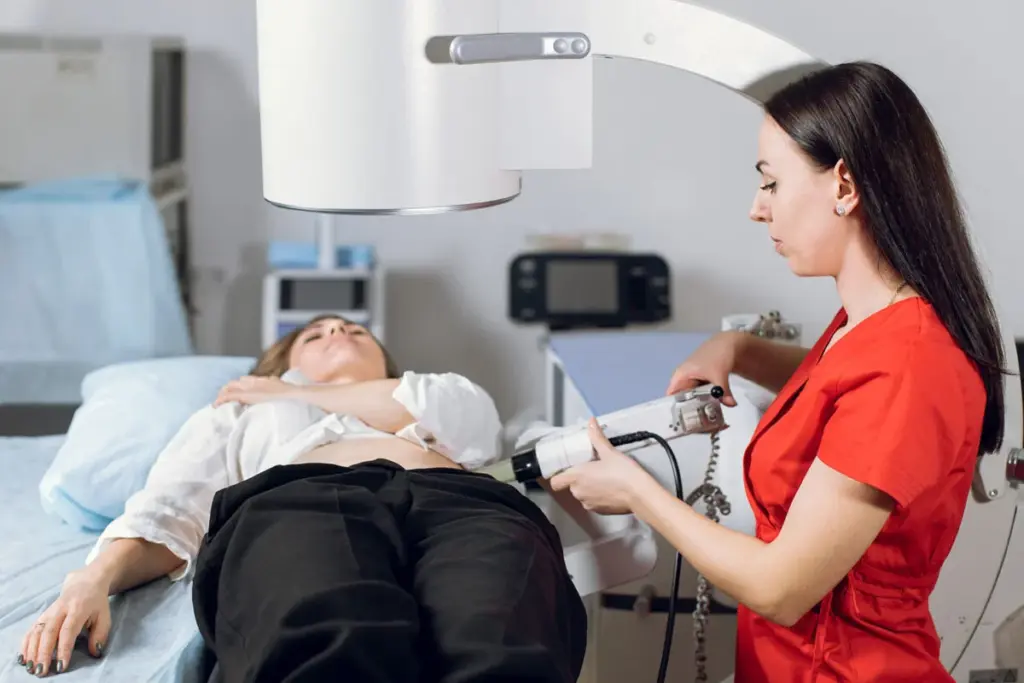
The operational definition of ureteroscopy is inseparable from the energy sources used to treat pathology. The Holmium: YAG (Yttrium-Aluminum-Garnet) laser is the gold standard energy source for ureteroscopy. This pulsed, solid-state laser emits light at 2100 nanometers, a wavelength highly absorbed by water. When the laser energy is delivered from the tip of a silica fiber into the fluid-filled ureter, it instantly vaporizes the water in its path, creating a microscopic plasma bubble. This bubble expands and collapses within microseconds, generating a photo-mechanical shockwave that disrupts the crystalline lattice of kidney stones.
This mechanism is distinct from heat-based destruction; it is a “drilling” effect caused by vaporization. Modern laser systems used at Liv Hospital allow modulation of two key parameters: Frequency (Hertz) and Pulse Energy (Joules). By manipulating these variables, the surgeon can switch between different lithotripsy modes:
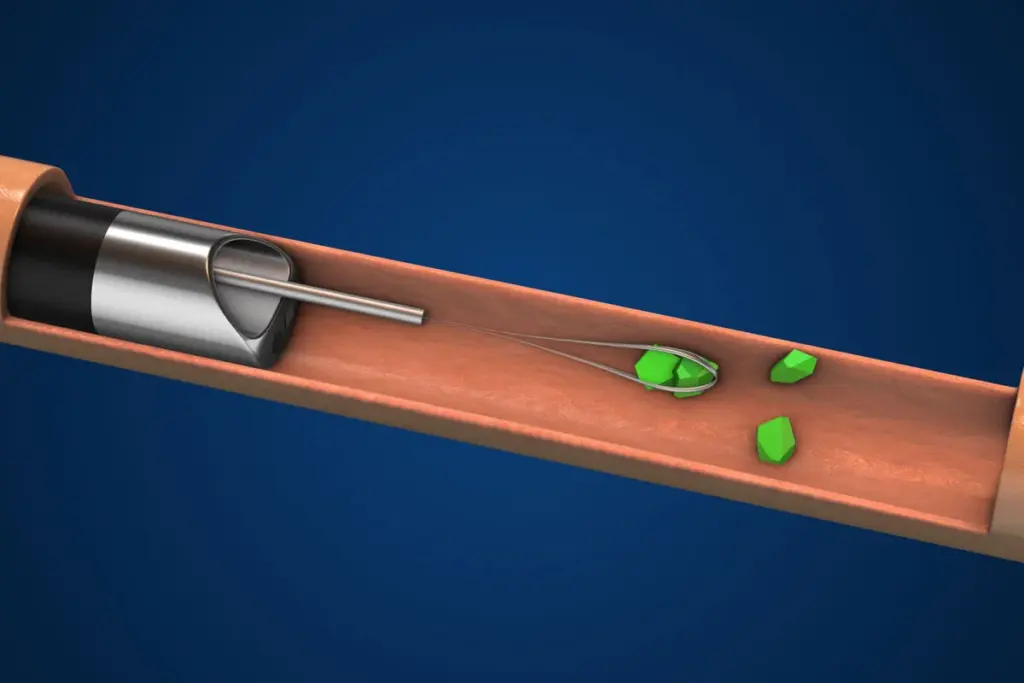
Retrograde Intrarenal Surgery (RIRS) is a key part of ureteroscopy. While ureteroscopy usually means looking at the ureter, RIRS involves doing surgery inside the kidney. This method has mostly replaced more invasive procedures for stones smaller than 2-3 centimeters or for stones that don’t respond to shock waves. RIRS uses flexible scopes that can bend up to 270 degrees, letting the surgeon reach hard-to-access areas like the lower part of the kidney. Being able to do RIRS shows that a center can treat complex stones without making cuts in the skin.
Ureteroscopy is also the main way to diagnose Upper Tract Urothelial Carcinoma (UTUC), which are cancers in the lining of the kidney or ureter. Unlike bladder cancer, UTUC is harder to reach. With ureteroscopy, doctors can see these tumors directly and take small tissue samples for testing. This helps decide if the patient needs the kidney and ureter removed or if a less invasive laser treatment is possible. Digital ureteroscopy helps map and grade tumors accurately, so healthy kidneys are not removed by mistake.

Send us all your questions or requests, and our expert team will assist you.
The primary difference lies in the instrument’s construction and reach. Semi-rigid ureteroscopy uses a straight, metallic rod with fiber-optics; it does not bend and is used solely for the ureter (the tube connecting the kidney to the bladder). Flexible ureteroscopy uses a soft, snake-like instrument controlled by wires that can bend up to 270 degrees. This flexibility allows it to pass beyond the ureter and navigate the kidney’s complex, curved chambers.
The “Dusting” technique is preferred because it minimizes trauma to the ureter. Instead of breaking a stone into large chunks that must be individually pulled out (which requires passing the instrument in and out of the ureter multiple times), dusting turns the stone into fine powder. This powder naturally flows out with urine, significantly shortening surgery time and reducing the risk of ureteral injury or stricture formation.
Ureteroscopy is considered a minimally invasive surgery, but it is a significant medical procedure performed under general anesthesia. While it has no external incisions, it involves manipulating delicate internal organs. It carries fewer risks and a faster recovery than open surgery, but it is more invasive than shock wave lithotripsy (ESWL). It is generally performed as an outpatient or “day surgery” procedure.
The Holmium laser acts as both the ‘knife’ and ‘hammer’ during the procedure. It sends pulsed energy through a thin fiber, and this energy is absorbed by water to create a bubble that breaks up kidney stones or burns away tumors. Because it only goes less than 0.5 mm deep, it is very safe and lets the surgeon treat the problem without harming healthy tissue nearby.
Yes, doctors can perform ureteroscopy on both kidneys at the same time in certain cases. Doing both sides in one session is efficient and easier for the patient. However, it is only done when it is safe, because working on both ureters can cause swelling and affect kidney drainage, so stents are often placed in both sides.


Leave your phone number and our medical team will call you back to discuss your healthcare needs and answer all your questions.
Your Comparison List (you must select at least 2 packages)