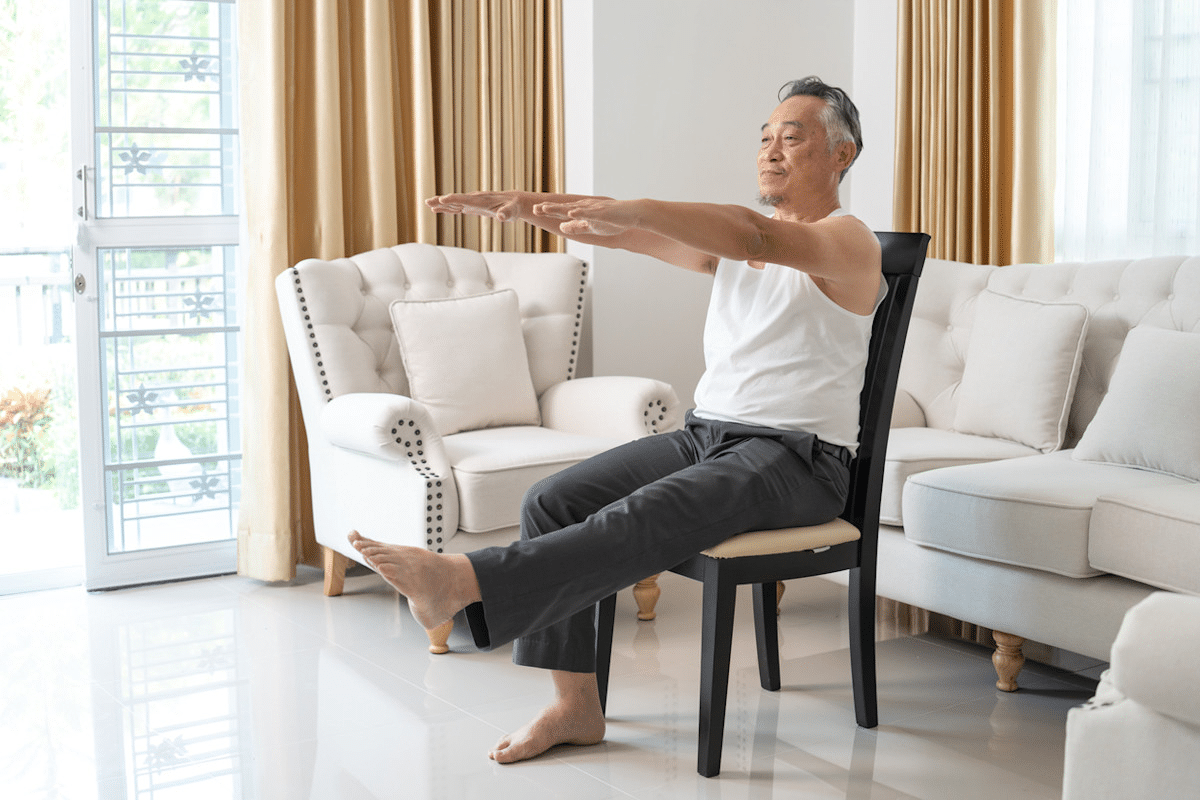
Staying active can be tough, whether you’re busy or recovering. That’s why we’re excited to share a simple fitness solution: chair exercises for men. Studies show that chair workouts boost strength, balance, and flexibility in adults of all ages and fitness levels. Chair exercises for men build strength. Get the best workout plan to target muscles and improve fitness without heavy gym equipment.
Our routine has seven chair exercises you can do at home. This easy fitness plan helps you build muscle, improve balance, and boost your health. It works for anyone, no matter your age or fitness level.
Key Takeaways
- Chair exercises can be done from the comfort of your home, making it a convenient fitness solution.
- Our workout routine is backed by peer-reviewed research and trusted by healthcare professionals.
- These exercises can help improve strength, balance, flexibility, and gait speed.
- The routine is suitable for adults across all age groups and fitness levels.
- Regular practice can lead to significant health benefits and improved overall well-being.
The Science Behind Chair Exercises for Men
Chair exercises are a top choice for workouts, backed by solid research. They bring many benefits to men of all ages and fitness levels. This makes them a great option for improving health.
Evidence-Based Benefits for All Age Groups
Research shows chair workouts boost strength, balance, and flexibility. They also improve how fast you can walk. These gains are available to men of any age, helping them stay fit and active.
Key benefits include:
- Improved muscular strength, in arms and legs
- Better balance and coordination, lowering fall risks
- Increased flexibility, making everyday tasks simpler
- Enhanced mobility and walking speed
Research-Backed Results After 9 Weeks
A study found chair exercises effective over nine weeks. Those who did them regularly saw big gains in arm strength and mobility. This shows chair exercises are a solid choice for men wanting to get in shape.
Consistency and correct form are key when doing chair exercises. Regular practice leads to real improvements in strength and movement. Men can see these changes over time.
Why Chair Workouts Are Ideal for Modern Men
In today’s fast world, chair workouts are a great fit for men wanting to stay fit. They don’t need to stop their busy lives to exercise. Chair exercises are a smart way to keep fit, no matter how busy you are.
Accessibility for Busy Professionals
Chair workouts are perfect for those with tight schedules. They can be done anywhere with a sturdy chair. This makes them great for office breaks, travel, or at home.
These exercises are not just easy to do. They also save money by not needing a gym or special gear. Plus, you can work out anytime, anywhere. This helps keep you on track with your fitness goals.
Benefits for Men Over 50
For men over 50, chair exercises bring many benefits. They help fight muscle loss that comes with age. This keeps you strong and makes daily tasks easier.
Chair workouts can be adjusted to fit any fitness level. This means men of all ages can start slowly and get stronger without risking injury. It’s a great way to stay healthy as you get older.
Equipment and Setup for Effective Chair Exercises
Starting a chair exercise routine needs the right gear. You’ll need a strong chair without wheels. This is key for staying stable and safe while working out.
Choosing the Right Chair
When picking a chair for your exercises, think about these points:
- A sturdy base to prevent tipping or sliding
- A solid, flat seat that can support your weight
- A backrest that allows you to maintain proper posture
- Armrests that can be used for support or resistance
Here’s a comparison of chair types suitable for chair exercises:
|
Chair Type |
Stability |
Comfort |
|---|---|---|
|
Armless Office Chair |
Moderate |
High |
|
Chair with Armrests |
High |
Moderate |
|
Folding Chair |
Low |
Low |
Optional Equipment to Enhance Your Workout
While a sturdy chair is essential, you can also use extra tools to boost your workout. Resistance bands and dumbbells are great for adding variety and challenge to your chair exercises.
Benefits of Optional Equipment:
- Resistance bands: Portable, versatile, and suitable for a range of exercises
- Dumbbells: Effective for strength training and can be used in seated positions
By picking the right chair and adding optional equipment, you can make a full and effective chair exercise routine. This meets your fitness goals.
Proper Form and Safety Guidelines
Starting any new exercise, like chair exercises for men, means focusing on proper form and safety guidelines. This ensures you get the most from your workout and lowers injury risk.
Always talk to a healthcare professional before starting. This is key if you have injuries or doubts about your physical readiness. It helps create a safe, effective workout plan for you.
Maintaining Correct Posture
Keeping the right posture is key for safe, effective chair exercises. Good posture targets the right muscles and eases joint strain. Make sure your feet are flat on the floor or on a footrest, with knees at or below hip level.
Your back should be straight, and your core engaged. Adjust the chair height to keep this posture. Also, keep your shoulders relaxed and down, avoiding slouching or leaning.
Preventing Common Injuries
To avoid injuries, use proper form, control your movements, and know your limits. Start slow and gradually increase your workout intensity and time as you get stronger.
Listen to your body and stop if you feel pain or discomfort. Preventing injuries also means warming up before and cooling down after your workout to avoid muscle strain.
By sticking to these safety guidelines and focusing on proper form, you can enjoy chair exercises safely. Remember, success in exercise comes from being consistent and patient.
Exercise 1: Chair Squats for Lower Body Strength
Chair squats are a key exercise for strengthening your lower body. They are great for men because they work on the quadriceps, hamstrings, glutes, and core. These muscles are vital for daily activities and overall strength.
Step-by-Step Instructions
To do chair squats right, follow these steps:
- Stand behind a sturdy chair with your feet shoulder-width apart.
- Hold the backrest lightly for balance, keeping your back straight.
- Slowly lower yourself into a squat, keeping your weight in your heels.
- Pause for a moment when your thighs are parallel to the floor.
- Push through your heels to return to the standing position.
Tips for Proper Form: Keep your knees behind your toes, and avoid letting them extend past your toes. Engage your core to maintain balance and stability.
Variations and Progressions
To make chair squats more challenging, try these:
- Single-Leg Chair Squats: Perform the squat on one leg, alternating legs with each repetition.
- Pause Squats: Hold the squat position for a few seconds before standing up.
- Deep Squats: Lower yourself further than parallel to increase the depth of the squat.
These variations will keep your workout interesting and help you avoid plateaus.
Chair squats are a great way to boost your lower body strength. By following the steps and trying different variations, you can see big improvements in your strength and fitness.
Exercise 2: Seated Chest Press for Upper Body Power
The seated chest press is a great way to build upper body strength. It’s perfect for men wanting to boost their fitness and power.
Step-by-Step Instructions
To do the seated chest press, just follow these steps:
- Sit in a strong chair with your back straight and feet on the floor.
- Hold a dumbbell or resistance band at shoulder height, with elbows bent at 90 degrees.
- Push the weight forward, extending your arms fully.
- Slowly go back to the start, keeping control.
Proper form is key to avoid injury and get the most out of the exercise. Keep a steady pace and don’t jerk the weights.
Variations and Progressions
To make the seated chest press harder or to progress, try these:
- Use heavier weights or more resistance.
- Do the exercise slower to increase tension time.
- Try different grip positions, like a neutral grip, to work muscles from different angles.
Adding variety to your workout is important. By trying different seated chest press variations, your workouts stay interesting and prevent getting stuck in a routine.
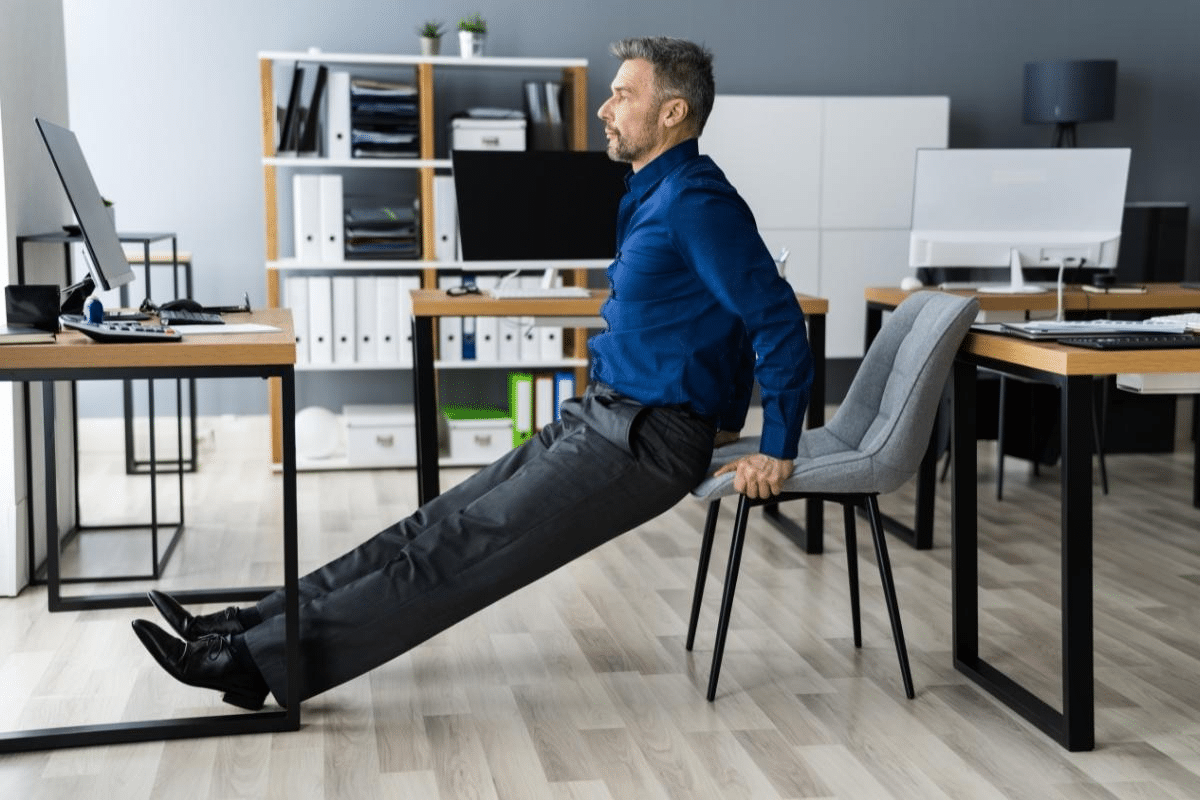
Exercise 3: Chair Dips for Triceps and Shoulders
Chair dips are great for strengthening your triceps and shoulders. They work on multiple muscles at once. This makes them a smart choice for any workout.
Step-by-Step Instructions
To do chair dips right, follow these steps:
- Sit on the edge of a sturdy chair with your hands beside your hips.
- Slide your buttocks off the edge, using your arms for support.
- Bend your elbows until they are at a 90-degree angle.
- Push back up to the starting position, keeping your elbows slightly bent.
It’s important to keep the right form to avoid injury and get the most out of the exercise. Keep your core tight and your back near the chair for stability.
Variations and Progressions
Once you get the hang of chair dips, try these variations to make it harder:
- Go deeper in your dip to challenge yourself more.
- Use a lower chair or add weights to your lap for more resistance.
- Do the exercise slower to work your muscles harder.
Consistency is key for seeing results from chair dips. Add this exercise to your routine and make it harder as you get stronger.
Fitness experts say, “Chair dips are a great bodyweight exercise that can be done anywhere. They’re perfect for those with busy lives or who prefer working out at home.”
“Adding chair dips to your workout can really boost your upper body strength and endurance.”
Exercise 4: Seated Core Rotations for Abdominal Strength
Men looking to boost their core strength can try seated core rotations. This exercise targets the abdominal muscles. It helps improve overall core stability and strength.
Step-by-Step Instructions
To do seated core rotations right, follow these steps:
- Sit comfortably in a sturdy chair with your feet flat on the floor.
- Hold a medicine ball or weight in both hands at chest level.
- Engage your core by slightly tightening your abdominal muscles.
- Rotate your torso to the left, keeping your arms straight, and then return to the center.
- Repeat the rotation to the right.
- Continue alternating rotations for the desired number of repetitions.
Variations and Progressions
To make seated core rotations more challenging, try these modifications:
|
Variation |
Description |
Benefit |
|---|---|---|
|
Increased Weight |
Use a heavier medicine ball or weight. |
Greater challenge to abdominal muscles. |
|
Slower Rotations |
Rotate your torso more slowly. |
Increased time under tension for core muscles. |
|
Pulse Rotations |
Add a small pulse at the end of each rotation. |
Enhanced engagement of core muscles. |
By adding these variations, you can keep challenging your core muscles. This helps prevent plateaus in your workout routine.
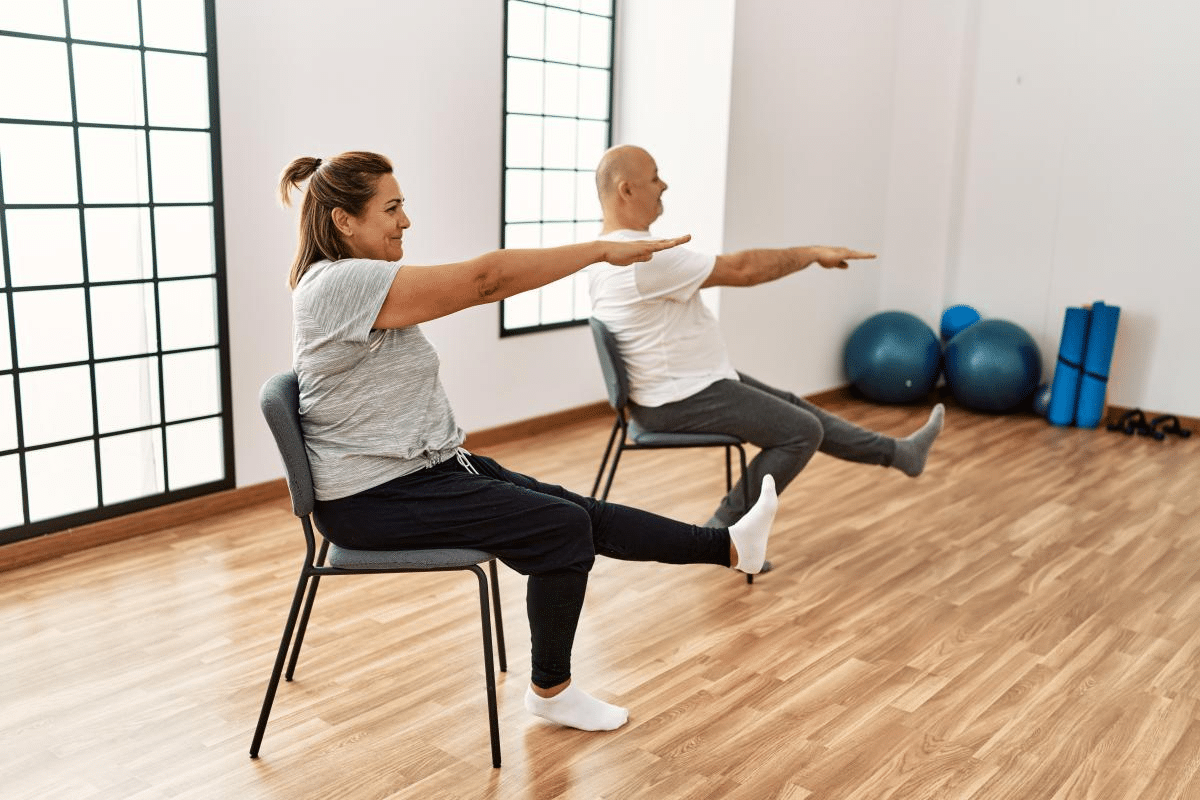
Exercise 5: Chair Leg Raises for Hip Flexors
Chair leg raises are a simple yet powerful exercise for targeting the hip flexors. These muscles are key for daily activities. Strengthening them can improve mobility, reduce injury risk, and boost lower body strength.
Step-by-Step Instructions
To perform chair leg raises effectively, follow these steps:
- Sit comfortably in a sturdy chair with your back straight and feet flat on the floor.
- Lift one leg off the floor, keeping it straight, and raise it to a comfortable height.
- Hold the position for a brief moment, then slowly lower your leg back down to the starting position.
- Repeat the exercise with the other leg.
Tips for Proper Form: Keep your back against the chair back. Avoid swinging your leg. The movement should be controlled and smooth.
Variations and Progressions
To add variety and challenge to the chair leg raises, consider the following modifications:
- Increased Height: Gradually raise your leg higher to engage your hip flexors more intensely.
- Slower Movement: Take more time to lift and lower your leg, increasing the time under tension for your muscles.
- Added Resistance: Wear ankle weights to increase the resistance and challenge your hip flexors further.
As you become more comfortable with chair leg raises, you can incorporate these variations. This will help you continue making progress and avoid plateaus.
“Strengthening the hip flexors through exercises like chair leg raises can significantly improve mobility and reduce the risk of lower body injuries.”
Exercise 6: Seated Shoulder Press for Upper Body Definition
Getting stronger shoulders is easy with the seated shoulder press. This exercise works the deltoids and trapezius muscles. It helps make your shoulders broader and stronger.
Step-by-Step Instructions
To do the seated shoulder press, follow these steps:
- Sit in a sturdy chair with your back straight and feet flat.
- Hold dumbbells or resistance bands at shoulder height, palms forward.
- Press the weights straight up over your head, arms fully extended.
- Lower the weights back down to shoulder height.
Proper Form: Keep your back straight and avoid arching or using momentum.
Variations and Progressions
To make your workout more interesting, try these changes:
|
Variation |
Description |
Benefit |
|---|---|---|
|
Alternating Arm Press |
Press one arm at a time, alternating with each rep. |
Improves coordination and balance. |
|
Increased Weight |
Gradually add more weight or resistance. |
Increases muscle strength and definition. |
|
Higher Repetitions |
Do more repetitions. |
Boosts muscular endurance. |
Fitness expert Jim Stoppani says, “The seated shoulder press is great for all fitness levels. It’s perfect for beginners and advanced trainees.”
“The seated shoulder press is a versatile exercise that can be adapted to different fitness levels, making it ideal for both beginners and advanced trainees.”
Jim Stoppani
Adding the seated shoulder press to your routine will improve your upper body strength and definition. Always focus on proper form and increase the challenge as you get better.
Exercise 7: Chair-Assisted Balance Exercises for Stability
Chair-assisted balance exercises are key for a good fitness routine, great for men wanting better stability. They help improve balance and lower fall risks. This makes them a must-have in any workout plan.
Step-by-Step Instructions
To do chair-assisted balance exercises, follow these steps:
- Stand behind a sturdy chair, holding the backrest lightly for support.
- Stand with your feet shoulder-width apart, ensuring a stable base.
- Lift one foot off the ground, keeping the other foot firmly planted.
- Hold this position for a few seconds, then lower your foot back down.
- Repeat the exercise on the other leg.
Proper form is essential to get the most from this exercise and avoid injury. Keep your back straight and core tight during the movement.
Variations and Progressions
Once you get the hang of chair-assisted balance exercises, try these variations to challenge yourself more:
- Close your eyes while doing the exercise to improve balance without seeing.
- Stand on a soft surface, like a foam pad or pillow, to make it harder.
- Do the exercise with your arms extended or at your sides to work your core and boost stability.
Adding these variations lets you keep getting better and improve your balance and stability over time.
Creating Your Complete Chair Exercises for Men Routine
A good chair exercises for men routine can boost strength and endurance. We must think about how often to work out, what exercises to do, and our fitness level.
The American College of Sports Medicine (ACSM) has guidelines for exercise frequency. They say doing chair exercises 2-3 times a week can improve strength and endurance.
ACSM Recommendations for Frequency
The ACSM guidelines help create an effective routine. Start with 2-3 times a week and adjust based on progress and goals.
To follow the ACSM, consider these steps:
- Beginners should start with 2 times a week, focusing on easier exercises.
- As fitness improves, increase to 3 times a week.
- Change the routine as needed to keep challenging yourself.
Beginner’s 15-Minute Routine
Beginners should start with a 15-minute routine. This routine should mix exercises for different muscles. A beginner’s routine could include:
- Chair Squats: 3 sets of 10 repetitions
- Seated Chest Press: 3 sets of 10 repetitions
- Chair Leg Raises: 3 sets of 10 repetitions per leg
Intermediate 30-Minute Routine
As you get better, extend the routine to 30 minutes. Add more challenging exercises or do more reps. An intermediate routine might include:
- Chair Dips: 3 sets of 15 repetitions
- Seated Core Rotations: 3 sets of 15 repetitions
- Seated Shoulder Press: 3 sets of 15 repetitions
Always listen to your body and adjust the routine if needed. If you feel pain or discomfort, stop right away.
Advanced 45-Minute Routine
For those who’ve mastered the intermediate routine, try a 45-minute advanced routine. This could include:
- Do more sets and reps for each exercise.
- Add exercises that work multiple muscles at once.
- Try isometric holds or slower movements for more challenge.
By moving through these routines, men can keep pushing themselves and see ongoing improvements in strength and endurance.
Regularly review and adjust your routine to keep making progress and avoid plateaus.
Conclusion
Chair exercises for men are a great way to boost health and fitness, no matter your age or fitness level. They help improve strength, balance, flexibility, and how fast you can walk. Plus, they lower the risk of chronic diseases.
We’ve given you a detailed guide on chair exercises. It covers the science behind their benefits, how to do them safely, and exercises for all fitness levels. Our aim is to help you start your chair exercise journey and improve your health and life quality.
Adding chair exercises to your daily routine is a smart move for your physical health and independence. Try out the exercises we’ve suggested. See how they can make your life healthier and more active.
FAQ
What are the benefits of chair exercises for men?
Chair exercises boost strength, balance, and flexibility. They also lower the risk of chronic diseases. This improves overall health and fitness.
Are chair exercises suitable for men over 50?
Yes, they are great for men over 50. They help improve strength, balance, and flexibility. This reduces the risk of falls and injuries.
What equipment is required for chair exercises?
You need a sturdy chair without wheels. Optional gear like resistance bands or dumbbells adds variety to your workouts.
How often should I perform chair exercises?
The American Council on Exercise (ACE) and the American College of Sports Medicine (ACSM) suggest doing chair exercises 2-3 times a week. Make sure to rest at least one day in between.
Can chair exercises help improve balance and stability?
Yes, chair-assisted balance exercises can enhance balance and stability. This reduces the risk of falls and injuries.
Are chair exercises suitable for men with mobility issues?
Yes, they can be modified for men with mobility issues. You can do them while seated or standing with chair support.
Can I create a customized chair exercise routine?
Yes, you can tailor a chair exercise routine to fit your fitness level and goals. As you get more comfortable, you can progress the exercises.
What is a good chair workout routine for men?
A good routine includes exercises targeting different muscle groups. Examples are chair squats, seated chest press, and chair dips.
How long should a chair workout routine last?
Chair workouts can last from 15-45 minutes. This depends on your fitness level and goals.
Are there any free chair workout routines available?
Yes, many free chair workout routines are online. You can find 7-minute and 28-day plans.
Can chair exercises help improve overall health and fitness?
Yes, chair exercises can enhance overall health and fitness. They improve strength, balance, and flexibility. They also lower the risk of chronic diseases.
Reference
National Center for Biotechnology Information. Evidence-Based Medical Guidance. Retrieved from https://pubmed.ncbi.nlm.nih.gov/30550887/