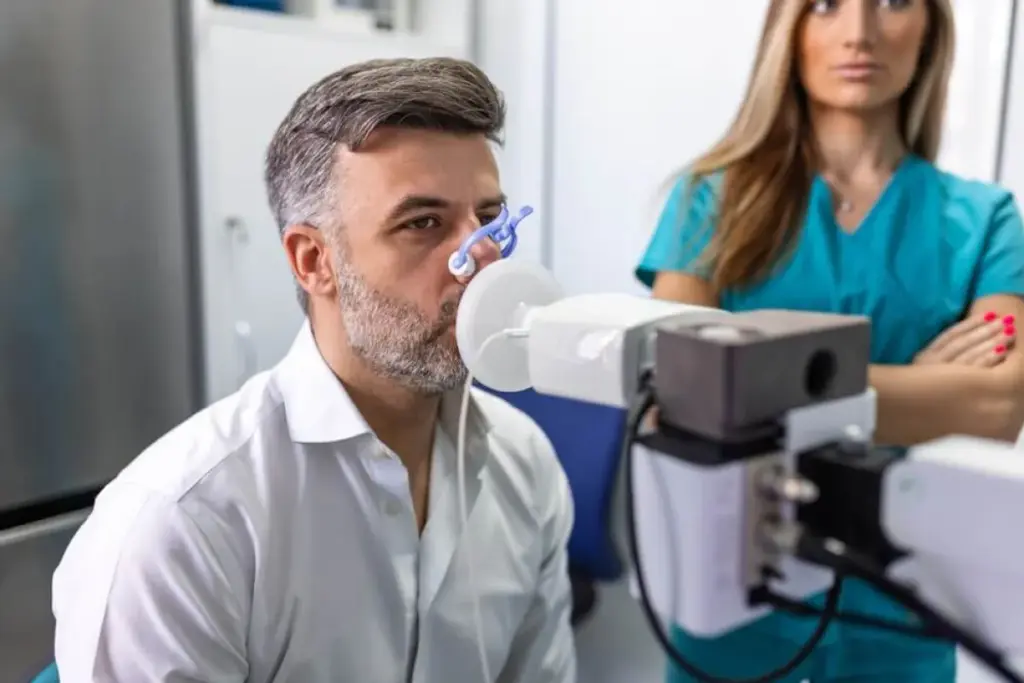
Understanding spirometry with bronchodilator results is key for diagnosing and treating lung diseases like asthma and COPD.
At Liv Hospital, we use evidence-based spirometry protocols and focus on the patient. This helps us give accurate lung function tests. Knowing the difference between reversible and fixed airway obstruction is vital. It helps doctors make the right treatment choices.
Spirometry definition is a test that checks lung function. It measures how much air a person can breathe in and out.
Key Takeaways
- Understanding spirometry results is essential for diagnosing respiratory conditions.
- The bronchodilator test helps determine if airway obstruction is reversible.
- Accurate interpretation guides appropriate treatment decisions for patients.
- Liv Hospital combines evidence-based protocols with patient-centered care.
- Precise pulmonary function assessments are vital for managing lung diseases.
Understanding Spirometry Fundamentals
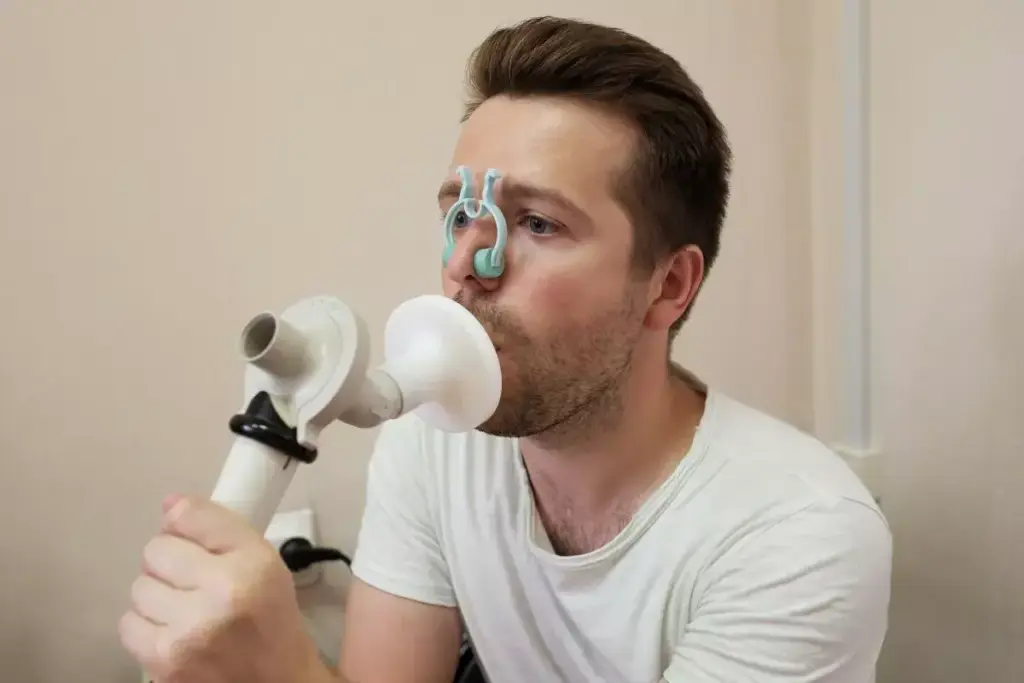
Spirometry is a key tool in respiratory medicine. It gives insights into lung function. This test is simple and non-invasive. It checks how well the lungs work by measuring air inhaled and exhaled.
“Spirometry is the top choice for diagnosing and tracking respiratory diseases like COPD and asthma,” say top health groups.
What Spirometry Measures
Spirometry looks at important lung function areas. It checks forced expiratory volume in one second (FEV1) and forced vital capacity (FVC). FEV1 is the air exhaled in the first second of a forced breath. FVC is the total air exhaled.
Key Spirometry Parameters and Normal Values
Normal spirometry values depend on age, sex, height, and ethnicity. A normal FEV1/FVC ratio is usually over 70-75%. But, this can change slightly based on the guidelines used.
The Global Initiative for Chronic Obstructive Lung Disease (GOLD) has specific criteria for COPD diagnosis. It looks at the post-bronchodilator FEV1/FVC ratio.
Knowing these values is vital for understanding spirometry results. It helps doctors diagnose, track, and treat respiratory issues.
Spirometry With Bronchodilator Testing Procedure

It’s important to know how spirometry with bronchodilator testing works. This test checks how lungs change after taking a bronchodilator. It helps find problems like asthma and COPD.
Pre-Bronchodilator Testing Protocol
First, we do a spirometry test before the bronchodilator. This test shows how well lungs work at the start. Patients should not use bronchodilators for 4-6 hours before.
The test asks you to breathe out as much as you can into a spirometer. It looks at FEV1 and FVC, which are important lung measures.
Post-Bronchodilator Assessment
After the first test, we give a bronchodilator to inhale. Then, we wait 15-20 minutes for it to work. After that, we do another spirometry test.
This test shows how lungs work after the bronchodilator. A big change in FEV1 means the airways can open up better.
Getting the right diagnosis depends on doing the test right and preparing well. It’s key for patients to follow instructions closely. This way, doctors can make better plans for treatment.
Interpreting Bronchodilator Response Results
The results of spirometry with bronchodilator tests tell us a lot about airway health. Spirometry tests show how well airways open up with bronchodilators. This is key for spotting and treating breathing problems.
Criteria for Positive Bronchodilator Response
A positive bronchodilator response means certain changes in spirometry. We look for a 12% increase in FEV1 and a 200 mL rise from before the test. This shows airways can open up, which is important for some diseases.
Recognizing Obstructive Ventilatory Defects
Obstructive ventilatory defects mean air can’t flow well and doesn’t fully come back. We check the FEV1/FVC ratio after bronchodilators. A low ratio means there’s an obstruction, like in COPD or asthma. Knowing how bad it is helps us plan treatment.
GOLD Guidelines for COPD Diagnosis
The Global Initiative for Chronic Obstructive Lung Disease (GOLD) sets rules for COPD diagnosis. If the FEV1/FVC ratio is under 0.70 after bronchodilators, it’s COPD. For more on COPD, check out this article from the American Academy of Family Physicians.
Using these rules helps us understand test results better. This makes diagnosing and treating breathing issues more accurate.
Clinical Applications and Conclusion
Spirometry is key in respiratory medicine. It gives insights into lung function through the medical spirometry test. Healthcare providers use spirometry to diagnose and manage respiratory conditions.
The spirom, a device used in spirometry, measures lung function. It’s vital for diagnosing asthma and COPD. We use spirometry to check if treatments work and make decisions about patient care.
In our practice, spirometry with bronchodilator testing is essential. It helps us deliver quality, patient-centered care. By understanding spirometry and interpreting bronchodilator responses, we create treatment plans that meet each patient’s needs. This improves outcomes and enhances quality of life.
As we move forward in respiratory medicine, accurate spirometry interpretation is more important than ever. It’s a cornerstone in diagnosing and managing respiratory diseases. It guides our clinical decisions and ensures the best care for our patients.
FAQ:
What is spirometry, and how is it used in diagnosing respiratory conditions?
Spirometry is a lung function test that measures airflow and volume to diagnose conditions like asthma and COPD.
What is a bronchodilator test, and why is it performed with spirometry?
It evaluates lung function before and after a bronchodilator to determine reversible airway obstruction.
What are the key parameters measured in spirometry, and what do they indicate?
Parameters like FEV₁, FVC, and FEV₁/FVC ratio indicate airway obstruction and lung capacity.
How is a positive bronchodilator response defined?
A positive response is typically an FEV₁ increase of ≥12% and ≥200 mL after bronchodilator use.
What are GOLD guidelines, and how are they used in diagnosing COPD?
GOLD guidelines classify COPD severity using post-bronchodilator FEV₁ and recommend management strategies.
What is the significance of pre- and post-bronchodilator spirometry assessments?
They distinguish between reversible and fixed airway obstruction to guide diagnosis and treatment.
How is spirometry used in patient care, and what are its clinical applications?
Spirometry monitors disease progression, evaluates treatment response, and aids in diagnosing respiratory disorders.
What is the role of spirometry in delivering high-quality, patient-centered care?
It provides objective data for accurate diagnosis, personalized treatment planning, and improved respiratory health outcomes.
References:
The bronchi (singular. bronchus) are an extension of the trachea and serve as the central passageway into the lungs.https://www.ncbi.nlm.nih.gov/books/NBK537353/